

16
environmental impact. For example, while the information available for DWH was
more extensive than a typical spill incident, certain weathering characteristics
remained unknown. Crude oil has a typical elemental composition of 83–87% carbon, 10–14% hydrogen, 0.1–2% nitrogen, 0.05–6% sulfur, 0.05–1.5% oxygen, and
less than 1% other trace elements (Speight 2007). Industry traditionally separates
oil by structure into one of four somewhat arbitrary categories, labeled SARA after
the first letter in the category name: saturates, aromatics, resins, and asphaltenes.
The first two groups, saturates and aromatics, represent the largest mass fraction of
most crude oils. The saturate group is nonpolar oil molecules without double bonds
that include linear, branched, and cyclic saturated hydrocarbons. The group name
refers to the fact that the carbon atoms are “saturated” with the maximum number of
hydrogen atoms. Smaller saturate molecules (less than seven carbons) are relatively
volatile and are mostly lost to evaporation in surface oil spills. However, they have
extremely low solubility in seawater, even when compared to other hydrocarbons of
similar molecular weight. For example, while hexane and benzene (smallest aromatic)
have similar molar masses and limited solubility, benzene is nevertheless the much
more soluble by more than an order of magnitude. This distinction between the two
hydrocarbon categories has consequences for deep oil spills where dissolution replaces
evaporation as an important weathering process and toxicity is a concern.
The aromatic group hydrocarbons have at least one benzene ring and often play
the lead role with regard to toxic impacts from the oil while being generally less
biodegradable than saturates of the same carbon number. Fingas and Fieldhouse
(2012), based on laboratory results, claim that the ratio of aromatics to saturates
plays a role in the formation of stable water-in-oil emulsions. However, the quantity
and ratio of the two remaining groups, resins and asphaltenes, are even more important for emulsion stability. Resins are large hydrocarbon molecules with one to three
sulfur, oxygen, or nitrogen atoms per molecule. Resins can dissolve in oil, an important factor in the initiation of emulsification where they prevent escape of water
droplets until the larger asphaltene molecules can migrate to the oil-water interface.
Asphaltenes are not uniquely defined in the literature although a common definition
might be very large hydrocarbon molecules that have one to three sulfur, oxygen, or
nitrogen atoms per molecule but do not dissolve in oil. The ambiguity in asphaltene
classification between laboratories complicates the task of devising computer models of spill weathering, particularly emulsification onset. Added to this complication
is the inherent limitation of the SARA classification scheme itself, as it does not
record important oil characteristics such as the detailed structure and degree of
polarization in the larger hydrocarbons, particularly the asphaltenes. This is an
active area of research (Groenzin and Mullins 2007) with good prospects for
improved oil characterization databases in the future.
Certain bulk oil properties are not dependent on the individual hydrocarbons in
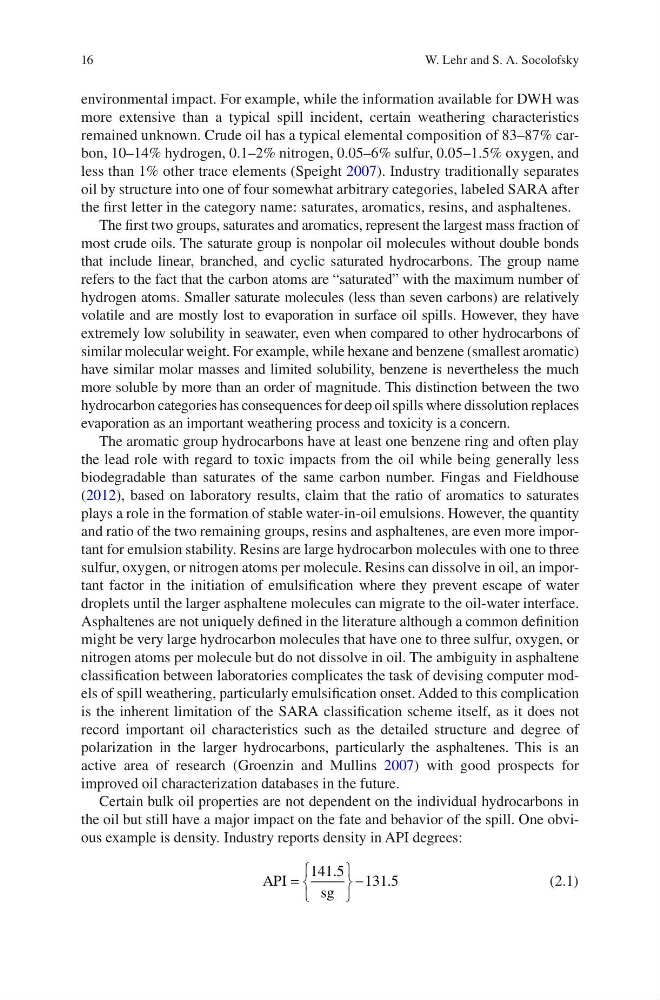
the oil but still have a major impact on the fate and behavior of the spill. One obvious example is density. Industry reports density in API degrees:
API
sg
=
−
141 5 131 5
.
.
(2.1)
W. Lehr and S. A. Socolofsky
environmental impact. For example, while the information available for DWH was
more extensive than a typical spill incident, certain weathering characteristics
remained unknown. Crude oil has a typical elemental composition of 83–87% carbon, 10–14% hydrogen, 0.1–2% nitrogen, 0.05–6% sulfur, 0.05–1.5% oxygen, and
less than 1% other trace elements (Speight 2007). Industry traditionally separates
oil by structure into one of four somewhat arbitrary categories, labeled SARA after
the first letter in the category name: saturates, aromatics, resins, and asphaltenes.
The first two groups, saturates and aromatics, represent the largest mass fraction of
most crude oils. The saturate group is nonpolar oil molecules without double bonds
that include linear, branched, and cyclic saturated hydrocarbons. The group name
refers to the fact that the carbon atoms are “saturated” with the maximum number of
hydrogen atoms. Smaller saturate molecules (less than seven carbons) are relatively
volatile and are mostly lost to evaporation in surface oil spills. However, they have
extremely low solubility in seawater, even when compared to other hydrocarbons of
similar molecular weight. For example, while hexane and benzene (smallest aromatic)
have similar molar masses and limited solubility, benzene is nevertheless the much
more soluble by more than an order of magnitude. This distinction between the two
hydrocarbon categories has consequences for deep oil spills where dissolution replaces
evaporation as an important weathering process and toxicity is a concern.
The aromatic group hydrocarbons have at least one benzene ring and often play
the lead role with regard to toxic impacts from the oil while being generally less
biodegradable than saturates of the same carbon number. Fingas and Fieldhouse
(2012), based on laboratory results, claim that the ratio of aromatics to saturates
plays a role in the formation of stable water-in-oil emulsions. However, the quantity
and ratio of the two remaining groups, resins and asphaltenes, are even more important for emulsion stability. Resins are large hydrocarbon molecules with one to three
sulfur, oxygen, or nitrogen atoms per molecule. Resins can dissolve in oil, an important factor in the initiation of emulsification where they prevent escape of water
droplets until the larger asphaltene molecules can migrate to the oil-water interface.
Asphaltenes are not uniquely defined in the literature although a common definition
might be very large hydrocarbon molecules that have one to three sulfur, oxygen, or
nitrogen atoms per molecule but do not dissolve in oil. The ambiguity in asphaltene
classification between laboratories complicates the task of devising computer models of spill weathering, particularly emulsification onset. Added to this complication
is the inherent limitation of the SARA classification scheme itself, as it does not
record important oil characteristics such as the detailed structure and degree of
polarization in the larger hydrocarbons, particularly the asphaltenes. This is an
active area of research (Groenzin and Mullins 2007) with good prospects for
improved oil characterization databases in the future.
Certain bulk oil properties are not dependent on the individual hydrocarbons in
the oil but still have a major impact on the fate and behavior of the spill. One obvious example is density. Industry reports density in API degrees:
API
sg
=
−
141 5 131 5
.
.
(2.1)
W. Lehr and S. A. Socolofsky