

261
assessment of environmental variability at a given deepwater site with minimal sample workup. Radović and coworkers also expanded the range of putatively identified
biomarkers to include pheopigments, branched GDGTs, and other, more tentatively
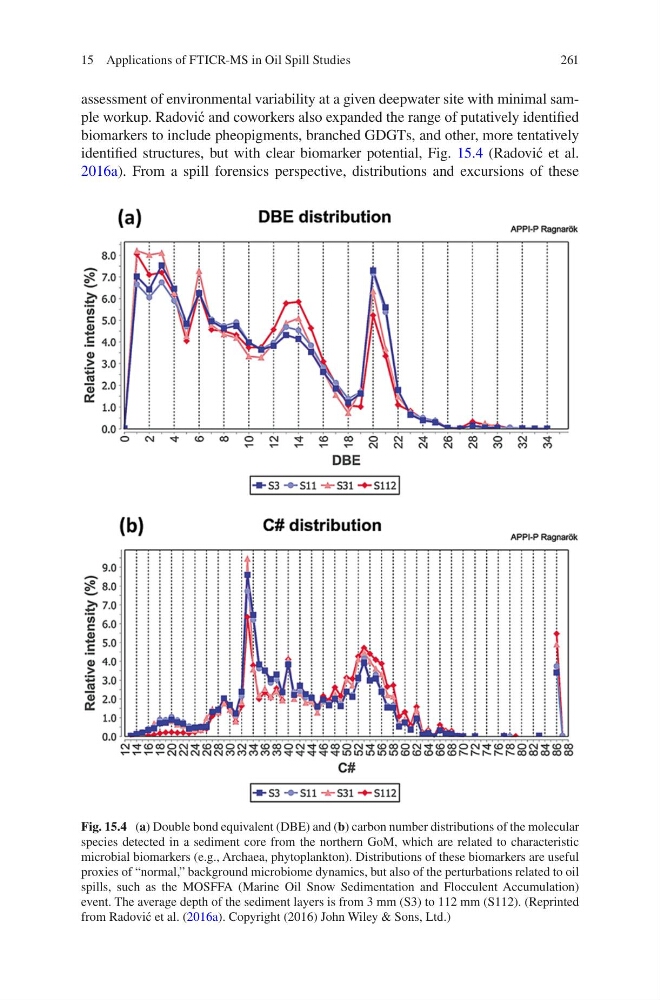
identified structures, but with clear biomarker potential, Fig. 15.4 (Radović et al.
2016a). From a spill forensics perspective, distributions and excursions of these
Fig. 15.4 (a) Double bond equivalent (DBE) and (b) carbon number distributions of the molecular
species detected in a sediment core from the northern GoM, which are related to characteristic
microbial biomarkers (e.g., Archaea, phytoplankton). Distributions of these biomarkers are useful
proxies of “normal,” background microbiome dynamics, but also of the perturbations related to oil
spills, such as the MOSFFA (Marine Oil Snow Sedimentation and Flocculent Accumulation)
event. The average depth of the sediment layers is from 3 mm (S3) to 112 mm (S112). (Reprinted
from Radović et al. (2016a). Copyright (2016) John Wiley & Sons, Ltd.)
15 Applications of FTICR-MS in Oil Spill Studies
assessment of environmental variability at a given deepwater site with minimal sample workup. Radović and coworkers also expanded the range of putatively identified
biomarkers to include pheopigments, branched GDGTs, and other, more tentatively
identified structures, but with clear biomarker potential, Fig. 15.4 (Radović et al.
2016a). From a spill forensics perspective, distributions and excursions of these
Fig. 15.4 (a) Double bond equivalent (DBE) and (b) carbon number distributions of the molecular
species detected in a sediment core from the northern GoM, which are related to characteristic
microbial biomarkers (e.g., Archaea, phytoplankton). Distributions of these biomarkers are useful
proxies of “normal,” background microbiome dynamics, but also of the perturbations related to oil
spills, such as the MOSFFA (Marine Oil Snow Sedimentation and Flocculent Accumulation)
event. The average depth of the sediment layers is from 3 mm (S3) to 112 mm (S112). (Reprinted
from Radović et al. (2016a). Copyright (2016) John Wiley & Sons, Ltd.)
15 Applications of FTICR-MS in Oil Spill Studies