

257
of FTICR-MS to access the pool of nonvolatile compounds in the MW oil residues
has been crucial and was leveraged, in combination with two-dimensional gas chromatography, to characterize and identify the weathering products of MW oil as
ketones, carboxylic acids, and higher numbered (>3) oxygen-containing species
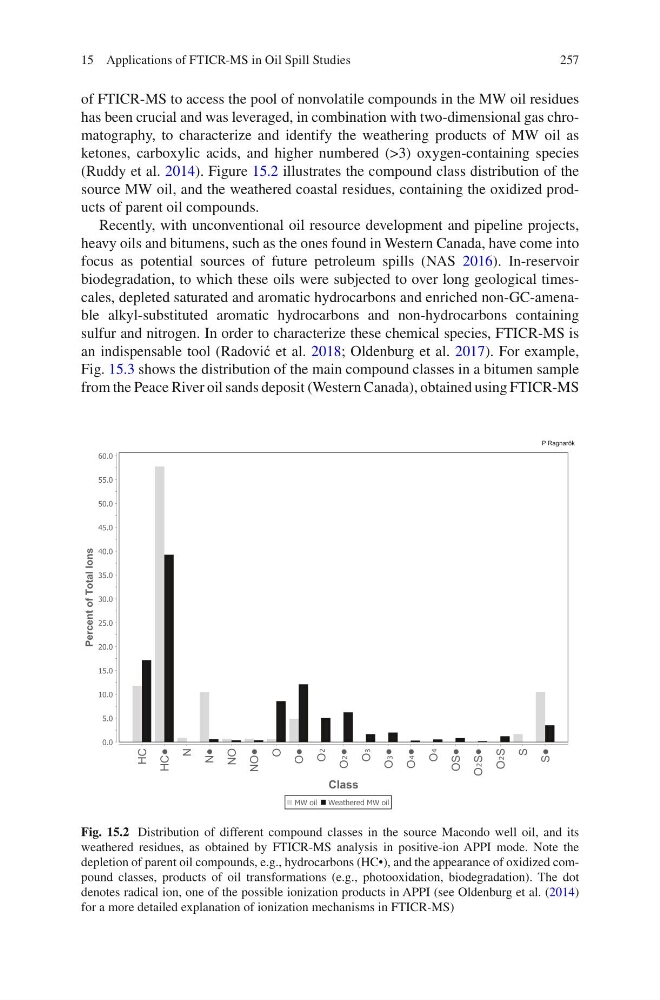
(Ruddy et al. 2014). Figure 15.2 illustrates the compound class distribution of the
source MW oil, and the weathered coastal residues, containing the oxidized products of parent oil compounds.
Recently, with unconventional oil resource development and pipeline projects,
heavy oils and bitumens, such as the ones found in Western Canada, have come into
focus as potential sources of future petroleum spills (NAS 2016). In-reservoir
biodegradation, to which these oils were subjected to over long geological timescales, depleted saturated and aromatic hydrocarbons and enriched non-GC-amenable alkyl-substituted aromatic hydrocarbons and non-hydrocarbons containing
sulfur and nitrogen. In order to characterize these chemical species, FTICR-MS is
an indispensable tool (Radović et al. 2018; Oldenburg et al. 2017). For example,
Fig. 15.3 shows the distribution of the main compound classes in a bitumen sample
from the Peace River oil sands deposit (Western Canada), obtained using FTICR-MS
Fig. 15.2 Distribution of different compound classes in the source Macondo well oil, and its
weathered residues, as obtained by FTICR-MS analysis in positive-ion APPI mode. Note the
depletion of parent oil compounds, e.g., hydrocarbons (HC•), and the appearance of oxidized compound classes, products of oil transformations (e.g., photooxidation, biodegradation). The dot
denotes radical ion, one of the possible ionization products in APPI (see Oldenburg et al. (2014)
for a more detailed explanation of ionization mechanisms in FTICR-MS)
15 Applications of FTICR-MS in Oil Spill Studies
of FTICR-MS to access the pool of nonvolatile compounds in the MW oil residues
has been crucial and was leveraged, in combination with two-dimensional gas chromatography, to characterize and identify the weathering products of MW oil as
ketones, carboxylic acids, and higher numbered (>3) oxygen-containing species
(Ruddy et al. 2014). Figure 15.2 illustrates the compound class distribution of the
source MW oil, and the weathered coastal residues, containing the oxidized products of parent oil compounds.
Recently, with unconventional oil resource development and pipeline projects,
heavy oils and bitumens, such as the ones found in Western Canada, have come into
focus as potential sources of future petroleum spills (NAS 2016). In-reservoir
biodegradation, to which these oils were subjected to over long geological timescales, depleted saturated and aromatic hydrocarbons and enriched non-GC-amenable alkyl-substituted aromatic hydrocarbons and non-hydrocarbons containing
sulfur and nitrogen. In order to characterize these chemical species, FTICR-MS is
an indispensable tool (Radović et al. 2018; Oldenburg et al. 2017). For example,
Fig. 15.3 shows the distribution of the main compound classes in a bitumen sample
from the Peace River oil sands deposit (Western Canada), obtained using FTICR-MS
Fig. 15.2 Distribution of different compound classes in the source Macondo well oil, and its
weathered residues, as obtained by FTICR-MS analysis in positive-ion APPI mode. Note the
depletion of parent oil compounds, e.g., hydrocarbons (HC•), and the appearance of oxidized compound classes, products of oil transformations (e.g., photooxidation, biodegradation). The dot
denotes radical ion, one of the possible ionization products in APPI (see Oldenburg et al. (2014)
for a more detailed explanation of ionization mechanisms in FTICR-MS)
15 Applications of FTICR-MS in Oil Spill Studies