

255
15.2 FTICR-MS Basics
FTICR-MS can be paired with several soft ionization source mechanisms, each of
which is used to focus analysis on different types of chemical compounds. For
example, APPI (atmospheric pressure photoionization) is most effective on compounds with aromatic rings and sulfur-containing compounds, as these have electrons that can be easily removed with a UV photon or charged indirectly via a
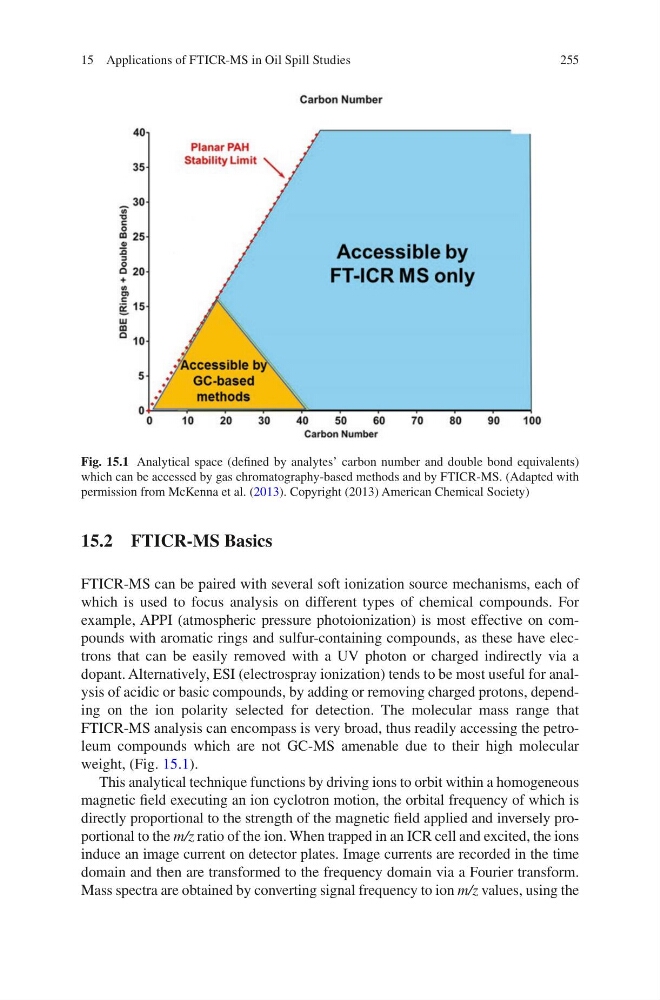
dopant. Alternatively, ESI (electrospray ionization) tends to be most useful for analysis of acidic or basic compounds, by adding or removing charged protons, depending on the ion polarity selected for detection. The molecular mass range that
FTICR-MS analysis can encompass is very broad, thus readily accessing the petroleum compounds which are not GC-MS amenable due to their high molecular
weight, (Fig. 15.1).
This analytical technique functions by driving ions to orbit within a homogeneous
magnetic field executing an ion cyclotron motion, the orbital frequency of which is
directly proportional to the strength of the magnetic field applied and inversely proportional to the m/z ratio of the ion. When trapped in an ICR cell and excited, the ions
induce an image current on detector plates. Image currents are recorded in the time
domain and then are transformed to the frequency domain via a Fourier transform.
Mass spectra are obtained by converting signal frequency to ion m/z values, using the
Fig. 15.1 Analytical space (defined by analytes’ carbon number and double bond equivalents)
which can be accessed by gas chromatography-based methods and by FTICR-MS. (Adapted with
permission from McKenna et al. (2013). Copyright (2013) American Chemical Society)
15 Applications of FTICR-MS in Oil Spill Studies
15.2 FTICR-MS Basics
FTICR-MS can be paired with several soft ionization source mechanisms, each of
which is used to focus analysis on different types of chemical compounds. For
example, APPI (atmospheric pressure photoionization) is most effective on compounds with aromatic rings and sulfur-containing compounds, as these have electrons that can be easily removed with a UV photon or charged indirectly via a
dopant. Alternatively, ESI (electrospray ionization) tends to be most useful for analysis of acidic or basic compounds, by adding or removing charged protons, depending on the ion polarity selected for detection. The molecular mass range that
FTICR-MS analysis can encompass is very broad, thus readily accessing the petroleum compounds which are not GC-MS amenable due to their high molecular
weight, (Fig. 15.1).
This analytical technique functions by driving ions to orbit within a homogeneous
magnetic field executing an ion cyclotron motion, the orbital frequency of which is
directly proportional to the strength of the magnetic field applied and inversely proportional to the m/z ratio of the ion. When trapped in an ICR cell and excited, the ions
induce an image current on detector plates. Image currents are recorded in the time
domain and then are transformed to the frequency domain via a Fourier transform.
Mass spectra are obtained by converting signal frequency to ion m/z values, using the
Fig. 15.1 Analytical space (defined by analytes’ carbon number and double bond equivalents)
which can be accessed by gas chromatography-based methods and by FTICR-MS. (Adapted with
permission from McKenna et al. (2013). Copyright (2013) American Chemical Society)
15 Applications of FTICR-MS in Oil Spill Studies