

187
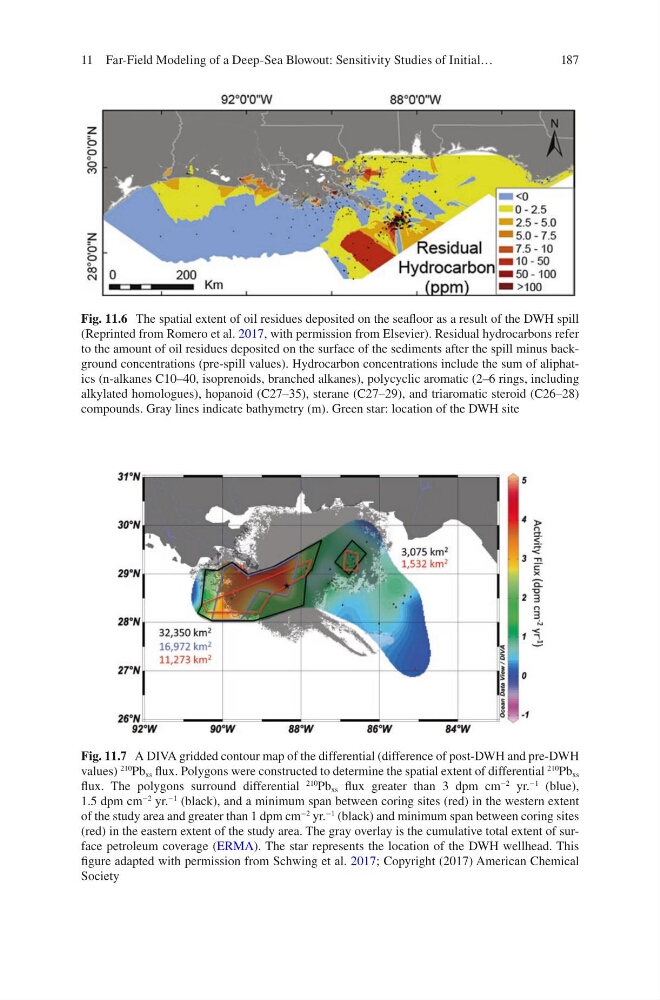
Fig. 11.6 The spatial extent of oil residues deposited on the seafloor as a result of the DWH spill
(Reprinted from Romero et al. 2017, with permission from Elsevier). Residual hydrocarbons refer
to the amount of oil residues deposited on the surface of the sediments after the spill minus background concentrations (pre-spill values). Hydrocarbon concentrations include the sum of aliphatics (n-alkanes C10–40, isoprenoids, branched alkanes), polycyclic aromatic (2–6 rings, including
alkylated homologues), hopanoid (C27–35), sterane (C27–29), and triaromatic steroid (C26–28)
compounds. Gray lines indicate bathymetry (m). Green star: location of the DWH site
Fig. 11.7 A DIVA gridded contour map of the differential (difference of post-DWH and pre-DWH
values)
210 Pb xs flux. Polygons were constructed to determine the spatial extent of differential
210 Pb xs
flux. The polygons surround differential
210 Pb xs flux greater than 3 dpm cm
−2
yr.
−1 (blue),
1.5 dpm cm
−2 yr.
−1 (black), and a minimum span between coring sites (red) in the western extent
of the study area and greater than 1 dpm cm
−2
yr.
−1 (black) and minimum span between coring sites
(red) in the eastern extent of the study area. The gray overlay is the cumulative total extent of surface petroleum coverage (ERMA). The star represents the location of the DWH wellhead. This
figure adapted with permission from Schwing et al. 2017; Copyright (2017) American Chemical
Society
11 Far-Field Modeling of a Deep-Sea Blowout: Sensitivity Studies of Initial…
Fig. 11.6 The spatial extent of oil residues deposited on the seafloor as a result of the DWH spill
(Reprinted from Romero et al. 2017, with permission from Elsevier). Residual hydrocarbons refer
to the amount of oil residues deposited on the surface of the sediments after the spill minus background concentrations (pre-spill values). Hydrocarbon concentrations include the sum of aliphatics (n-alkanes C10–40, isoprenoids, branched alkanes), polycyclic aromatic (2–6 rings, including
alkylated homologues), hopanoid (C27–35), sterane (C27–29), and triaromatic steroid (C26–28)
compounds. Gray lines indicate bathymetry (m). Green star: location of the DWH site
Fig. 11.7 A DIVA gridded contour map of the differential (difference of post-DWH and pre-DWH
values)
210 Pb xs flux. Polygons were constructed to determine the spatial extent of differential
210 Pb xs
flux. The polygons surround differential
210 Pb xs flux greater than 3 dpm cm
−2
yr.
−1 (blue),
1.5 dpm cm
−2 yr.
−1 (black), and a minimum span between coring sites (red) in the western extent
of the study area and greater than 1 dpm cm
−2
yr.
−1 (black) and minimum span between coring sites
(red) in the eastern extent of the study area. The gray overlay is the cumulative total extent of surface petroleum coverage (ERMA). The star represents the location of the DWH wellhead. This
figure adapted with permission from Schwing et al. 2017; Copyright (2017) American Chemical
Society
11 Far-Field Modeling of a Deep-Sea Blowout: Sensitivity Studies of Initial…