

177
Prediction System (NOGAPS, Hogan and Rosemond 1991) are interpolated into
HYCOM GoM 0.04 degree grid, and 3% of their values were added to the
horizontal components of the upper ocean level velocity, taking into account wind
stress rotation. The corrected ocean velocity fields are then used as a hydrodynamic forcing in the oil-CMS control experiment.
11.3.2 Suite of Numerical Case Studies
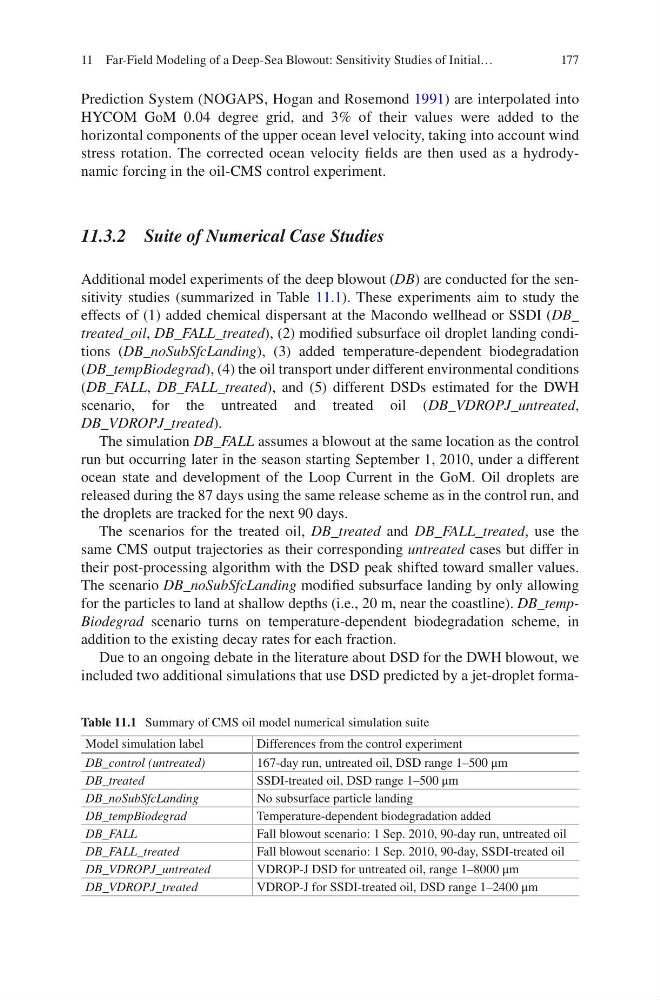
Additional model experiments of the deep blowout (DB) are conducted for the sensitivity studies (summarized in Table 11.1). These experiments aim to study the
effects of (1) added chemical dispersant at the Macondo wellhead or SSDI (DB_
treated_oil, DB_FALL_treated), (2) modified subsurface oil droplet landing conditions (DB_noSubSfcLanding), (3) added temperature-dependent biodegradation
(DB_tempBiodegrad), (4) the oil transport under different environmental conditions
(DB_FALL, DB_FALL_treated), and (5) different DSDs estimated for the DWH
scenario, for the untreated and treated oil (DB_VDROPJ_untreated,
DB_VDROPJ_treated).
The simulation DB_FALL assumes a blowout at the same location as the control
run but occurring later in the season starting September 1, 2010, under a different
ocean state and development of the Loop Current in the GoM. Oil droplets are
released during the 87 days using the same release scheme as in the control run, and
the droplets are tracked for the next 90 days.
The scenarios for the treated oil, DB_treated and DB_FALL_treated, use the
same CMS output trajectories as their corresponding untreated cases but differ in
their post-processing algorithm with the DSD peak shifted toward smaller values.
The scenario DB_noSubSfcLanding modified subsurface landing by only allowing
for the particles to land at shallow depths (i.e., 20 m, near the coastline). DB_tempBiodegrad scenario turns on temperature-dependent biodegradation scheme, in
addition to the existing decay rates for each fraction.
Due to an ongoing debate in the literature about DSD for the DWH blowout, we
included two additional simulations that use DSD predicted by a jet-droplet formaTable 11.1 Summary of CMS oil model numerical simulation suite
Model simulation label
Differences from the control experiment
DB_control (untreated)
167-day run, untreated oil, DSD range 1–500 μm
DB_treated
SSDI-treated oil, DSD range 1–500 μm
DB_noSubSfcLanding
No subsurface particle landing
DB_tempBiodegrad
Temperature-dependent biodegradation added
DB_FALL
Fall blowout scenario: 1 Sep. 2010, 90-day run, untreated oil
DB_FALL_treated
Fall blowout scenario: 1 Sep. 2010, 90-day, SSDI-treated oil
DB_VDROPJ_untreated
VDROP-J DSD for untreated oil, range 1–8000 μm
DB_VDROPJ_treated
VDROP-J for SSDI-treated oil, DSD range 1–2400 μm
11 Far-Field Modeling of a Deep-Sea Blowout: Sensitivity Studies of Initial…
Prediction System (NOGAPS, Hogan and Rosemond 1991) are interpolated into
HYCOM GoM 0.04 degree grid, and 3% of their values were added to the
horizontal components of the upper ocean level velocity, taking into account wind
stress rotation. The corrected ocean velocity fields are then used as a hydrodynamic forcing in the oil-CMS control experiment.
11.3.2 Suite of Numerical Case Studies
Additional model experiments of the deep blowout (DB) are conducted for the sensitivity studies (summarized in Table 11.1). These experiments aim to study the
effects of (1) added chemical dispersant at the Macondo wellhead or SSDI (DB_
treated_oil, DB_FALL_treated), (2) modified subsurface oil droplet landing conditions (DB_noSubSfcLanding), (3) added temperature-dependent biodegradation
(DB_tempBiodegrad), (4) the oil transport under different environmental conditions
(DB_FALL, DB_FALL_treated), and (5) different DSDs estimated for the DWH
scenario, for the untreated and treated oil (DB_VDROPJ_untreated,
DB_VDROPJ_treated).
The simulation DB_FALL assumes a blowout at the same location as the control
run but occurring later in the season starting September 1, 2010, under a different
ocean state and development of the Loop Current in the GoM. Oil droplets are
released during the 87 days using the same release scheme as in the control run, and
the droplets are tracked for the next 90 days.
The scenarios for the treated oil, DB_treated and DB_FALL_treated, use the
same CMS output trajectories as their corresponding untreated cases but differ in
their post-processing algorithm with the DSD peak shifted toward smaller values.
The scenario DB_noSubSfcLanding modified subsurface landing by only allowing
for the particles to land at shallow depths (i.e., 20 m, near the coastline). DB_tempBiodegrad scenario turns on temperature-dependent biodegradation scheme, in
addition to the existing decay rates for each fraction.
Due to an ongoing debate in the literature about DSD for the DWH blowout, we
included two additional simulations that use DSD predicted by a jet-droplet formaTable 11.1 Summary of CMS oil model numerical simulation suite
Model simulation label
Differences from the control experiment
DB_control (untreated)
167-day run, untreated oil, DSD range 1–500 μm
DB_treated
SSDI-treated oil, DSD range 1–500 μm
DB_noSubSfcLanding
No subsurface particle landing
DB_tempBiodegrad
Temperature-dependent biodegradation added
DB_FALL
Fall blowout scenario: 1 Sep. 2010, 90-day run, untreated oil
DB_FALL_treated
Fall blowout scenario: 1 Sep. 2010, 90-day, SSDI-treated oil
DB_VDROPJ_untreated
VDROP-J DSD for untreated oil, range 1–8000 μm
DB_VDROPJ_treated
VDROP-J for SSDI-treated oil, DSD range 1–2400 μm
11 Far-Field Modeling of a Deep-Sea Blowout: Sensitivity Studies of Initial…