

165
10.4.1 Effectiveness
When applying dispersants on a surface oil slick with the goal of mitigating the
effects of the floating oil, the term “effectiveness” should express that aspect.
Assuming a minimal oil layer thickness above which impacts occur (in this case
25 μm), potential for oil slick impact can be inferred from the size of the oil slick
above this threshold and its lifetime. The parameter “time-integrated length of slick
exceeding the effects threshold of 25 μm” was devised for this purpose. This parameter allows for comparison of potential impact in different conditions, as well as for
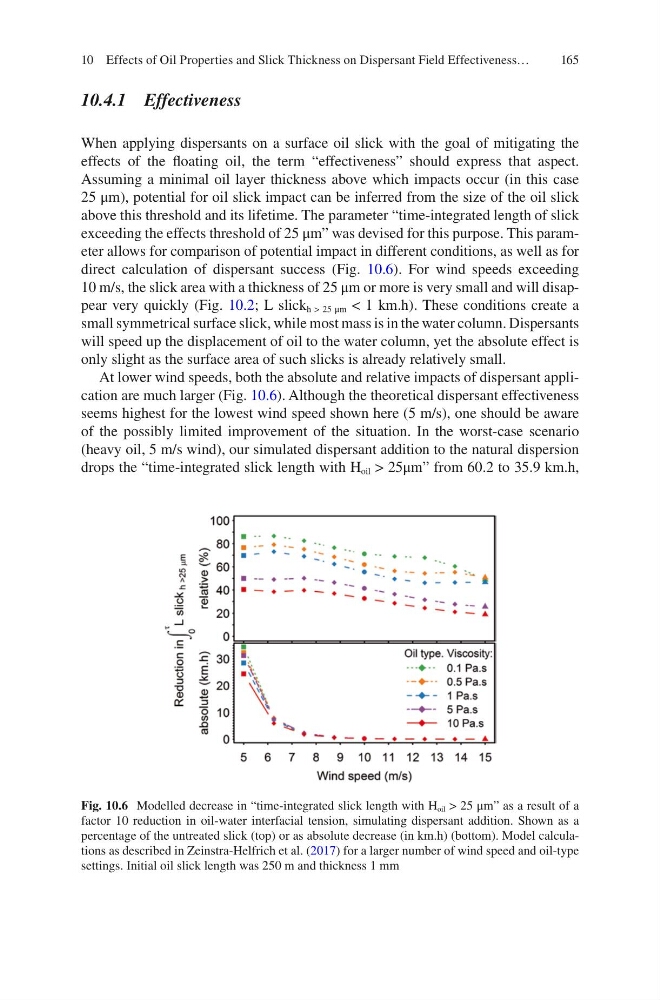
direct calculation of dispersant success (Fig. 10.6). For wind speeds exceeding
10 m/s, the slick area with a thickness of 25 μm or more is very small and will disappear very quickly (Fig. 10.2; L slick h > 25 μm < 1 km.h). These conditions create a
small symmetrical surface slick, while most mass is in the water column. Dispersants
will speed up the displacement of oil to the water column, yet the absolute effect is
only slight as the surface area of such slicks is already relatively small.
At lower wind speeds, both the absolute and relative impacts of dispersant application are much larger (Fig. 10.6). Although the theoretical dispersant effectiveness
seems highest for the lowest wind speed shown here (5 m/s), one should be aware
of the possibly limited improvement of the situation. In the worst-case scenario
(heavy oil, 5 m/s wind), our simulated dispersant addition to the natural dispersion
drops the “time-integrated slick length with H oil > 25μm” from 60.2 to 35.9 km.h,
Fig. 10.6 Modelled decrease in “time-integrated slick length with H oil > 25 μm” as a result of a
factor 10 reduction in oil-water interfacial tension, simulating dispersant addition. Shown as a
percentage of the untreated slick (top) or as absolute decrease (in km.h) (bottom). Model calculations as described in Zeinstra-Helfrich et al. (2017) for a larger number of wind speed and oil-type
settings. Initial oil slick length was 250 m and thickness 1 mm
10 Effects of Oil Properties and Slick Thickness on Dispersant Field Effectiveness…
10.4.1 Effectiveness
When applying dispersants on a surface oil slick with the goal of mitigating the
effects of the floating oil, the term “effectiveness” should express that aspect.
Assuming a minimal oil layer thickness above which impacts occur (in this case
25 μm), potential for oil slick impact can be inferred from the size of the oil slick
above this threshold and its lifetime. The parameter “time-integrated length of slick
exceeding the effects threshold of 25 μm” was devised for this purpose. This parameter allows for comparison of potential impact in different conditions, as well as for
direct calculation of dispersant success (Fig. 10.6). For wind speeds exceeding
10 m/s, the slick area with a thickness of 25 μm or more is very small and will disappear very quickly (Fig. 10.2; L slick h > 25 μm < 1 km.h). These conditions create a
small symmetrical surface slick, while most mass is in the water column. Dispersants
will speed up the displacement of oil to the water column, yet the absolute effect is
only slight as the surface area of such slicks is already relatively small.
At lower wind speeds, both the absolute and relative impacts of dispersant application are much larger (Fig. 10.6). Although the theoretical dispersant effectiveness
seems highest for the lowest wind speed shown here (5 m/s), one should be aware
of the possibly limited improvement of the situation. In the worst-case scenario
(heavy oil, 5 m/s wind), our simulated dispersant addition to the natural dispersion
drops the “time-integrated slick length with H oil > 25μm” from 60.2 to 35.9 km.h,
Fig. 10.6 Modelled decrease in “time-integrated slick length with H oil > 25 μm” as a result of a
factor 10 reduction in oil-water interfacial tension, simulating dispersant addition. Shown as a
percentage of the untreated slick (top) or as absolute decrease (in km.h) (bottom). Model calculations as described in Zeinstra-Helfrich et al. (2017) for a larger number of wind speed and oil-type
settings. Initial oil slick length was 250 m and thickness 1 mm
10 Effects of Oil Properties and Slick Thickness on Dispersant Field Effectiveness…