

160
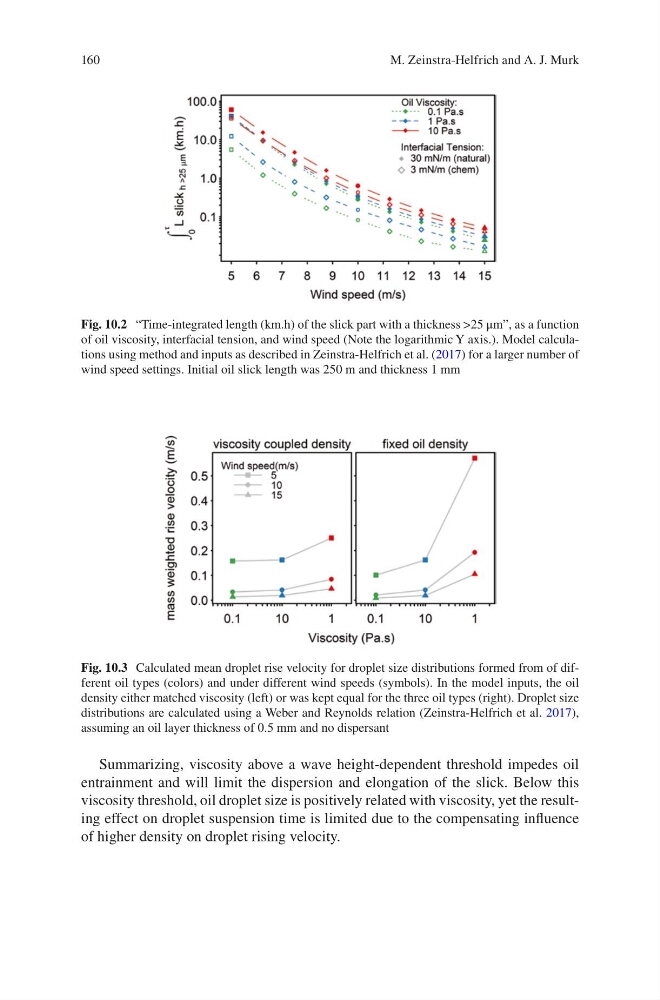
Summarizing, viscosity above a wave height-dependent threshold impedes oil
entrainment and will limit the dispersion and elongation of the slick. Below this
viscosity threshold, oil droplet size is positively related with viscosity, yet the resulting effect on droplet suspension time is limited due to the compensating influence
of higher density on droplet rising velocity.
Fig. 10.2 “Time-integrated length (km.h) of the slick part with a thickness >25 μm”, as a function
of oil viscosity, interfacial tension, and wind speed (Note the logarithmic Y axis.). Model calculations using method and inputs as described in Zeinstra-Helfrich et al. (2017) for a larger number of
wind speed settings. Initial oil slick length was 250 m and thickness 1 mm
Fig. 10.3 Calculated mean droplet rise velocity for droplet size distributions formed from of different oil types (colors) and under different wind speeds (symbols). In the model inputs, the oil
density either matched viscosity (left) or was kept equal for the three oil types (right). Droplet size
distributions are calculated using a Weber and Reynolds relation (Zeinstra-Helfrich et al. 2017),
assuming an oil layer thickness of 0.5 mm and no dispersant
M. Zeinstra-Helfrich and A. J. Murk
Summarizing, viscosity above a wave height-dependent threshold impedes oil
entrainment and will limit the dispersion and elongation of the slick. Below this
viscosity threshold, oil droplet size is positively related with viscosity, yet the resulting effect on droplet suspension time is limited due to the compensating influence
of higher density on droplet rising velocity.
Fig. 10.2 “Time-integrated length (km.h) of the slick part with a thickness >25 μm”, as a function
of oil viscosity, interfacial tension, and wind speed (Note the logarithmic Y axis.). Model calculations using method and inputs as described in Zeinstra-Helfrich et al. (2017) for a larger number of
wind speed settings. Initial oil slick length was 250 m and thickness 1 mm
Fig. 10.3 Calculated mean droplet rise velocity for droplet size distributions formed from of different oil types (colors) and under different wind speeds (symbols). In the model inputs, the oil
density either matched viscosity (left) or was kept equal for the three oil types (right). Droplet size
distributions are calculated using a Weber and Reynolds relation (Zeinstra-Helfrich et al. 2017),
assuming an oil layer thickness of 0.5 mm and no dispersant
M. Zeinstra-Helfrich and A. J. Murk