

157
their size and the oil’s density. Some of these droplets reach the water surface relatively quickly, while others are remixed by subsequent breaking wave events. As
the floating oil moves downwind at a faster rate than the suspended droplets, some
of the oil resurfaces upwind of the slick, elongating and diluting the slick.
The oil dispersion model (Zeinstra-Helfrich et al. 2017) uses a number of relatively simple input parameters (wind speed, oil viscosity, oil density, oil-water interfacial tension, and initial slick thickness and length) to calculate the entrainment
and subsequent resurfacing of oil over a predefined period of time, yielding the slick
length, displacement, and mass distribution between slick and water column and
across the slick length.
The modelling outcomes reveal that the mechanism by which the oil slick disappears from the water surface ultimately determines the nature of the oil slick over
time. In ideal dispersion conditions, identified by very high wind speed paired with
low-viscosity oil and dispersants, the disappearing of the oil slick is a vertical process. The abundance of breaking waves provides ample “entrainment events,”
where a substantial amount of oil is temporarily transferred to the water column.
High mixing energy combined with oil properties that enable easy breakup results
in a large portion of the entrained oil, now in small droplets, to remain suspended
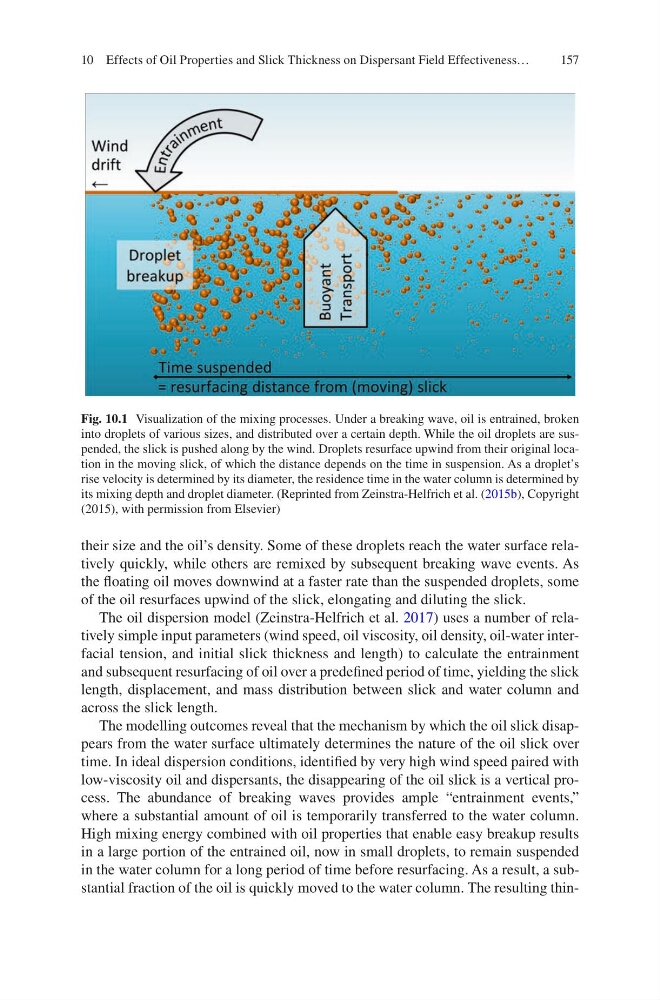
in the water column for a long period of time before resurfacing. As a result, a substantial fraction of the oil is quickly moved to the water column. The resulting thinFig. 10.1 Visualization of the mixing processes. Under a breaking wave, oil is entrained, broken
into droplets of various sizes, and distributed over a certain depth. While the oil droplets are suspended, the slick is pushed along by the wind. Droplets resurface upwind from their original location in the moving slick, of which the distance depends on the time in suspension. As a droplet’s
rise velocity is determined by its diameter, the residence time in the water column is determined by
its mixing depth and droplet diameter. (Reprinted from Zeinstra-Helfrich et al. (2015b), Copyright
(2015), with permission from Elsevier)
10 Effects of Oil Properties and Slick Thickness on Dispersant Field Effectiveness…
their size and the oil’s density. Some of these droplets reach the water surface relatively quickly, while others are remixed by subsequent breaking wave events. As
the floating oil moves downwind at a faster rate than the suspended droplets, some
of the oil resurfaces upwind of the slick, elongating and diluting the slick.
The oil dispersion model (Zeinstra-Helfrich et al. 2017) uses a number of relatively simple input parameters (wind speed, oil viscosity, oil density, oil-water interfacial tension, and initial slick thickness and length) to calculate the entrainment
and subsequent resurfacing of oil over a predefined period of time, yielding the slick
length, displacement, and mass distribution between slick and water column and
across the slick length.
The modelling outcomes reveal that the mechanism by which the oil slick disappears from the water surface ultimately determines the nature of the oil slick over
time. In ideal dispersion conditions, identified by very high wind speed paired with
low-viscosity oil and dispersants, the disappearing of the oil slick is a vertical process. The abundance of breaking waves provides ample “entrainment events,”
where a substantial amount of oil is temporarily transferred to the water column.
High mixing energy combined with oil properties that enable easy breakup results
in a large portion of the entrained oil, now in small droplets, to remain suspended
in the water column for a long period of time before resurfacing. As a result, a substantial fraction of the oil is quickly moved to the water column. The resulting thinFig. 10.1 Visualization of the mixing processes. Under a breaking wave, oil is entrained, broken
into droplets of various sizes, and distributed over a certain depth. While the oil droplets are suspended, the slick is pushed along by the wind. Droplets resurface upwind from their original location in the moving slick, of which the distance depends on the time in suspension. As a droplet’s
rise velocity is determined by its diameter, the residence time in the water column is determined by
its mixing depth and droplet diameter. (Reprinted from Zeinstra-Helfrich et al. (2015b), Copyright
(2015), with permission from Elsevier)
10 Effects of Oil Properties and Slick Thickness on Dispersant Field Effectiveness…