

134
expected to contribute to the increased partitioning. In addition, the filtration of
the water sample collected from the partition device ensured the absence of a
water accommodated fraction from the smaller oil droplets, and the analysis represents only the dissolved BTEX fraction. Therefore, the results might indicate
that the addition of dispersant actually changes the equilibrium conditions of the
system, resulting in an increased partitioning of organics from the oil into the
water phase.
As the plume migrates upward buoyantly, the exsolving methane would set up a
triphasic equilibrium of the oil, water, and gas components partitioning between
each other: [X] oil /[X] water , [X] oil /[X] gas , and [X] water /[X] gas . With the experimental design
used in this study, only two phases are experimentally considered: methane-charged
oil and water. In order to understand and address the influence of this variation on
the partitioning values from the experimental setup to a “real” water column, PVTSIM (pressure/volume/temperature simulation software, Mort A, personal communication) software was used to simulate the partitioning of BTEX into the gaseous
phase with changing pressure and temperature conditions. The extent of BTEX partitioning from the oil to the vapor phase was simulated to range between 1% and
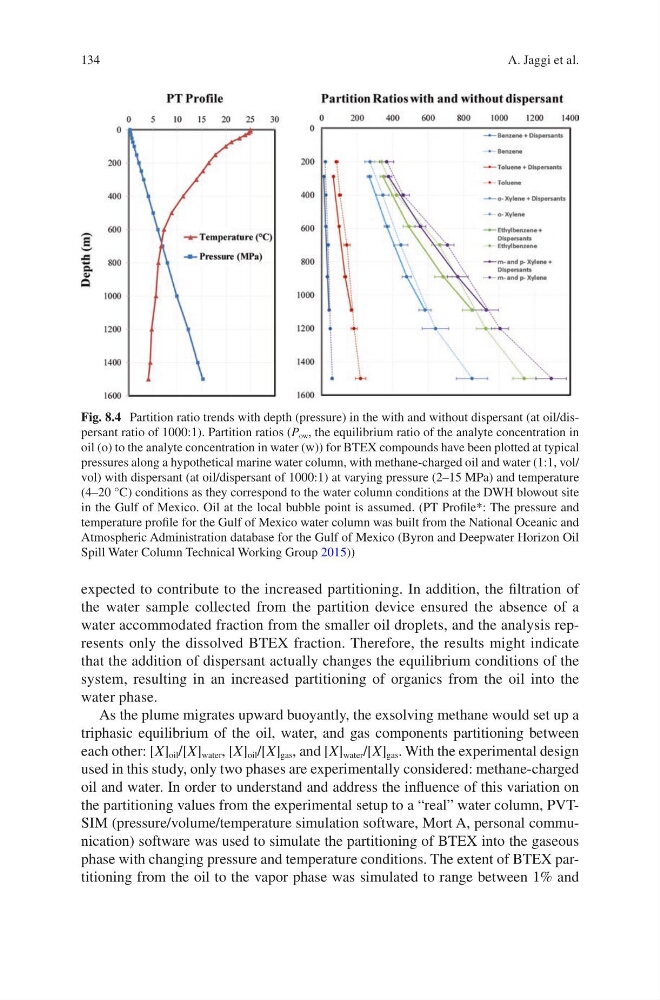
Fig. 8.4 Partition ratio trends with depth (pressure) in the with and without dispersant (at oil/dispersant ratio of 1000:1). Partition ratios (P ow , the equilibrium ratio of the analyte concentration in
oil (o) to the analyte concentration in water (w)) for BTEX compounds have been plotted at typical
pressures along a hypothetical marine water column, with methane-charged oil and water (1:1, vol/
vol) with dispersant (at oil/dispersant of 1000:1) at varying pressure (2–15 MPa) and temperature
(4–20 °C) conditions as they correspond to the water column conditions at the DWH blowout site
in the Gulf of Mexico. Oil at the local bubble point is assumed. (PT Profile*: The pressure and
temperature profile for the Gulf of Mexico water column was built from the National Oceanic and
Atmospheric Administration database for the Gulf of Mexico (Byron and Deepwater Horizon Oil
Spill Water Column Technical Working Group 2015))
A. Jaggi et al.
expected to contribute to the increased partitioning. In addition, the filtration of
the water sample collected from the partition device ensured the absence of a
water accommodated fraction from the smaller oil droplets, and the analysis represents only the dissolved BTEX fraction. Therefore, the results might indicate
that the addition of dispersant actually changes the equilibrium conditions of the
system, resulting in an increased partitioning of organics from the oil into the
water phase.
As the plume migrates upward buoyantly, the exsolving methane would set up a
triphasic equilibrium of the oil, water, and gas components partitioning between
each other: [X] oil /[X] water , [X] oil /[X] gas , and [X] water /[X] gas . With the experimental design
used in this study, only two phases are experimentally considered: methane-charged
oil and water. In order to understand and address the influence of this variation on
the partitioning values from the experimental setup to a “real” water column, PVTSIM (pressure/volume/temperature simulation software, Mort A, personal communication) software was used to simulate the partitioning of BTEX into the gaseous
phase with changing pressure and temperature conditions. The extent of BTEX partitioning from the oil to the vapor phase was simulated to range between 1% and
Fig. 8.4 Partition ratio trends with depth (pressure) in the with and without dispersant (at oil/dispersant ratio of 1000:1). Partition ratios (P ow , the equilibrium ratio of the analyte concentration in
oil (o) to the analyte concentration in water (w)) for BTEX compounds have been plotted at typical
pressures along a hypothetical marine water column, with methane-charged oil and water (1:1, vol/
vol) with dispersant (at oil/dispersant of 1000:1) at varying pressure (2–15 MPa) and temperature
(4–20 °C) conditions as they correspond to the water column conditions at the DWH blowout site
in the Gulf of Mexico. Oil at the local bubble point is assumed. (PT Profile*: The pressure and
temperature profile for the Gulf of Mexico water column was built from the National Oceanic and
Atmospheric Administration database for the Gulf of Mexico (Byron and Deepwater Horizon Oil
Spill Water Column Technical Working Group 2015))
A. Jaggi et al.