

114
7.3.1 Biodegradation of Petroleum in Marine Sediments
(DWH and Other Case Studies)
Oil is transported to the deep seafloor via two main mechanisms, through subsurface intrusions impinging on bottom sediments (Brooks et al. 2015; Romero et al.
2017) and through the sedimentation of oiled marine snow across large areas of the
northern Gulf of Mexico (Passow et al. 2012; Brooks et al. 2015; Romero et al.
2017; Quigg et al. 2020). Estimates for the amount of DWH oil sequestered in deep
ocean sediments range from 2% to 14% (Chanton et al. 2012; Valentine et al. 2014;
Bagby et al. 2017; Romero et al. 2017) and vary in footprint size from 3200 km
2
to
32,000 km
2
(Valentine et al. 2014; Romero et al. 2017). As for the spatial distribution of DWH-sourced hydrocarbons in the sediments, results suggest that the deposition was focused in the deep bathymetric depo-centers and negligibly on the
continental shelf (Bagby et al. 2017; Romero et al. 2017).
The chemistry of deposited oil in sediments indicated that biodegradation rates
were dependent of the degree of oiling, and consistent with previous findings, the
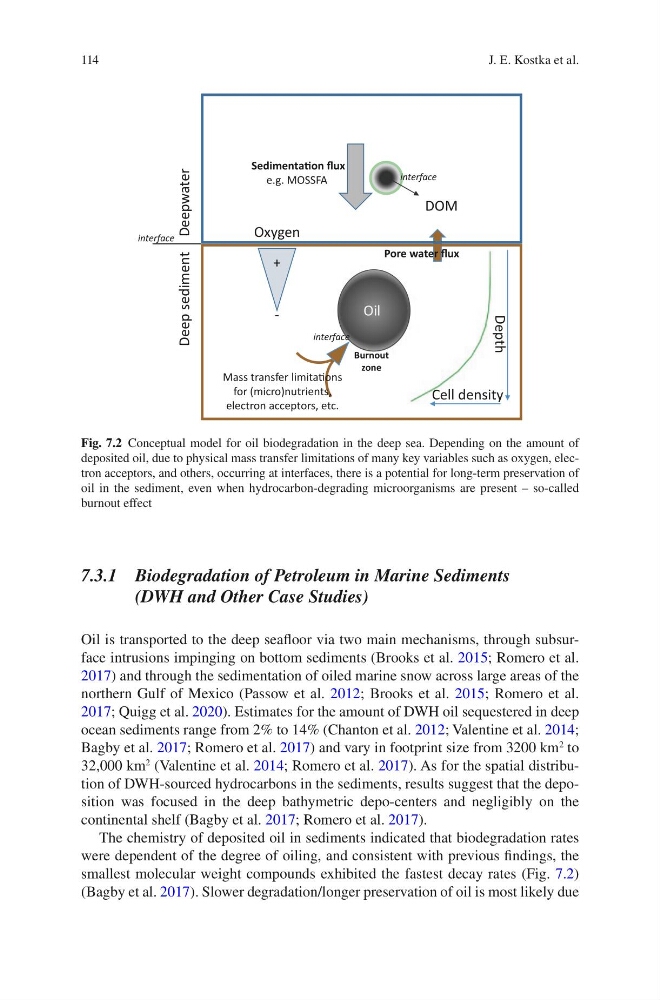
smallest molecular weight compounds exhibited the fastest decay rates (Fig. 7.2)
(Bagby et al. 2017). Slower degradation/longer preservation of oil is most likely due
ĞůůĚĞŶƐŝƚLJ
н
ƵƌŶŽƵƚ
njŽŶĞ
Kŝů
ĞĞƉƐĞĚŝŵĞŶƚ ĞĞƉǁĂƚĞƌ
KD
^ĞĚŝŵĞŶƚĂƟŽŶŇƵdž
Ğ͘Ő͘DK^^&
WŽƌĞǁĂƚĞƌŇƵdž
DĂƐƐƚƌĂŶƐĨĞƌůŝŵŝƚĂƟŽŶƐ
ĨŽƌ;ŵŝĐƌŽͿŶƵƚƌŝĞŶƚƐ͕
ĞůĞĐƚƌŽŶĂĐĐĞƉƚŽƌƐ͕ĞƚĐ͘
KdžLJŐĞŶ
Ͳ
ŝŶƚĞƌĨĂĐĞ
ŝŶƚĞƌĨĂĐĞ
ŝŶƚĞƌĨĂĐĞ
ĞƉƚŚ
Fig. 7.2 Conceptual model for oil biodegradation in the deep sea. Depending on the amount of
deposited oil, due to physical mass transfer limitations of many key variables such as oxygen, electron acceptors, and others, occurring at interfaces, there is a potential for long-term preservation of
oil in the sediment, even when hydrocarbon-degrading microorganisms are present – so- called
burnout effect
J. E. Kostka et al.
7.3.1 Biodegradation of Petroleum in Marine Sediments
(DWH and Other Case Studies)
Oil is transported to the deep seafloor via two main mechanisms, through subsurface intrusions impinging on bottom sediments (Brooks et al. 2015; Romero et al.
2017) and through the sedimentation of oiled marine snow across large areas of the
northern Gulf of Mexico (Passow et al. 2012; Brooks et al. 2015; Romero et al.
2017; Quigg et al. 2020). Estimates for the amount of DWH oil sequestered in deep
ocean sediments range from 2% to 14% (Chanton et al. 2012; Valentine et al. 2014;
Bagby et al. 2017; Romero et al. 2017) and vary in footprint size from 3200 km
2
to
32,000 km
2
(Valentine et al. 2014; Romero et al. 2017). As for the spatial distribution of DWH-sourced hydrocarbons in the sediments, results suggest that the deposition was focused in the deep bathymetric depo-centers and negligibly on the
continental shelf (Bagby et al. 2017; Romero et al. 2017).
The chemistry of deposited oil in sediments indicated that biodegradation rates
were dependent of the degree of oiling, and consistent with previous findings, the
smallest molecular weight compounds exhibited the fastest decay rates (Fig. 7.2)
(Bagby et al. 2017). Slower degradation/longer preservation of oil is most likely due
ĞůůĚĞŶƐŝƚLJ
н
ƵƌŶŽƵƚ
njŽŶĞ
Kŝů
ĞĞƉƐĞĚŝŵĞŶƚ ĞĞƉǁĂƚĞƌ
KD
^ĞĚŝŵĞŶƚĂƟŽŶŇƵdž
Ğ͘Ő͘DK^^&
WŽƌĞǁĂƚĞƌŇƵdž
DĂƐƐƚƌĂŶƐĨĞƌůŝŵŝƚĂƟŽŶƐ
ĨŽƌ;ŵŝĐƌŽͿŶƵƚƌŝĞŶƚƐ͕
ĞůĞĐƚƌŽŶĂĐĐĞƉƚŽƌƐ͕ĞƚĐ͘
KdžLJŐĞŶ
Ͳ
ŝŶƚĞƌĨĂĐĞ
ŝŶƚĞƌĨĂĐĞ
ŝŶƚĞƌĨĂĐĞ
ĞƉƚŚ
Fig. 7.2 Conceptual model for oil biodegradation in the deep sea. Depending on the amount of
deposited oil, due to physical mass transfer limitations of many key variables such as oxygen, electron acceptors, and others, occurring at interfaces, there is a potential for long-term preservation of
oil in the sediment, even when hydrocarbon-degrading microorganisms are present – so- called
burnout effect
J. E. Kostka et al.