

98
Yang et al. 2016), and their appetites altered the oil in a predictable fashion—nalkanes and small aromatics were degraded most rapidly, followed by branched
alkanes and unsubstituted PAH, followed by alkylated PAH (Prince et al. 2017;
Brakstad et al. 2015; Prince et al. 2013; Wang et al. 2016). The biodegradation of
the asphaltenes is less clear, not least because there are no good tools for characterizing their individual molecular structures. It may be that biodegradation is restricted
to alkyl side chains (Hernández-López et al. 2015).
Among the last molecules to be degraded are the hopanes, and individual hopanes
can serve as conserved internal markers of how much oil was originally present
(Prince et al. 1994). The family of these molecules also provides a fingerprint that
allows Macondo oil to be distinguished from other indigenous oils in the GoM
(Stout et al. 2016; Murray et al. 2017). It is thus possible to clearly identify biodegradation (and other specific chemical processes, such as evaporation and photooxidation (Prince et al. 2003) in an oil sample—information that would not be available
if the analysis was restricted to simple quantitation of analytes.
Biodegradation has profound effects on the density of the remaining oil. Most
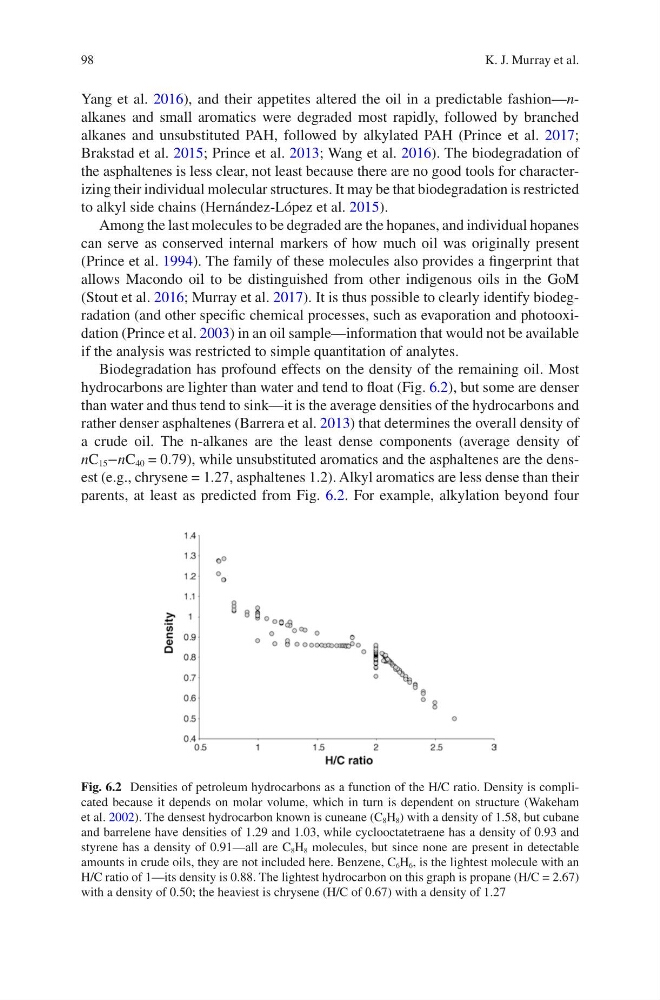
hydrocarbons are lighter than water and tend to float (Fig. 6.2), but some are denser
than water and thus tend to sink—it is the average densities of the hydrocarbons and
rather denser asphaltenes (Barrera et al. 2013) that determines the overall density of
a crude oil. The n-alkanes are the least dense components (average density of
nC 15 −nC 40 = 0.79), while unsubstituted aromatics and the asphaltenes are the densest (e.g., chrysene = 1.27, asphaltenes 1.2). Alkyl aromatics are less dense than their
parents, at least as predicted from Fig. 6.2. For example, alkylation beyond four
Fig. 6.2 Densities of petroleum hydrocarbons as a function of the H/C ratio. Density is complicated because it depends on molar volume, which in turn is dependent on structure (Wakeham
et al. 2002). The densest hydrocarbon known is cuneane (C 8 H 8 ) with a density of 1.58, but cubane
and barrelene have densities of 1.29 and 1.03, while cyclooctatetraene has a density of 0.93 and
styrene has a density of 0.91—all are C 8 H 8 molecules, but since none are present in detectable
amounts in crude oils, they are not included here. Benzene, C 6 H 6 , is the lightest molecule with an
H/C ratio of 1—its density is 0.88. The lightest hydrocarbon on this graph is propane (H/C = 2.67)
with a density of 0.50; the heaviest is chrysene (H/C of 0.67) with a density of 1.27
K. J. Murray et al.
Yang et al. 2016), and their appetites altered the oil in a predictable fashion—nalkanes and small aromatics were degraded most rapidly, followed by branched
alkanes and unsubstituted PAH, followed by alkylated PAH (Prince et al. 2017;
Brakstad et al. 2015; Prince et al. 2013; Wang et al. 2016). The biodegradation of
the asphaltenes is less clear, not least because there are no good tools for characterizing their individual molecular structures. It may be that biodegradation is restricted
to alkyl side chains (Hernández-López et al. 2015).
Among the last molecules to be degraded are the hopanes, and individual hopanes
can serve as conserved internal markers of how much oil was originally present
(Prince et al. 1994). The family of these molecules also provides a fingerprint that
allows Macondo oil to be distinguished from other indigenous oils in the GoM
(Stout et al. 2016; Murray et al. 2017). It is thus possible to clearly identify biodegradation (and other specific chemical processes, such as evaporation and photooxidation (Prince et al. 2003) in an oil sample—information that would not be available
if the analysis was restricted to simple quantitation of analytes.
Biodegradation has profound effects on the density of the remaining oil. Most
hydrocarbons are lighter than water and tend to float (Fig. 6.2), but some are denser
than water and thus tend to sink—it is the average densities of the hydrocarbons and
rather denser asphaltenes (Barrera et al. 2013) that determines the overall density of
a crude oil. The n-alkanes are the least dense components (average density of
nC 15 −nC 40 = 0.79), while unsubstituted aromatics and the asphaltenes are the densest (e.g., chrysene = 1.27, asphaltenes 1.2). Alkyl aromatics are less dense than their
parents, at least as predicted from Fig. 6.2. For example, alkylation beyond four
Fig. 6.2 Densities of petroleum hydrocarbons as a function of the H/C ratio. Density is complicated because it depends on molar volume, which in turn is dependent on structure (Wakeham
et al. 2002). The densest hydrocarbon known is cuneane (C 8 H 8 ) with a density of 1.58, but cubane
and barrelene have densities of 1.29 and 1.03, while cyclooctatetraene has a density of 0.93 and
styrene has a density of 0.91—all are C 8 H 8 molecules, but since none are present in detectable
amounts in crude oils, they are not included here. Benzene, C 6 H 6 , is the lightest molecule with an
H/C ratio of 1—its density is 0.88. The lightest hydrocarbon on this graph is propane (H/C = 2.67)
with a density of 0.50; the heaviest is chrysene (H/C of 0.67) with a density of 1.27
K. J. Murray et al.