

2.2 Pre-treatment Technologies of Anaerobic Fermentation
23
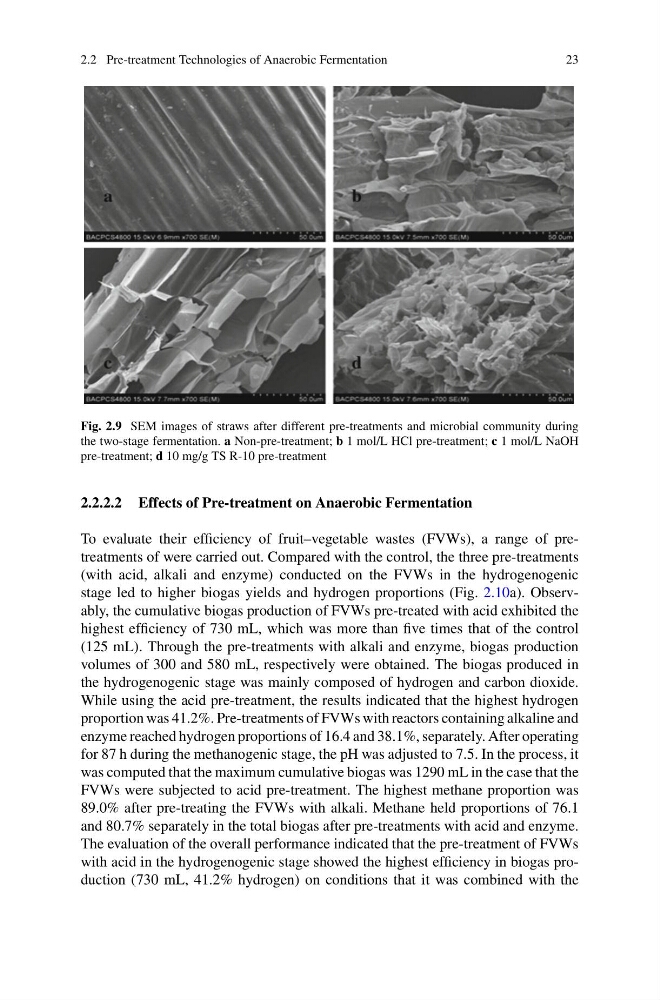
Fig. 2.9 SEM images of straws after different pre-treatments and microbial community during
the two-stage fermentation. a Non-pre-treatment; b 1 mol/L HCl pre-treatment; c 1 mol/L NaOH
pre-treatment; d 10 mg/g TS R-10 pre-treatment
2.2.2.2 Effects of Pre-treatment on Anaerobic Fermentation
To evaluate their efficiency of fruit–vegetable wastes (FVWs), a range of pretreatments of were carried out. Compared with the control, the three pre-treatments
(with acid, alkali and enzyme) conducted on the FVWs in the hydrogenogenic
stage led to higher biogas yields and hydrogen proportions (Fig. 2.10a). Observably, the cumulative biogas production of FVWs pre-treated with acid exhibited the
highest efficiency of 730 mL, which was more than five times that of the control
(125 mL). Through the pre-treatments with alkali and enzyme, biogas production
volumes of 300 and 580 mL, respectively were obtained. The biogas produced in
the hydrogenogenic stage was mainly composed of hydrogen and carbon dioxide.
While using the acid pre-treatment, the results indicated that the highest hydrogen
proportion was 41.2%. Pre-treatments of FVWs with reactors containing alkaline and
enzyme reached hydrogen proportions of 16.4 and 38.1%, separately. After operating
for 87 h during the methanogenic stage, the pH was adjusted to 7.5. In the process, it
was computed that the maximum cumulative biogas was 1290 mL in the case that the
FVWs were subjected to acid pre-treatment. The highest methane proportion was
89.0% after pre-treating the FVWs with alkali. Methane held proportions of 76.1
and 80.7% separately in the total biogas after pre-treatments with acid and enzyme.
The evaluation of the overall performance indicated that the pre-treatment of FVWs
with acid in the hydrogenogenic stage showed the highest efficiency in biogas production (730 mL, 41.2% hydrogen) on conditions that it was combined with the
23
Fig. 2.9 SEM images of straws after different pre-treatments and microbial community during
the two-stage fermentation. a Non-pre-treatment; b 1 mol/L HCl pre-treatment; c 1 mol/L NaOH
pre-treatment; d 10 mg/g TS R-10 pre-treatment
2.2.2.2 Effects of Pre-treatment on Anaerobic Fermentation
To evaluate their efficiency of fruit–vegetable wastes (FVWs), a range of pretreatments of were carried out. Compared with the control, the three pre-treatments
(with acid, alkali and enzyme) conducted on the FVWs in the hydrogenogenic
stage led to higher biogas yields and hydrogen proportions (Fig. 2.10a). Observably, the cumulative biogas production of FVWs pre-treated with acid exhibited the
highest efficiency of 730 mL, which was more than five times that of the control
(125 mL). Through the pre-treatments with alkali and enzyme, biogas production
volumes of 300 and 580 mL, respectively were obtained. The biogas produced in
the hydrogenogenic stage was mainly composed of hydrogen and carbon dioxide.
While using the acid pre-treatment, the results indicated that the highest hydrogen
proportion was 41.2%. Pre-treatments of FVWs with reactors containing alkaline and
enzyme reached hydrogen proportions of 16.4 and 38.1%, separately. After operating
for 87 h during the methanogenic stage, the pH was adjusted to 7.5. In the process, it
was computed that the maximum cumulative biogas was 1290 mL in the case that the
FVWs were subjected to acid pre-treatment. The highest methane proportion was
89.0% after pre-treating the FVWs with alkali. Methane held proportions of 76.1
and 80.7% separately in the total biogas after pre-treatments with acid and enzyme.
The evaluation of the overall performance indicated that the pre-treatment of FVWs
with acid in the hydrogenogenic stage showed the highest efficiency in biogas production (730 mL, 41.2% hydrogen) on conditions that it was combined with the