

18
2 High-Efficient Anaerobic Fermentation Technology of Organic …
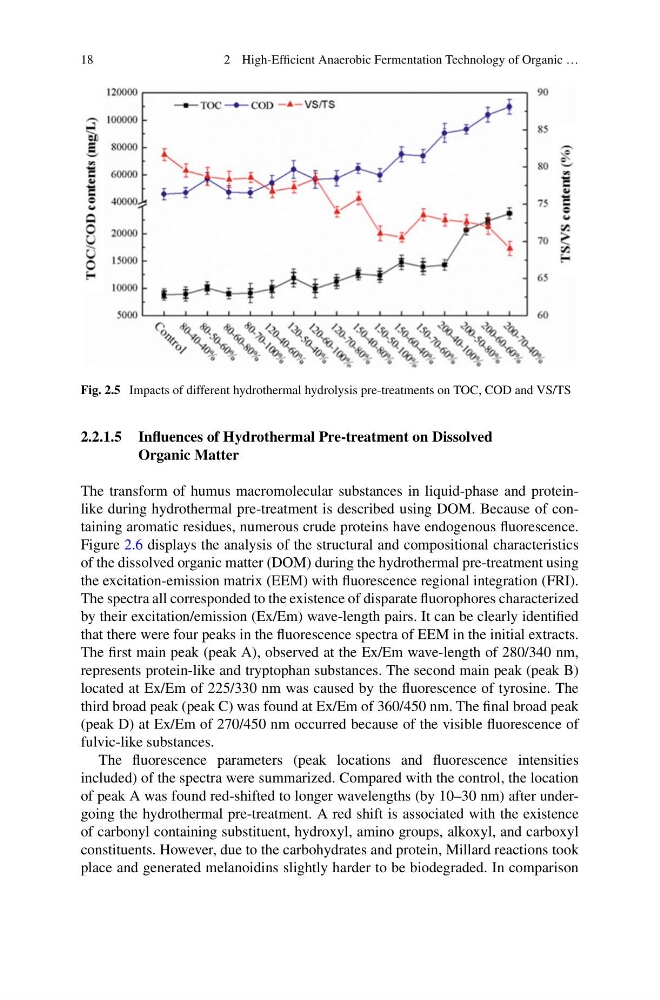
Fig. 2.5 Impacts of different hydrothermal hydrolysis pre-treatments on TOC, COD and VS/TS
2.2.1.5 Influences of Hydrothermal Pre-treatment on Dissolved
Organic Matter
The transform of humus macromolecular substances in liquid-phase and proteinlike during hydrothermal pre-treatment is described using DOM. Because of containing aromatic residues, numerous crude proteins have endogenous fluorescence.
Figure 2.6 displays the analysis of the structural and compositional characteristics
of the dissolved organic matter (DOM) during the hydrothermal pre-treatment using
the excitation-emission matrix (EEM) with fluorescence regional integration (FRI).
The spectra all corresponded to the existence of disparate fluorophores characterized
by their excitation/emission (Ex/Em) wave-length pairs. It can be clearly identified
that there were four peaks in the fluorescence spectra of EEM in the initial extracts.
The first main peak (peak A), observed at the Ex/Em wave-length of 280/340 nm,
represents protein-like and tryptophan substances. The second main peak (peak B)
located at Ex/Em of 225/330 nm was caused by the fluorescence of tyrosine. The
third broad peak (peak C) was found at Ex/Em of 360/450 nm. The final broad peak
(peak D) at Ex/Em of 270/450 nm occurred because of the visible fluorescence of
fulvic-like substances.
The fluorescence parameters (peak locations and fluorescence intensities
included) of the spectra were summarized. Compared with the control, the location
of peak A was found red-shifted to longer wavelengths (by 10–30 nm) after undergoing the hydrothermal pre-treatment. A red shift is associated with the existence
of carbonyl containing substituent, hydroxyl, amino groups, alkoxyl, and carboxyl
constituents. However, due to the carbohydrates and protein, Millard reactions took
place and generated melanoidins slightly harder to be biodegraded. In comparison
2 High-Efficient Anaerobic Fermentation Technology of Organic …
Fig. 2.5 Impacts of different hydrothermal hydrolysis pre-treatments on TOC, COD and VS/TS
2.2.1.5 Influences of Hydrothermal Pre-treatment on Dissolved
Organic Matter
The transform of humus macromolecular substances in liquid-phase and proteinlike during hydrothermal pre-treatment is described using DOM. Because of containing aromatic residues, numerous crude proteins have endogenous fluorescence.
Figure 2.6 displays the analysis of the structural and compositional characteristics
of the dissolved organic matter (DOM) during the hydrothermal pre-treatment using
the excitation-emission matrix (EEM) with fluorescence regional integration (FRI).
The spectra all corresponded to the existence of disparate fluorophores characterized
by their excitation/emission (Ex/Em) wave-length pairs. It can be clearly identified
that there were four peaks in the fluorescence spectra of EEM in the initial extracts.
The first main peak (peak A), observed at the Ex/Em wave-length of 280/340 nm,
represents protein-like and tryptophan substances. The second main peak (peak B)
located at Ex/Em of 225/330 nm was caused by the fluorescence of tyrosine. The
third broad peak (peak C) was found at Ex/Em of 360/450 nm. The final broad peak
(peak D) at Ex/Em of 270/450 nm occurred because of the visible fluorescence of
fulvic-like substances.
The fluorescence parameters (peak locations and fluorescence intensities
included) of the spectra were summarized. Compared with the control, the location
of peak A was found red-shifted to longer wavelengths (by 10–30 nm) after undergoing the hydrothermal pre-treatment. A red shift is associated with the existence
of carbonyl containing substituent, hydroxyl, amino groups, alkoxyl, and carboxyl
constituents. However, due to the carbohydrates and protein, Millard reactions took
place and generated melanoidins slightly harder to be biodegraded. In comparison