

98
3 Bio-augmented Composting of Organic Wastes in Villages and Towns
Table 3.13 Evaluation on fermentation effect
Treatment
T1
T2
T3
T4
Temperature index
1
3
3
1
T value
0.6
0.9
1.2
0.3
Total nutrient content
0.2
0.3
0.4
0.1
Sensory experience
2
3
3
1
Total score
2.8
7.2
7.6
2.4
Table 3.14 Results of orthogonal experiment
Treatment Amount of biogas
residue
Amount of pig
manure
Amount of chicken
manure
Synthesis score
T1
7.02
7.425
8.19
3.8
T2
5.85
7.425
6.825
7.2
T3
5.85
8.49
8.19
7.6
T4
7.02
8.49
6.825
2.4
Mean 1
3.100
5.500
5.7
Mean 2
7.400
5.000
4.8
Range
4.300
0.500
0.900
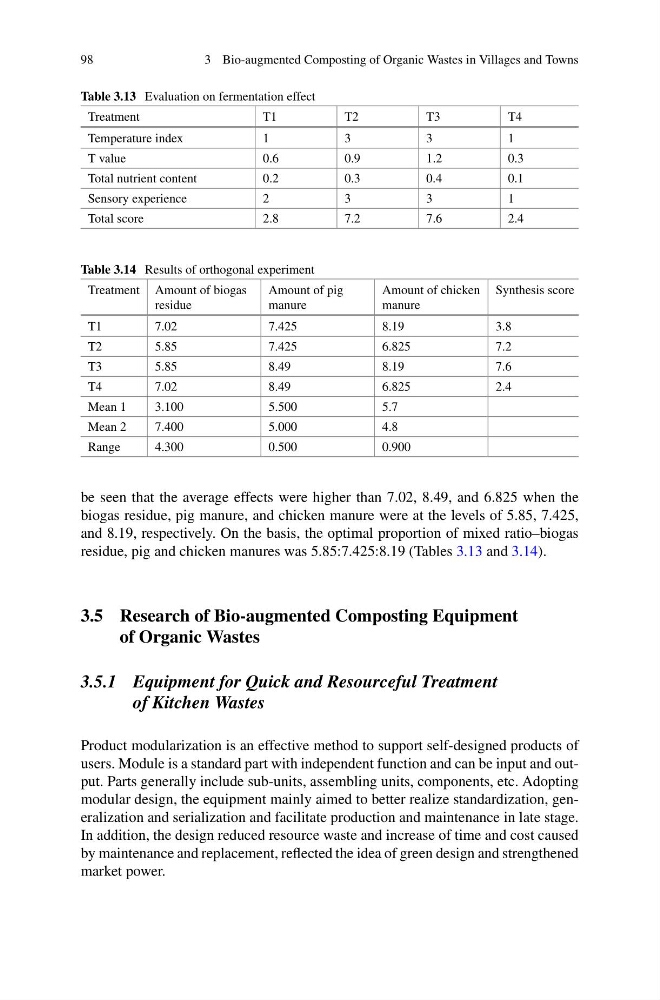
be seen that the average effects were higher than 7.02, 8.49, and 6.825 when the
biogas residue, pig manure, and chicken manure were at the levels of 5.85, 7.425,
and 8.19, respectively. On the basis, the optimal proportion of mixed ratio–biogas
residue, pig and chicken manures was 5.85:7.425:8.19 (Tables 3.13 and 3.14).
3.5 Research of Bio-augmented Composting Equipment
of Organic Wastes
3.5.1 Equipment for Quick and Resourceful Treatment
of Kitchen Wastes
Product modularization is an effective method to support self-designed products of
users. Module is a standard part with independent function and can be input and output. Parts generally include sub-units, assembling units, components, etc. Adopting
modular design, the equipment mainly aimed to better realize standardization, generalization and serialization and facilitate production and maintenance in late stage.
In addition, the design reduced resource waste and increase of time and cost caused
by maintenance and replacement, reflected the idea of green design and strengthened
market power.
3 Bio-augmented Composting of Organic Wastes in Villages and Towns
Table 3.13 Evaluation on fermentation effect
Treatment
T1
T2
T3
T4
Temperature index
1
3
3
1
T value
0.6
0.9
1.2
0.3
Total nutrient content
0.2
0.3
0.4
0.1
Sensory experience
2
3
3
1
Total score
2.8
7.2
7.6
2.4
Table 3.14 Results of orthogonal experiment
Treatment Amount of biogas
residue
Amount of pig
manure
Amount of chicken
manure
Synthesis score
T1
7.02
7.425
8.19
3.8
T2
5.85
7.425
6.825
7.2
T3
5.85
8.49
8.19
7.6
T4
7.02
8.49
6.825
2.4
Mean 1
3.100
5.500
5.7
Mean 2
7.400
5.000
4.8
Range
4.300
0.500
0.900
be seen that the average effects were higher than 7.02, 8.49, and 6.825 when the
biogas residue, pig manure, and chicken manure were at the levels of 5.85, 7.425,
and 8.19, respectively. On the basis, the optimal proportion of mixed ratio–biogas
residue, pig and chicken manures was 5.85:7.425:8.19 (Tables 3.13 and 3.14).
3.5 Research of Bio-augmented Composting Equipment
of Organic Wastes
3.5.1 Equipment for Quick and Resourceful Treatment
of Kitchen Wastes
Product modularization is an effective method to support self-designed products of
users. Module is a standard part with independent function and can be input and output. Parts generally include sub-units, assembling units, components, etc. Adopting
modular design, the equipment mainly aimed to better realize standardization, generalization and serialization and facilitate production and maintenance in late stage.
In addition, the design reduced resource waste and increase of time and cost caused
by maintenance and replacement, reflected the idea of green design and strengthened
market power.