

2.2 Where, What, and When to Sample
45
Streams in the southeastern United States, where snowmelt is not a major
hydrologic factor, are often sampled during spring. Samples collected under
base flow conditions are often used to evaluate long-term changes in water
quality. Short-term changes are more commonly evaluated under episodic
conditions influenced by snowmelt or rainstorms. Because of the possibility
for either episodic or incremental degradation of water quality in response
to atmospheric deposition, it may be important to implement a program for
monitoring both short- and long-term changes. For some studies, it may be
desirable to avoid sampling during abnormally low- or high-runoff conditions.
Other studies may be focused on extreme flow conditions. USGS discharge
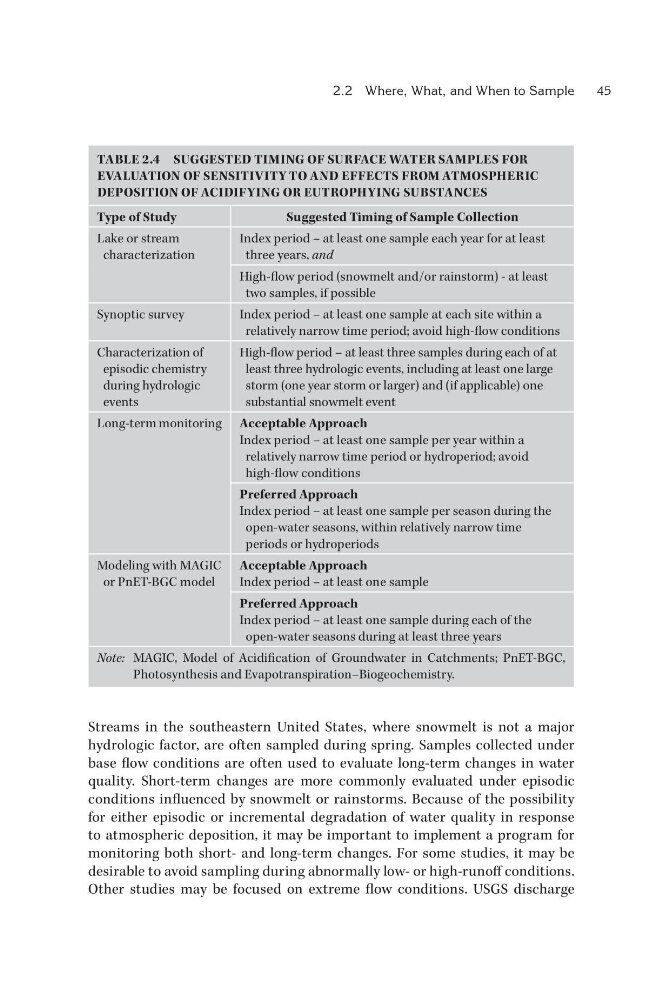
TABLE 2.4 SUGGESTED TIMING OF SURFACE WATER SAMPLES FOR
EVALUATION OF SENSITIVITY TO AND EFFECTS FROM ATMOSPHERIC
DEPOSITION OF ACIDIFYING OR EUTROPHYING SUBSTANCES
Type of Study
Suggested Timing of Sample Collection
Lake or stream
characterization
Index period – at least one sample each year for at least
three years, and
High-flow period (snowmelt and/or rainstorm) - at least
two samples, if possible
Synoptic survey
Index period – at least one sample at each site within a
relatively narrow time period; avoid high-flow conditions
Characterization of
episodic chemistry
during hydrologic
events
High-flow period – at least three samples during each of at
least three hydrologic events, including at least one large
storm (one year storm or larger) and (if applicable) one
substantial snowmelt event
Long-term monitoring Acceptable Approach
Index period – at least one sample per year within a
relatively narrow time period or hydroperiod; avoid
high-flow conditions
Preferred Approach
Index period – at least one sample per season during the
open-water seasons, within relatively narrow time
periods or hydroperiods
Modeling with MAGIC
or PnET-BGC model
Acceptable Approach
Index period – at least one sample
Preferred Approach
Index period – at least one sample during each of the
open-water seasons during at least three years
Note: MAGIC, Model of Acidification of Groundwater in Catchments; PnET-BGC,
Photosynthesis and Evapotranspiration–Biogeochemistry.
45
Streams in the southeastern United States, where snowmelt is not a major
hydrologic factor, are often sampled during spring. Samples collected under
base flow conditions are often used to evaluate long-term changes in water
quality. Short-term changes are more commonly evaluated under episodic
conditions influenced by snowmelt or rainstorms. Because of the possibility
for either episodic or incremental degradation of water quality in response
to atmospheric deposition, it may be important to implement a program for
monitoring both short- and long-term changes. For some studies, it may be
desirable to avoid sampling during abnormally low- or high-runoff conditions.
Other studies may be focused on extreme flow conditions. USGS discharge
TABLE 2.4 SUGGESTED TIMING OF SURFACE WATER SAMPLES FOR
EVALUATION OF SENSITIVITY TO AND EFFECTS FROM ATMOSPHERIC
DEPOSITION OF ACIDIFYING OR EUTROPHYING SUBSTANCES
Type of Study
Suggested Timing of Sample Collection
Lake or stream
characterization
Index period – at least one sample each year for at least
three years, and
High-flow period (snowmelt and/or rainstorm) - at least
two samples, if possible
Synoptic survey
Index period – at least one sample at each site within a
relatively narrow time period; avoid high-flow conditions
Characterization of
episodic chemistry
during hydrologic
events
High-flow period – at least three samples during each of at
least three hydrologic events, including at least one large
storm (one year storm or larger) and (if applicable) one
substantial snowmelt event
Long-term monitoring Acceptable Approach
Index period – at least one sample per year within a
relatively narrow time period or hydroperiod; avoid
high-flow conditions
Preferred Approach
Index period – at least one sample per season during the
open-water seasons, within relatively narrow time
periods or hydroperiods
Modeling with MAGIC
or PnET-BGC model
Acceptable Approach
Index period – at least one sample
Preferred Approach
Index period – at least one sample during each of the
open-water seasons during at least three years
Note: MAGIC, Model of Acidification of Groundwater in Catchments; PnET-BGC,
Photosynthesis and Evapotranspiration–Biogeochemistry.