

2.2 Where, What, and When to Sample
33
A number of factors need to be considered in selecting the specific sampling
point in each chosen stream. Any sampling point along a stream will be
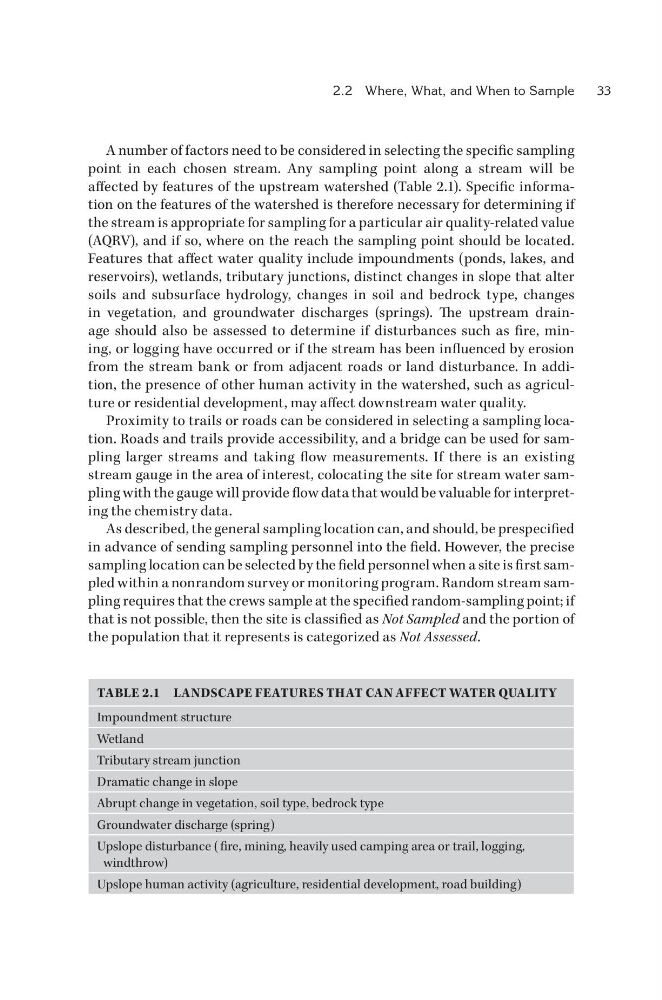
affected by features of the upstream watershed (Table 2.1). Specific information on the features of the watershed is therefore necessary for determining if
the stream is appropriate for sampling for a particular air quality-related value
(AQRV), and if so, where on the reach the sampling point should be located.
Features that affect water quality include impoundments (ponds, lakes, and
reservoirs), wetlands, tributary junctions, distinct changes in slope that alter
soils and subsurface hydrology, changes in soil and bedrock type, changes
in vegetation, and groundwater discharges (springs). The upstream drainage should also be assessed to determine if disturbances such as fire, mining, or logging have occurred or if the stream has been influenced by erosion
from the stream bank or from adjacent roads or land disturbance. In addition, the presence of other human activity in the watershed, such as agriculture or residential development, may affect downstream water quality.
Proximity to trails or roads can be considered in selecting a sampling location. Roads and trails provide accessibility, and a bridge can be used for sampling larger streams and taking flow measurements. If there is an existing
stream gauge in the area of interest, colocating the site for stream water sampling with the gauge will provide flow data that would be valuable for interpreting the chemistry data.
As described, the general sampling location can, and should, be prespecified
in advance of sending sampling personnel into the field. However, the precise
sampling location can be selected by the field personnel when a site is first sampled within a nonrandom survey or monitoring program. Random stream sampling requires that the crews sample at the specified random-sampling point; if
that is not possible, then the site is classified as Not Sampled and the portion of
the population that it represents is categorized as Not Assessed.
TABLE 2.1 LANDSCAPE FEATURES THAT CAN AFFECT WATER QUALITY
Impoundment structure
Wetland
Tributary stream junction
Dramatic change in slope
Abrupt change in vegetation, soil type, bedrock type
Groundwater discharge (spring)
Upslope disturbance ( fire, mining, heavily used camping area or trail, logging,
windthrow)
Upslope human activity (agriculture, residential development, road building)
33
A number of factors need to be considered in selecting the specific sampling
point in each chosen stream. Any sampling point along a stream will be
affected by features of the upstream watershed (Table 2.1). Specific information on the features of the watershed is therefore necessary for determining if
the stream is appropriate for sampling for a particular air quality-related value
(AQRV), and if so, where on the reach the sampling point should be located.
Features that affect water quality include impoundments (ponds, lakes, and
reservoirs), wetlands, tributary junctions, distinct changes in slope that alter
soils and subsurface hydrology, changes in soil and bedrock type, changes
in vegetation, and groundwater discharges (springs). The upstream drainage should also be assessed to determine if disturbances such as fire, mining, or logging have occurred or if the stream has been influenced by erosion
from the stream bank or from adjacent roads or land disturbance. In addition, the presence of other human activity in the watershed, such as agriculture or residential development, may affect downstream water quality.
Proximity to trails or roads can be considered in selecting a sampling location. Roads and trails provide accessibility, and a bridge can be used for sampling larger streams and taking flow measurements. If there is an existing
stream gauge in the area of interest, colocating the site for stream water sampling with the gauge will provide flow data that would be valuable for interpreting the chemistry data.
As described, the general sampling location can, and should, be prespecified
in advance of sending sampling personnel into the field. However, the precise
sampling location can be selected by the field personnel when a site is first sampled within a nonrandom survey or monitoring program. Random stream sampling requires that the crews sample at the specified random-sampling point; if
that is not possible, then the site is classified as Not Sampled and the portion of
the population that it represents is categorized as Not Assessed.
TABLE 2.1 LANDSCAPE FEATURES THAT CAN AFFECT WATER QUALITY
Impoundment structure
Wetland
Tributary stream junction
Dramatic change in slope
Abrupt change in vegetation, soil type, bedrock type
Groundwater discharge (spring)
Upslope disturbance ( fire, mining, heavily used camping area or trail, logging,
windthrow)
Upslope human activity (agriculture, residential development, road building)