

1.1 Background
15
exists that could be considered appropriate for focusing field studies. These are
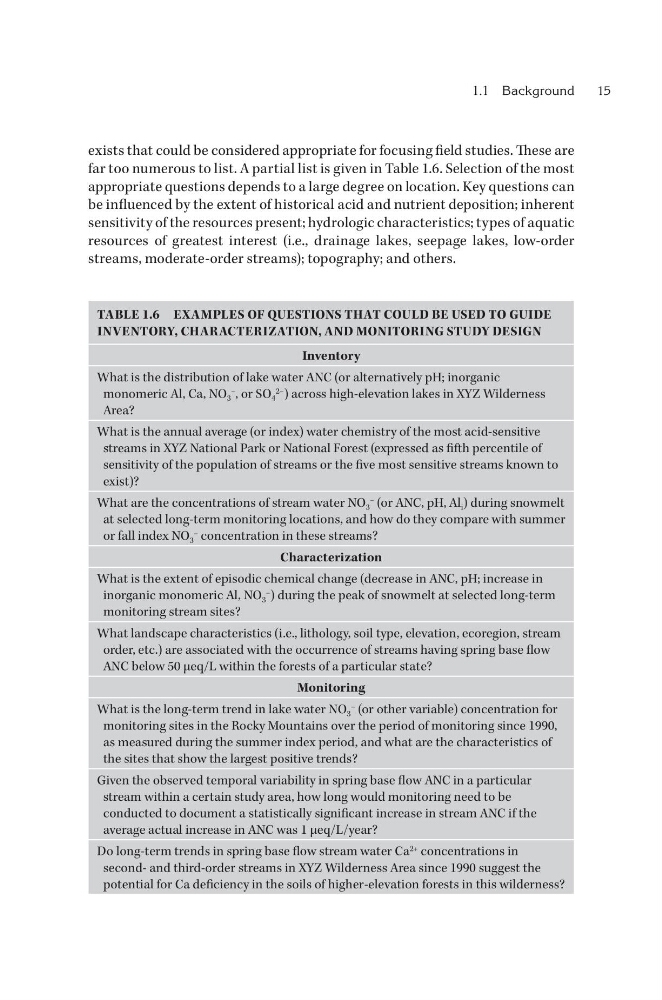
far too numerous to list. A partial list is given in Table 1.6. Selection of the most
appropriate questions depends to a large degree on location. Key questions can
be influenced by the extent of historical acid and nutrient deposition; inherent
sensitivity of the resources present; hydrologic characteristics; types of aquatic
resources of greatest interest (i.e., drainage lakes, seepage lakes, low-order
streams, moderate-order streams); topography; and others.
TABLE 1.6 EXAMPLES OF QUESTIONS THAT COULD BE USED TO GUIDE
INVENTORY, CHARACTERIZATION, AND MONITORING STUDY DESIGN
Inventory
What is the distribution of lake water ANC (or alternatively pH; inorganic
monomeric Al, Ca, NO 3
− , or SO 4
2− ) across high-elevation lakes in XYZ Wilderness
Area?
What is the annual average (or index) water chemistry of the most acid-sensitive
streams in XYZ National Park or National Forest (expressed as fifth percentile of
sensitivity of the population of streams or the five most sensitive streams known to
exist)?
What are the concentrations of stream water NO 3
− (or ANC, pH, Al i ) during snowmelt
at selected long-term monitoring locations, and how do they compare with summer
or fall index NO 3
− concentration in these streams?
Characterization
What is the extent of episodic chemical change (decrease in ANC, pH; increase in
inorganic monomeric Al, NO 3
− ) during the peak of snowmelt at selected long-term
monitoring stream sites?
What landscape characteristics (i.e., lithology, soil type, elevation, ecoregion, stream
order, etc.) are associated with the occurrence of streams having spring base flow
ANC below 50 μeq/L within the forests of a particular state?
Monitoring
What is the long-term trend in lake water NO 3
− (or other variable) concentration for
monitoring sites in the Rocky Mountains over the period of monitoring since 1990,
as measured during the summer index period, and what are the characteristics of
the sites that show the largest positive trends?
Given the observed temporal variability in spring base flow ANC in a particular
stream within a certain study area, how long would monitoring need to be
conducted to document a statistically significant increase in stream ANC if the
average actual increase in ANC was 1 μeq/L/year?
Do long-term trends in spring base flow stream water Ca 2+ concentrations in
second- and third-order streams in XYZ Wilderness Area since 1990 suggest the
potential for Ca deficiency in the soils of higher-elevation forests in this wilderness?
15
exists that could be considered appropriate for focusing field studies. These are
far too numerous to list. A partial list is given in Table 1.6. Selection of the most
appropriate questions depends to a large degree on location. Key questions can
be influenced by the extent of historical acid and nutrient deposition; inherent
sensitivity of the resources present; hydrologic characteristics; types of aquatic
resources of greatest interest (i.e., drainage lakes, seepage lakes, low-order
streams, moderate-order streams); topography; and others.
TABLE 1.6 EXAMPLES OF QUESTIONS THAT COULD BE USED TO GUIDE
INVENTORY, CHARACTERIZATION, AND MONITORING STUDY DESIGN
Inventory
What is the distribution of lake water ANC (or alternatively pH; inorganic
monomeric Al, Ca, NO 3
− , or SO 4
2− ) across high-elevation lakes in XYZ Wilderness
Area?
What is the annual average (or index) water chemistry of the most acid-sensitive
streams in XYZ National Park or National Forest (expressed as fifth percentile of
sensitivity of the population of streams or the five most sensitive streams known to
exist)?
What are the concentrations of stream water NO 3
− (or ANC, pH, Al i ) during snowmelt
at selected long-term monitoring locations, and how do they compare with summer
or fall index NO 3
− concentration in these streams?
Characterization
What is the extent of episodic chemical change (decrease in ANC, pH; increase in
inorganic monomeric Al, NO 3
− ) during the peak of snowmelt at selected long-term
monitoring stream sites?
What landscape characteristics (i.e., lithology, soil type, elevation, ecoregion, stream
order, etc.) are associated with the occurrence of streams having spring base flow
ANC below 50 μeq/L within the forests of a particular state?
Monitoring
What is the long-term trend in lake water NO 3
− (or other variable) concentration for
monitoring sites in the Rocky Mountains over the period of monitoring since 1990,
as measured during the summer index period, and what are the characteristics of
the sites that show the largest positive trends?
Given the observed temporal variability in spring base flow ANC in a particular
stream within a certain study area, how long would monitoring need to be
conducted to document a statistically significant increase in stream ANC if the
average actual increase in ANC was 1 μeq/L/year?
Do long-term trends in spring base flow stream water Ca 2+ concentrations in
second- and third-order streams in XYZ Wilderness Area since 1990 suggest the
potential for Ca deficiency in the soils of higher-elevation forests in this wilderness?