

Laboratory Analyses
90
12. Aliquots that require acidification should be acidified in the hood
using the appropriate acid dispenser.
13. Aliquots should be stored in the appropriate places as described in the
specific project sample-processing schedule.
14. Date and processor’s initials must be recorded on the laboratory data
sheet. Completed chain-of-custody forms and laboratory data sheets
should be filed in a safe location. Information on these forms will need
to be entered into the electronic database.
In some situations, it is possible that the sample bottle was not completely
filled in the field. If there is insufficient sample volume for all aliquots, analysis
of the sample volume available must be prioritized based on the objectives of
the project. If there is an anticipation that some low-volume samples will be
collected, a low-volume schedule needs to be prepared and made available to
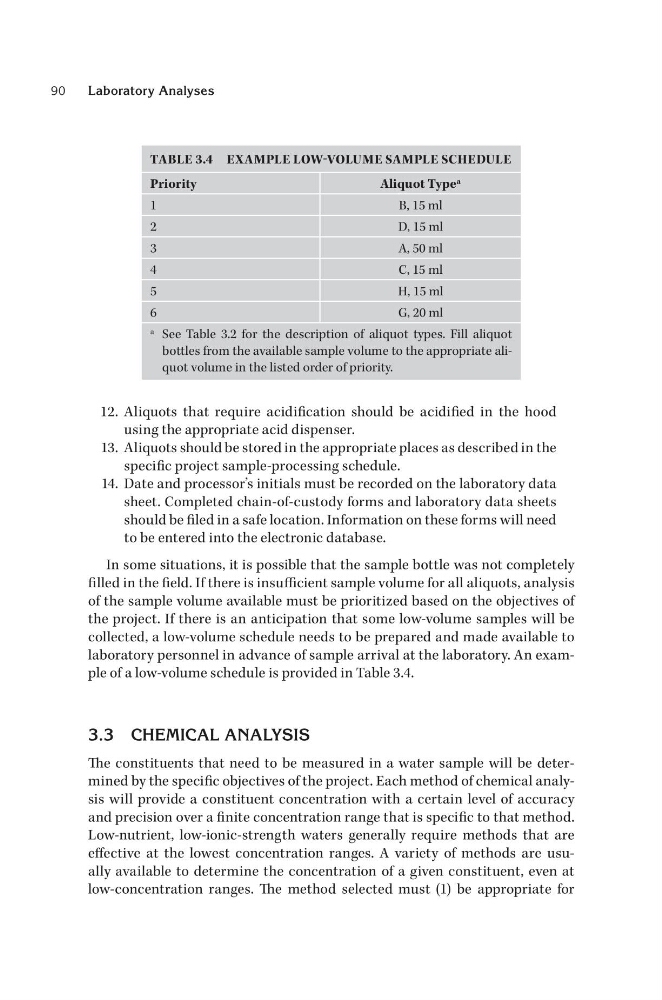
laboratory personnel in advance of sample arrival at the laboratory. An example of a low-volume schedule is provided in Table 3.4.
3.3 CHEMICAL ANALYSIS
The constituents that need to be measured in a water sample will be determined by the specific objectives of the project. Each method of chemical analysis will provide a constituent concentration with a certain level of accuracy
and precision over a finite concentration range that is specific to that method.
Low-nutrient, low-ionic-strength waters generally require methods that are
effective at the lowest concentration ranges. A variety of methods are usually available to determine the concentration of a given constituent, even at
low-concentration ranges. The method selected must (1) be appropriate for
TABLE 3.4 EXAMPLE LOW-VOLUME SAMPLE SCHEDULE
Priority
Aliquot Type a
1
B, 15 ml
2
D, 15 ml
3
A, 50 ml
4
C, 15 ml
5
H, 15 ml
6
G, 20 ml
a See Table 3.2 for the description of aliquot types. Fill aliquot
bottles from the available sample volume to the appropriate aliquot volume in the listed order of priority.
90
12. Aliquots that require acidification should be acidified in the hood
using the appropriate acid dispenser.
13. Aliquots should be stored in the appropriate places as described in the
specific project sample-processing schedule.
14. Date and processor’s initials must be recorded on the laboratory data
sheet. Completed chain-of-custody forms and laboratory data sheets
should be filed in a safe location. Information on these forms will need
to be entered into the electronic database.
In some situations, it is possible that the sample bottle was not completely
filled in the field. If there is insufficient sample volume for all aliquots, analysis
of the sample volume available must be prioritized based on the objectives of
the project. If there is an anticipation that some low-volume samples will be
collected, a low-volume schedule needs to be prepared and made available to
laboratory personnel in advance of sample arrival at the laboratory. An example of a low-volume schedule is provided in Table 3.4.
3.3 CHEMICAL ANALYSIS
The constituents that need to be measured in a water sample will be determined by the specific objectives of the project. Each method of chemical analysis will provide a constituent concentration with a certain level of accuracy
and precision over a finite concentration range that is specific to that method.
Low-nutrient, low-ionic-strength waters generally require methods that are
effective at the lowest concentration ranges. A variety of methods are usually available to determine the concentration of a given constituent, even at
low-concentration ranges. The method selected must (1) be appropriate for
TABLE 3.4 EXAMPLE LOW-VOLUME SAMPLE SCHEDULE
Priority
Aliquot Type a
1
B, 15 ml
2
D, 15 ml
3
A, 50 ml
4
C, 15 ml
5
H, 15 ml
6
G, 20 ml
a See Table 3.2 for the description of aliquot types. Fill aliquot
bottles from the available sample volume to the appropriate aliquot volume in the listed order of priority.