

Result and discussion
70
VII.
Antimicrobial activity of chitosan
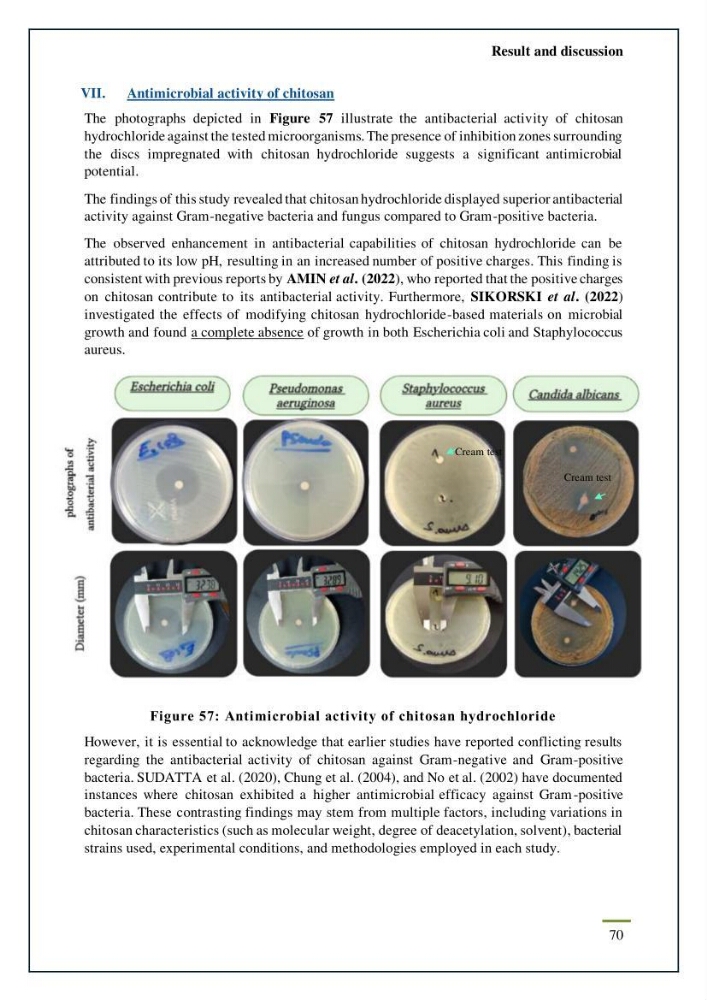
The photographs depicted in Figure 57 illustrate the antibacterial activity of chitosan
hydrochloride against the tested microorganisms. The presence of inhibition zones surrounding
the discs impregnated with chitosan hydrochloride suggests a significant antimicrobial
potential.
The findings of this study revealed that chitosan hydrochloride displayed superior antibacterial
activity against Gram-negative bacteria and fungus compared to Gram-positive bacteria.
The observed enhancement in antibacterial capabilities of chitosan hydrochloride can be
attributed to its low pH, resulting in an increased number of positive charges. This finding is
consistent with previous reports by AMIN et al. (2022), who reported that the positive charges
on chitosan contribute to its antibacterial activity. Furthermore, SIKORSKI et al. (2022)
investigated the effects of modifying chitosan hydrochloride-based materials on microbial
growth and found a complete absence of growth in both Escherichia coli and Staphylococcus
aureus.
Figure 57: Antimicrobial activity of chitosan hydrochloride
However, it is essential to acknowledge that earlier studies have reported conflicting results
regarding the antibacterial activity of chitosan against Gram-negative and Gram-positive
bacteria. SUDATTA et al. (2020), Chung et al. (2004), and No et al. (2002) have documented
instances where chitosan exhibited a higher antimicrobial efficacy against Gram -positive
bacteria. These contrasting findings may stem from multiple factors, including variations in
chitosan characteristics (such as molecular weight, degree of deacetylation, solvent), bacterial
strains used, experimental conditions, and methodologies employed in each study.
Cream test
Cream test
70
VII.
Antimicrobial activity of chitosan
The photographs depicted in Figure 57 illustrate the antibacterial activity of chitosan
hydrochloride against the tested microorganisms. The presence of inhibition zones surrounding
the discs impregnated with chitosan hydrochloride suggests a significant antimicrobial
potential.
The findings of this study revealed that chitosan hydrochloride displayed superior antibacterial
activity against Gram-negative bacteria and fungus compared to Gram-positive bacteria.
The observed enhancement in antibacterial capabilities of chitosan hydrochloride can be
attributed to its low pH, resulting in an increased number of positive charges. This finding is
consistent with previous reports by AMIN et al. (2022), who reported that the positive charges
on chitosan contribute to its antibacterial activity. Furthermore, SIKORSKI et al. (2022)
investigated the effects of modifying chitosan hydrochloride-based materials on microbial
growth and found a complete absence of growth in both Escherichia coli and Staphylococcus
aureus.
Figure 57: Antimicrobial activity of chitosan hydrochloride
However, it is essential to acknowledge that earlier studies have reported conflicting results
regarding the antibacterial activity of chitosan against Gram-negative and Gram-positive
bacteria. SUDATTA et al. (2020), Chung et al. (2004), and No et al. (2002) have documented
instances where chitosan exhibited a higher antimicrobial efficacy against Gram -positive
bacteria. These contrasting findings may stem from multiple factors, including variations in
chitosan characteristics (such as molecular weight, degree of deacetylation, solvent), bacterial
strains used, experimental conditions, and methodologies employed in each study.
Cream test
Cream test