

Result and discussion
59
V.
Chitin and Chitosan characterization results
1- Chitosan Yield
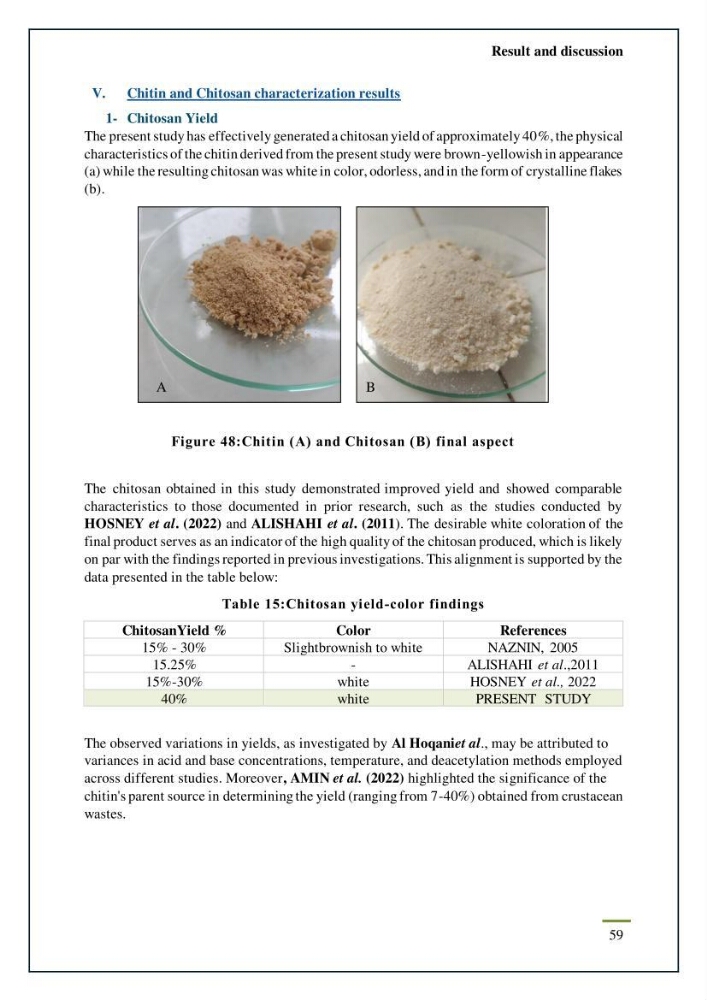
The present study has effectively generated a chitosan yield of approximately 40%, the physical
characteristics of the chitin derived from the present study were brown-yellowish in appearance
(a) while the resulting chitosan was white in color, odorless, and in the form of crystalline flakes
(b).
The chitosan obtained in this study demonstrated improved yield and showed comparable
characteristics to those documented in prior research, such as the studies conducted by
HOSNEY et al. (2022) and ALISHAHI et al. (2011). The desirable white coloration of the
final product serves as an indicator of the high quality of the chitosan produced, which is likely
on par with the findings reported in previous investigations. This alignment is supported by the
data presented in the table below:
Table 15:Chitosan yield-color findings
ChitosanYield %
Color
References
15% - 30%
Slightbrownish to white
NAZNIN, 2005
15.25%
-
ALISHAHI et al.,2011
15%-30%
white
HOSNEY et al., 2022
40%
white
PRESENT STUDY
The observed variations in yields, as investigated by Al Hoqaniet al., may be attributed to
variances in acid and base concentrations, temperature, and deacetylation methods employed
across different studies. Moreover, AMIN et al. (2022) highlighted the significance of the
chitin's parent source in determining the yield (ranging from 7-40%) obtained from crustacean
wastes.
Figure 48:Chitin (A) and Chitosan (B) final aspect
A
B
59
V.
Chitin and Chitosan characterization results
1- Chitosan Yield
The present study has effectively generated a chitosan yield of approximately 40%, the physical
characteristics of the chitin derived from the present study were brown-yellowish in appearance
(a) while the resulting chitosan was white in color, odorless, and in the form of crystalline flakes
(b).
The chitosan obtained in this study demonstrated improved yield and showed comparable
characteristics to those documented in prior research, such as the studies conducted by
HOSNEY et al. (2022) and ALISHAHI et al. (2011). The desirable white coloration of the
final product serves as an indicator of the high quality of the chitosan produced, which is likely
on par with the findings reported in previous investigations. This alignment is supported by the
data presented in the table below:
Table 15:Chitosan yield-color findings
ChitosanYield %
Color
References
15% - 30%
Slightbrownish to white
NAZNIN, 2005
15.25%
-
ALISHAHI et al.,2011
15%-30%
white
HOSNEY et al., 2022
40%
white
PRESENT STUDY
The observed variations in yields, as investigated by Al Hoqaniet al., may be attributed to
variances in acid and base concentrations, temperature, and deacetylation methods employed
across different studies. Moreover, AMIN et al. (2022) highlighted the significance of the
chitin's parent source in determining the yield (ranging from 7-40%) obtained from crustacean
wastes.
Figure 48:Chitin (A) and Chitosan (B) final aspect
A
B