

54
E) Burn-wound procedure
The objective of this second experiment was to investigate the anti-inflammatory properties of
a chitosan hydrochloride-based cream. Albino rabbits were prepared for the procedure by
shaving small zone of the dorsal area 24 hours prior. The site was disinfected, and an
anaesthesia cream was applied 30 minutes before the initiation of the experiment.
To induce a superficial wound burn and trigger an inflammatory reaction, a sterile scalpel was
heated to a temperature range of 50-60 degrees Celsius. One rabbit was treated with the
chitosan-based cream, while another rabbit served as the control and was left untreated.
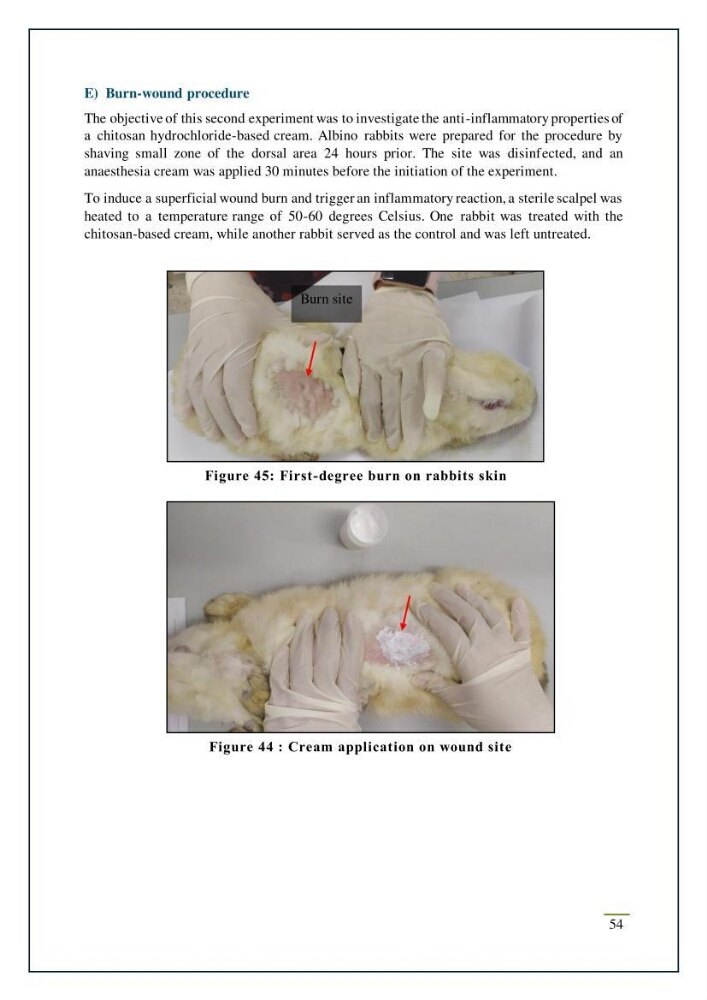
Burn site
Figure 45: First-degree burn on rabbits skin
Figure 44 : Cream application on wound site
E) Burn-wound procedure
The objective of this second experiment was to investigate the anti-inflammatory properties of
a chitosan hydrochloride-based cream. Albino rabbits were prepared for the procedure by
shaving small zone of the dorsal area 24 hours prior. The site was disinfected, and an
anaesthesia cream was applied 30 minutes before the initiation of the experiment.
To induce a superficial wound burn and trigger an inflammatory reaction, a sterile scalpel was
heated to a temperature range of 50-60 degrees Celsius. One rabbit was treated with the
chitosan-based cream, while another rabbit served as the control and was left untreated.
Burn site
Figure 45: First-degree burn on rabbits skin
Figure 44 : Cream application on wound site