

47
4. Preparation of inoculum
• Using a sterile inoculating loop or needle or a
cotton swab, touch four or five isolated
colonies of the organism to be tested. collect
several colonies of the same morphology (if
possible) to avoid selecting an atypical variant
• Suspend the organism in 2 ml of sterile saline.
• Vortex the saline tube to create a smooth
suspension
• Adjust the turbidity of this suspension to a 0.5
McFarland standard by adding more organism if
the suspension is too light or diluting with sterile
saline if the suspension is too heavy.
5. Chitosan Hydrochloride sample solution preparation
Chitosan hydrochloride sample was prepared at a
concentration of 1% for the purpose of conducting an
antimicrobial test. The preparation involved dissolving
0.5 grams of chitosan hydrochloride in 50 millilitres of
a 1% appropriate solvent
The resulting solution was stirred for a duration of one
hour to ensure complete dissolution. Subsequently, the
solution was subjected to centrifugation at 32,000
revolutions per minute for a duration of 15 minutes.
Following centrifugation, the supernatant was carefully
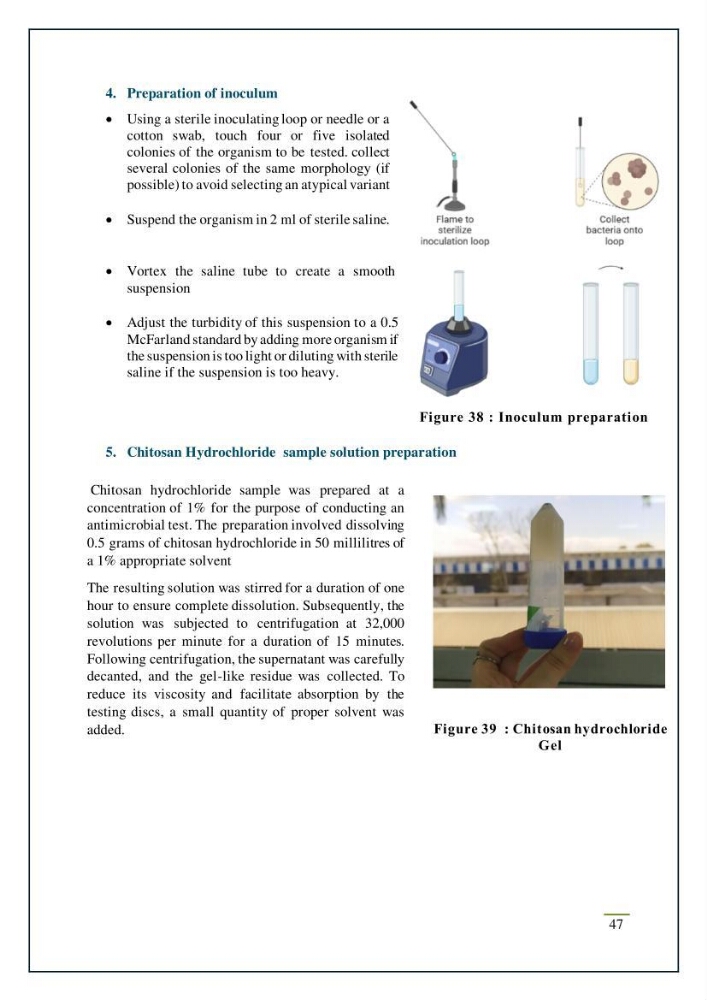
decanted, and the gel-like residue was collected. To
reduce its viscosity and facilitate absorption by the
testing discs, a small quantity of proper solvent was
added.
Figure 39 : Chitosan hydrochloride
Gel
Figure 38 : Inoculum preparation
4. Preparation of inoculum
• Using a sterile inoculating loop or needle or a
cotton swab, touch four or five isolated
colonies of the organism to be tested. collect
several colonies of the same morphology (if
possible) to avoid selecting an atypical variant
• Suspend the organism in 2 ml of sterile saline.
• Vortex the saline tube to create a smooth
suspension
• Adjust the turbidity of this suspension to a 0.5
McFarland standard by adding more organism if
the suspension is too light or diluting with sterile
saline if the suspension is too heavy.
5. Chitosan Hydrochloride sample solution preparation
Chitosan hydrochloride sample was prepared at a
concentration of 1% for the purpose of conducting an
antimicrobial test. The preparation involved dissolving
0.5 grams of chitosan hydrochloride in 50 millilitres of
a 1% appropriate solvent
The resulting solution was stirred for a duration of one
hour to ensure complete dissolution. Subsequently, the
solution was subjected to centrifugation at 32,000
revolutions per minute for a duration of 15 minutes.
Following centrifugation, the supernatant was carefully
decanted, and the gel-like residue was collected. To
reduce its viscosity and facilitate absorption by the
testing discs, a small quantity of proper solvent was
added.
Figure 39 : Chitosan hydrochloride
Gel
Figure 38 : Inoculum preparation