

44
VII.
Antimicrobial activity of chitosan
Chitosan, a natural biopolymer derived from chitin, has gained attention in recent years for its
potential antimicrobial properties. (AHMED and IKRAM, 2017).
Chitosan's antimicrobial activity has been demonstrated in various applications, including
wound healing, food preservation, and water treatment (MARGUERITE and FRANCISCO,
2019). In wound healing, chitosan has been shown to accelerate the healing process by
preventing infection and promoting tissue regeneration (KORDESTANI, 2019).
Several studies have reported the significant antibacterial effect of chitosan, including (NO,
2002), (QI et al., 2004), (AHMED and IKRAM, 2017) (ARANAZ et al., 2021), (AMIN et
al., 2022), (ABBAS and AL-SHAMMARI, 2022), (HASAN et al., 2022), (NGUYEN,.2021).
In this part of the study, we will test and confirm the anti-microbial activity of chitosan produced
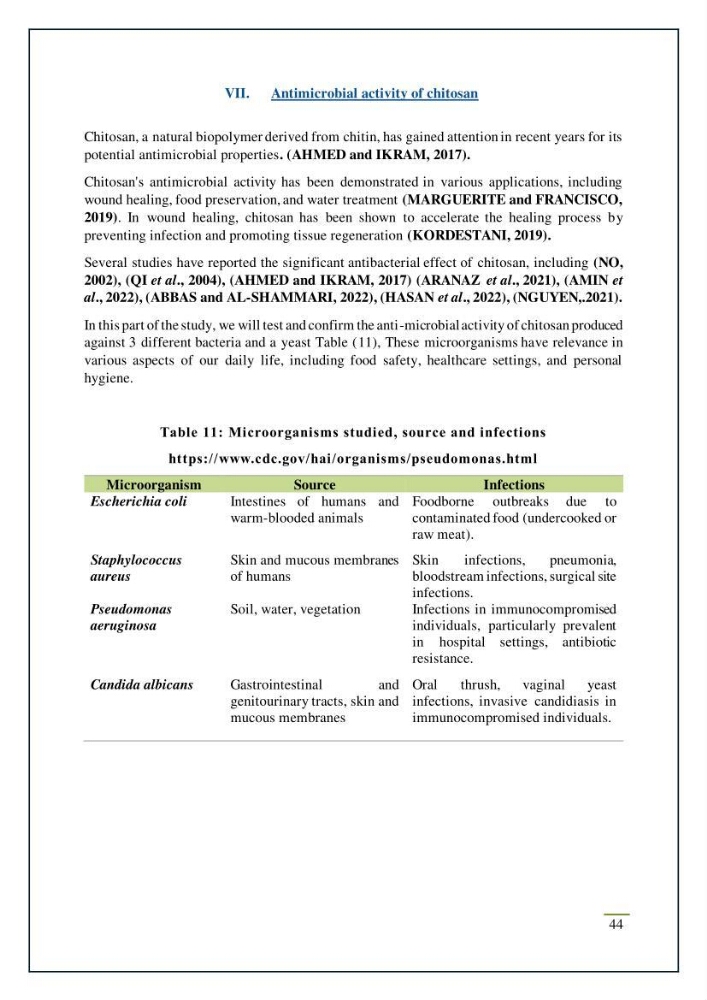
against 3 different bacteria and a yeast Table (11), These microorganisms have relevance in
various aspects of our daily life, including food safety, healthcare settings, and personal
hygiene.
Table 11: Microorganisms studied, source and infections
https://www.cdc.gov/hai/organisms/pseudomonas.html
Microorganism
Source
Infections
Escherichia coli
Intestines of humans and
warm-blooded animals
Foodborne outbreaks due to
contaminated food (undercooked or
raw meat).
Staphylococcus
aureus
Skin and mucous membranes
of humans
Skin
infections,
pneumonia,
bloodstream infections, surgical site
infections.
Pseudomonas
aeruginosa
Soil, water, vegetation
Infections in immunocompromised
individuals, particularly prevalent
in hospital settings, antibiotic
resistance.
Candida albicans
Gastrointestinal
and
genitourinary tracts, skin and
mucous membranes
Oral
thrush,
vaginal
yeast
infections, invasive candidiasis in
immunocompromised individuals.
VII.
Antimicrobial activity of chitosan
Chitosan, a natural biopolymer derived from chitin, has gained attention in recent years for its
potential antimicrobial properties. (AHMED and IKRAM, 2017).
Chitosan's antimicrobial activity has been demonstrated in various applications, including
wound healing, food preservation, and water treatment (MARGUERITE and FRANCISCO,
2019). In wound healing, chitosan has been shown to accelerate the healing process by
preventing infection and promoting tissue regeneration (KORDESTANI, 2019).
Several studies have reported the significant antibacterial effect of chitosan, including (NO,
2002), (QI et al., 2004), (AHMED and IKRAM, 2017) (ARANAZ et al., 2021), (AMIN et
al., 2022), (ABBAS and AL-SHAMMARI, 2022), (HASAN et al., 2022), (NGUYEN,.2021).
In this part of the study, we will test and confirm the anti-microbial activity of chitosan produced
against 3 different bacteria and a yeast Table (11), These microorganisms have relevance in
various aspects of our daily life, including food safety, healthcare settings, and personal
hygiene.
Table 11: Microorganisms studied, source and infections
https://www.cdc.gov/hai/organisms/pseudomonas.html
Microorganism
Source
Infections
Escherichia coli
Intestines of humans and
warm-blooded animals
Foodborne outbreaks due to
contaminated food (undercooked or
raw meat).
Staphylococcus
aureus
Skin and mucous membranes
of humans
Skin
infections,
pneumonia,
bloodstream infections, surgical site
infections.
Pseudomonas
aeruginosa
Soil, water, vegetation
Infections in immunocompromised
individuals, particularly prevalent
in hospital settings, antibiotic
resistance.
Candida albicans
Gastrointestinal
and
genitourinary tracts, skin and
mucous membranes
Oral
thrush,
vaginal
yeast
infections, invasive candidiasis in
immunocompromised individuals.