

Materials and Methods
29
II.
Raw material collection and processing
1. Source of the raw material
The raw material “shrimp shells waste “was collected at the end of December 2022, from
different restaurants located in Bab Ezzouar, the raw material was composed of different
types of shrimp waste, the approximate value of the total masse is about 10 kg.
2. Shell pre-treatment
Before initiating the use of the sample, some steps are considered essential to obtain the
desired result which are described in three points:
I. Cleaning process
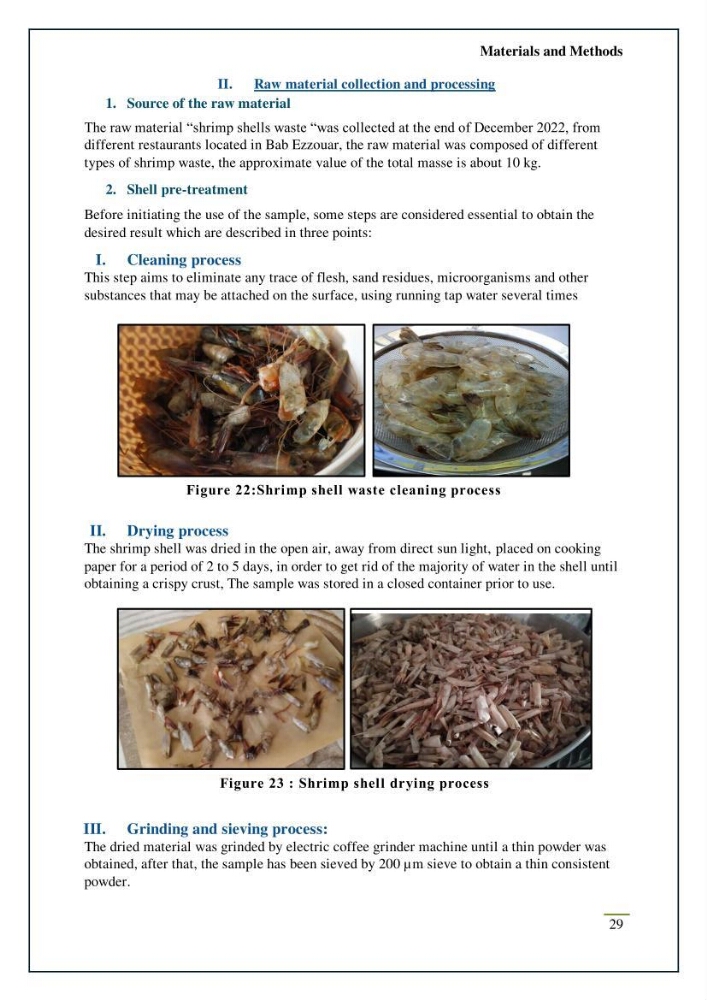
This step aims to eliminate any trace of flesh, sand residues, microorganisms and other
substances that may be attached on the surface, using running tap water several times
II. Drying process
The shrimp shell was dried in the open air, away from direct sun light, placed on cooking
paper for a period of 2 to 5 days, in order to get rid of the majority of water in the shell until
obtaining a crispy crust, The sample was stored in a closed container prior to use.
III. Grinding and sieving process:
The dried material was grinded by electric coffee grinder machine until a thin powder was
obtained, after that, the sample has been sieved by 200 µm sieve to obtain a thin consistent
powder.
Figure 23 : Shrimp shell drying process
Figure 22:Shrimp shell waste cleaning process
29
II.
Raw material collection and processing
1. Source of the raw material
The raw material “shrimp shells waste “was collected at the end of December 2022, from
different restaurants located in Bab Ezzouar, the raw material was composed of different
types of shrimp waste, the approximate value of the total masse is about 10 kg.
2. Shell pre-treatment
Before initiating the use of the sample, some steps are considered essential to obtain the
desired result which are described in three points:
I. Cleaning process
This step aims to eliminate any trace of flesh, sand residues, microorganisms and other
substances that may be attached on the surface, using running tap water several times
II. Drying process
The shrimp shell was dried in the open air, away from direct sun light, placed on cooking
paper for a period of 2 to 5 days, in order to get rid of the majority of water in the shell until
obtaining a crispy crust, The sample was stored in a closed container prior to use.
III. Grinding and sieving process:
The dried material was grinded by electric coffee grinder machine until a thin powder was
obtained, after that, the sample has been sieved by 200 µm sieve to obtain a thin consistent
powder.
Figure 23 : Shrimp shell drying process
Figure 22:Shrimp shell waste cleaning process