

Literature review
3
I.
Chitin
1. History
Over 200 years ago, the French botanist Henri Braconnot,
made an important discovery while conducting research on
edible mushrooms. He identified a new polysaccharide that
he called (fongine/fungine) (CRINI and LICHTFOUSE,
2019).
This preceded the discovery of cellulose by about three
decades. Chitin was later discovered in the cuticles of insects
by Odier in 1823, and the name "Chitin" was derived from
the Greek word meaning tunic, covering or envelop
(CASADIDIO et al., 2019).
In the years following its discovery, chitin and its derivative
chitosan, gained significant interest and became the focus of
numerous patents. Chitin, the most abundant naturally
occurring biopolymer with amino acid and sugar
components, is second only to cellulose in terms of
abundance among naturally occurring polymers, chitin’s
chemical composition comprises N-acetyl-D-glucosamine
units that are linked together through β-(1-4) glycosidic
bonds. (AHMED and IKRAM ,2017).
2. Structure
Chitin (C₈H₁₃O₅)ո, is a white, hard, inelastic, nitrogenous polysaccharide, is a copolymer of Nacetyl-D-glucosamine and D-glucosamine units linked with β-(1-4) glycosidic bonds, where Nacetyl-D-glucosamine units are predominant in the polymeric chain. (THOMAS et al., 2020).
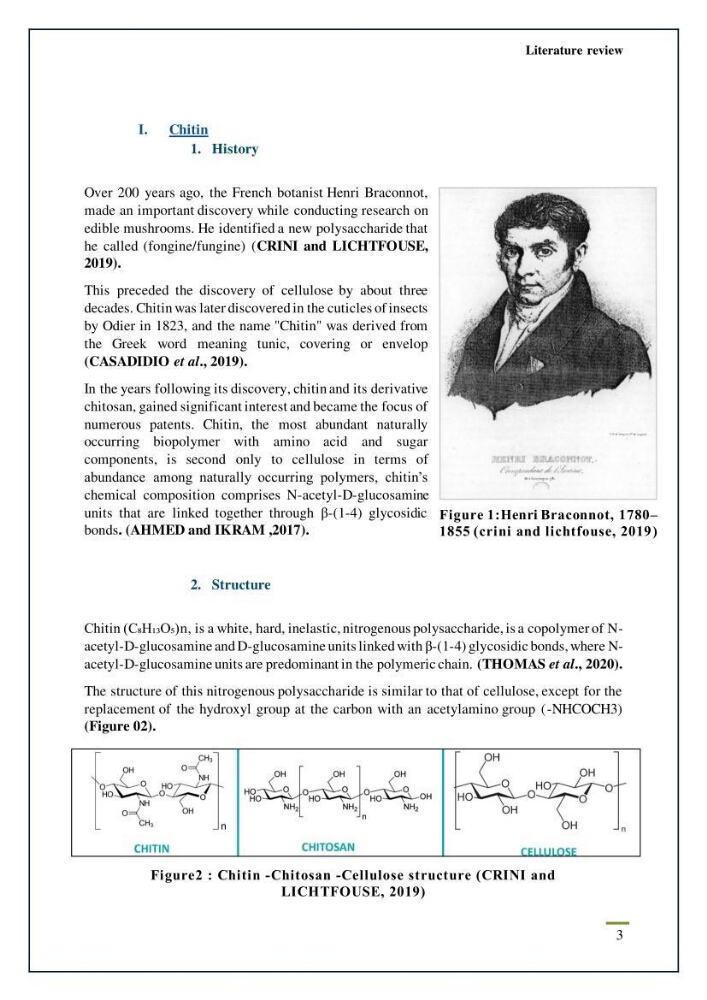
The structure of this nitrogenous polysaccharide is similar to that of cellulose, except for the
replacement of the hydroxyl group at the carbon with an acetylamino group (-NHCOCH3)
(Figure 02).
Figure2 : Chitin -Chitosan -Cellulose structure (CRINI and
LICHTFOUSE, 2019)
Figure 1:Henri Braconnot, 1780–
1855 (crini and lichtfouse, 2019)
3
I.
Chitin
1. History
Over 200 years ago, the French botanist Henri Braconnot,
made an important discovery while conducting research on
edible mushrooms. He identified a new polysaccharide that
he called (fongine/fungine) (CRINI and LICHTFOUSE,
2019).
This preceded the discovery of cellulose by about three
decades. Chitin was later discovered in the cuticles of insects
by Odier in 1823, and the name "Chitin" was derived from
the Greek word meaning tunic, covering or envelop
(CASADIDIO et al., 2019).
In the years following its discovery, chitin and its derivative
chitosan, gained significant interest and became the focus of
numerous patents. Chitin, the most abundant naturally
occurring biopolymer with amino acid and sugar
components, is second only to cellulose in terms of
abundance among naturally occurring polymers, chitin’s
chemical composition comprises N-acetyl-D-glucosamine
units that are linked together through β-(1-4) glycosidic
bonds. (AHMED and IKRAM ,2017).
2. Structure
Chitin (C₈H₁₃O₅)ո, is a white, hard, inelastic, nitrogenous polysaccharide, is a copolymer of Nacetyl-D-glucosamine and D-glucosamine units linked with β-(1-4) glycosidic bonds, where Nacetyl-D-glucosamine units are predominant in the polymeric chain. (THOMAS et al., 2020).
The structure of this nitrogenous polysaccharide is similar to that of cellulose, except for the
replacement of the hydroxyl group at the carbon with an acetylamino group (-NHCOCH3)
(Figure 02).
Figure2 : Chitin -Chitosan -Cellulose structure (CRINI and
LICHTFOUSE, 2019)
Figure 1:Henri Braconnot, 1780–
1855 (crini and lichtfouse, 2019)