

Methodology
54
S: Wetted cross-section of the screen with : S =
í µí± í µí± í µí±¤í µí±
í µí±£
(m
2 ).
We have : í µí±¸ í µí±¹í µí²í µí² :Rainy weather peak flow (We have : í µí±¸ í µí±¹í µí²í µí² = 0,31m
3 /s).
V: Raw water flow velocity at inlet (weassume that V=1m/s).
α : Angle of inclination of the screen in relative to the horizontal (generally
α=60°)
í µí±¯ í µí²í µí²í µí² : Maximum admissible height of water on the screen.With :
í µí±¯ í µí²í µí²í µí² = 0.4m for 20000IE.
í µí±¯ í µí²í µí²í µí² = 0.5m for 50,000 IE.
í µí±¯ í µí²í µí²í µí² = 0.6m for 100000 IE.
In our case, we assume : í µí±¯ í µí²í µí²í µí² =0.5 m.
δ: Clogging coefficient of the screen (δ = 0.5 for a mechanical grille, and 0.25
for a manual screen, we chose δ = 0.5).
β : Fraction of surface occupied by bars. With:
β =
í µí²
í µí²+í µí²
we have :
b: Grid bar thickness (b=20mm).
e : Spacing between bars (e=50mm).
6.5.1.2.2. Fine screen
After lifting (an optional operation, depending on the site), the effluent will reach the
end of a screening channel equipped with an automatic fine screen. This screen, with its 15mm
spacing between bars, stops larger suspended matter escaping from the coarse screen.
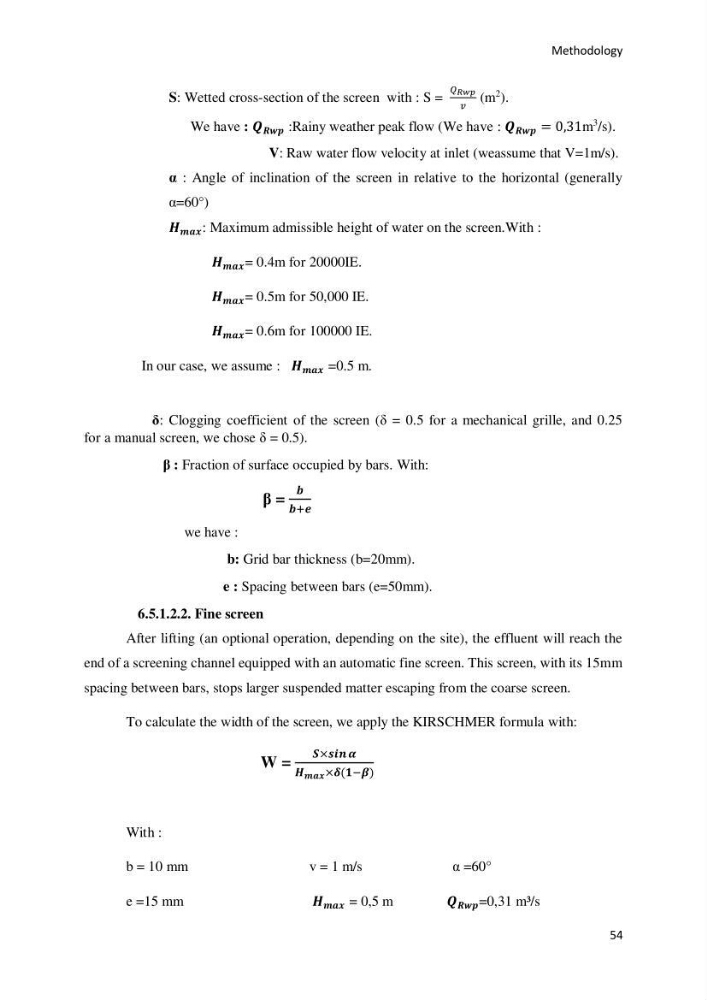
To calculate the width of the screen, we apply the KIRSCHMER formula with:
W =
í µí±º×í µí²í µí²í µí² í µí¼
í µí±¯ í µí²í µí²í µí² ×í µí¼¹(í µí¿−í µí¼·)
With :
b = 10 mm
v = 1 m/s
α =60°
e =15 mm
í µí±¯ í µí²í µí²í µí² = 0,5 m
í µí±¸ í µí±¹í µí²í µí² =0,31 m³/s
54
S: Wetted cross-section of the screen with : S =
í µí± í µí± í µí±¤í µí±
í µí±£
(m
2 ).
We have : í µí±¸ í µí±¹í µí²í µí² :Rainy weather peak flow (We have : í µí±¸ í µí±¹í µí²í µí² = 0,31m
3 /s).
V: Raw water flow velocity at inlet (weassume that V=1m/s).
α : Angle of inclination of the screen in relative to the horizontal (generally
α=60°)
í µí±¯ í µí²í µí²í µí² : Maximum admissible height of water on the screen.With :
í µí±¯ í µí²í µí²í µí² = 0.4m for 20000IE.
í µí±¯ í µí²í µí²í µí² = 0.5m for 50,000 IE.
í µí±¯ í µí²í µí²í µí² = 0.6m for 100000 IE.
In our case, we assume : í µí±¯ í µí²í µí²í µí² =0.5 m.
δ: Clogging coefficient of the screen (δ = 0.5 for a mechanical grille, and 0.25
for a manual screen, we chose δ = 0.5).
β : Fraction of surface occupied by bars. With:
β =
í µí²
í µí²+í µí²
we have :
b: Grid bar thickness (b=20mm).
e : Spacing between bars (e=50mm).
6.5.1.2.2. Fine screen
After lifting (an optional operation, depending on the site), the effluent will reach the
end of a screening channel equipped with an automatic fine screen. This screen, with its 15mm
spacing between bars, stops larger suspended matter escaping from the coarse screen.
To calculate the width of the screen, we apply the KIRSCHMER formula with:
W =
í µí±º×í µí²í µí²í µí² í µí¼
í µí±¯ í µí²í µí²í µí² ×í µí¼¹(í µí¿−í µí¼·)
With :
b = 10 mm
v = 1 m/s
α =60°
e =15 mm
í µí±¯ í µí²í µí²í µí² = 0,5 m
í µí±¸ í µí±¹í µí²í µí² =0,31 m³/s