

Methodology
48
6.3.4. Calculation of the inhabitant equivalent
The inhabitant equivalent (IE) is defined as the unit of measurement used in wastewater
treatment to assess the pollution load. It allows to standardize the various sources of pollution
by comparing it to the quantity of pollution produced by an average inhabitant. This
measurement facilitates the design and management of wastewater treatment systems.
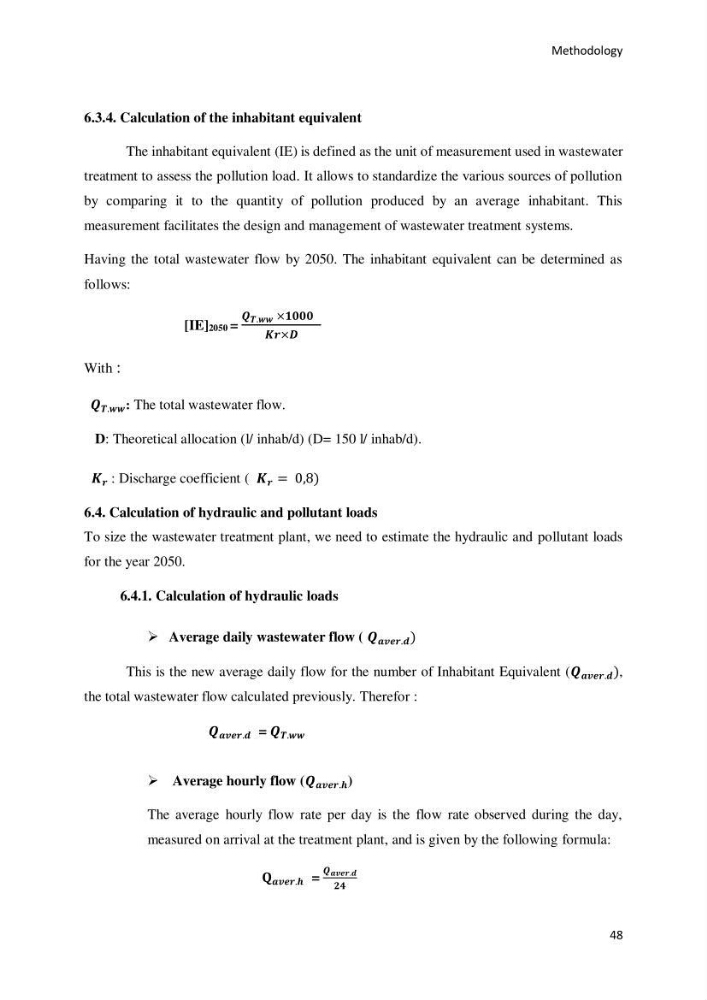
Having the total wastewater flow by 2050. The inhabitant equivalent can be determined as
follows:
[IE]2050 =
í µí±¸ í µí±».í µí²í µí² ×í µí¿í µí¿í µí¿í µí¿
í µí±²í µí²×í µí±«
With :
í µí±¸ í µí±».í µí²í µí² : The total wastewater flow.
D: Theoretical allocation (l/ inhab/d) (D= 150 l/ inhab/d).
í µí±² í µí² : Discharge coefficient ( í µí±² í µí² = 0,8)
6.4. Calculation of hydraulic and pollutant loads
To size the wastewater treatment plant, we need to estimate the hydraulic and pollutant loads
for the year 2050.
6.4.1. Calculation of hydraulic loads
Average daily wastewater flow ( í µí±¸ í µí²í µí²í µí²í µí².í µí² )
This is the new average daily flow for the number of Inhabitant Equivalent (í µí±¸ í µí²í µí²í µí²í µí².í µí² ),
the total wastewater flow calculated previously. Therefor :
í µí±¸ í µí²í µí²í µí²í µí².í µí² = í µí±¸ í µí±».í µí²í µí²
Average hourly flow (í µí±¸ í µí²í µí²í µí²í µí².í µí² )
The average hourly flow rate per day is the flow rate observed during the day,
measured on arrival at the treatment plant, and is given by the following formula:
í µí° í µí²í µí²í µí²í µí².í µí² =
í µí±¸ í µí²í µí²í µí²í µí².í µí²
í µí¿í µí¿
48
6.3.4. Calculation of the inhabitant equivalent
The inhabitant equivalent (IE) is defined as the unit of measurement used in wastewater
treatment to assess the pollution load. It allows to standardize the various sources of pollution
by comparing it to the quantity of pollution produced by an average inhabitant. This
measurement facilitates the design and management of wastewater treatment systems.
Having the total wastewater flow by 2050. The inhabitant equivalent can be determined as
follows:
[IE]2050 =
í µí±¸ í µí±».í µí²í µí² ×í µí¿í µí¿í µí¿í µí¿
í µí±²í µí²×í µí±«
With :
í µí±¸ í µí±».í µí²í µí² : The total wastewater flow.
D: Theoretical allocation (l/ inhab/d) (D= 150 l/ inhab/d).
í µí±² í µí² : Discharge coefficient ( í µí±² í µí² = 0,8)
6.4. Calculation of hydraulic and pollutant loads
To size the wastewater treatment plant, we need to estimate the hydraulic and pollutant loads
for the year 2050.
6.4.1. Calculation of hydraulic loads
Average daily wastewater flow ( í µí±¸ í µí²í µí²í µí²í µí².í µí² )
This is the new average daily flow for the number of Inhabitant Equivalent (í µí±¸ í µí²í µí²í µí²í µí².í µí² ),
the total wastewater flow calculated previously. Therefor :
í µí±¸ í µí²í µí²í µí²í µí².í µí² = í µí±¸ í µí±».í µí²í µí²
Average hourly flow (í µí±¸ í µí²í µí²í µí²í µí².í µí² )
The average hourly flow rate per day is the flow rate observed during the day,
measured on arrival at the treatment plant, and is given by the following formula:
í µí° í µí²í µí²í µí²í µí².í µí² =
í µí±¸ í µí²í µí²í µí²í µí².í µí²
í µí¿í µí¿