

Methodology
46
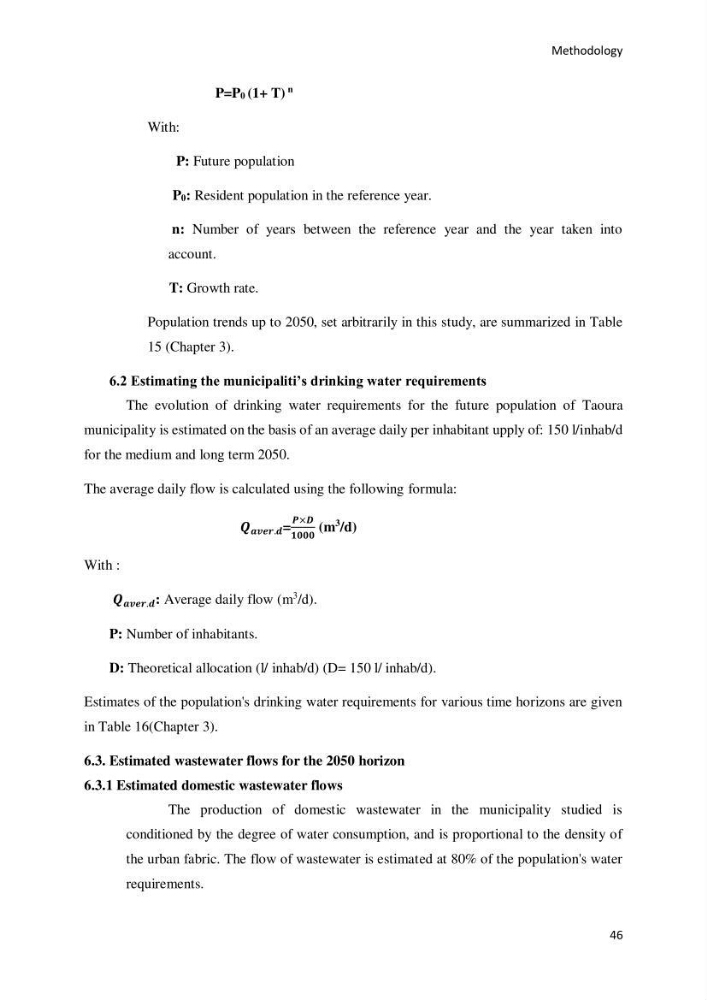
P=P0 (1+ T)
n
With:
P: Future population
P0: Resident population in the reference year.
n: Number of years between the reference year and the year taken into
account.
T: Growth rate.
Population trends up to 2050, set arbitrarily in this study, are summarized in Table
15 (Chapter 3).
6.2 Estimating the municipaliti’s drinking water requirements
The evolution of drinking water requirements for the future population of Taoura
municipality is estimated on the basis of an average daily per inhabitant upply of: 150 l/inhab/d
for the medium and long term 2050.
The average daily flow is calculated using the following formula:
í µí±¸ í µí²í µí²í µí²í µí².í µí² =
í µí±·×í µí±«
í µí¿í µí¿í µí¿í µí¿
(m
3 /d)
With :
í µí±¸ í µí²í µí²í µí²í µí².í µí² : Average daily flow (m
3 /d).
P: Number of inhabitants.
D: Theoretical allocation (l/ inhab/d) (D= 150 l/ inhab/d).
Estimates of the population's drinking water requirements for various time horizons are given
in Table 16(Chapter 3).
6.3. Estimated wastewater flows for the 2050 horizon
6.3.1 Estimated domestic wastewater flows
The production of domestic wastewater in the municipality studied is
conditioned by the degree of water consumption, and is proportional to the density of
the urban fabric. The flow of wastewater is estimated at 80% of the population's water
requirements.
46
P=P0 (1+ T)
n
With:
P: Future population
P0: Resident population in the reference year.
n: Number of years between the reference year and the year taken into
account.
T: Growth rate.
Population trends up to 2050, set arbitrarily in this study, are summarized in Table
15 (Chapter 3).
6.2 Estimating the municipaliti’s drinking water requirements
The evolution of drinking water requirements for the future population of Taoura
municipality is estimated on the basis of an average daily per inhabitant upply of: 150 l/inhab/d
for the medium and long term 2050.
The average daily flow is calculated using the following formula:
í µí±¸ í µí²í µí²í µí²í µí².í µí² =
í µí±·×í µí±«
í µí¿í µí¿í µí¿í µí¿
(m
3 /d)
With :
í µí±¸ í µí²í µí²í µí²í µí².í µí² : Average daily flow (m
3 /d).
P: Number of inhabitants.
D: Theoretical allocation (l/ inhab/d) (D= 150 l/ inhab/d).
Estimates of the population's drinking water requirements for various time horizons are given
in Table 16(Chapter 3).
6.3. Estimated wastewater flows for the 2050 horizon
6.3.1 Estimated domestic wastewater flows
The production of domestic wastewater in the municipality studied is
conditioned by the degree of water consumption, and is proportional to the density of
the urban fabric. The flow of wastewater is estimated at 80% of the population's water
requirements.