

Generalities
31
A variety of inorganic (ammonium, nitrate, nitrite and atmospheric nitrogen) and organic (urea
and glycine) forms of nitrogen could be assimilated by microalgae strains, although their
efficiencies vary according to strain and growth conditions, similarly phosphorus removal from
wastewater by these microorganisms could be a superior choice to chemical precipitation and
artificial phosphorus removal (Pizarro et al., 2006).
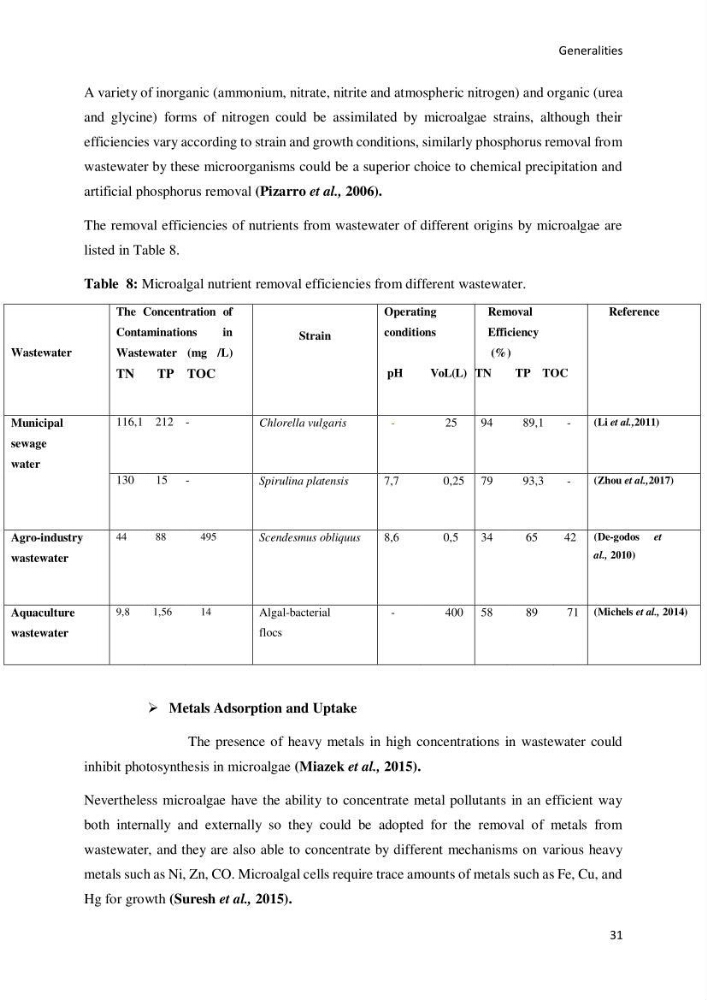
The removal efficiencies of nutrients from wastewater of different origins by microalgae are
listed in Table 8.
Table 8: Microalgal nutrient removal efficiencies from different wastewater.
Wastewater
The Concentration of
Contaminations
in
Wastewater (mg /L)
TN
TP TOC
Strain
Operating
conditions
pH
VoL(L)
Removal
Efficiency
(%)
TN
TP TOC
Reference
Municipal
sewage
water
116,1 212 -
Chlorella vulgaris
-
25
94
89,1
-
(Li et al.,2011)
130
15
-
Spirulina platensis
7,7
0,25 79
93,3
-
(Zhou et al.,2017)
Agro-industry
wastewater
44
88
495
Scendesmus obliquus
8,6
0,5
34
65
42 (De-godos et
al., 2010)
Aquaculture
wastewater
9,8
1,56
14
Algal-bacterial
flocs
-
400 58
89
71 (Michels et al., 2014)
Metals Adsorption and Uptake
The presence of heavy metals in high concentrations in wastewater could
inhibit photosynthesis in microalgae (Miazek et al., 2015).
Nevertheless microalgae have the ability to concentrate metal pollutants in an efficient way
both internally and externally so they could be adopted for the removal of metals from
wastewater, and they are also able to concentrate by different mechanisms on various heavy
metals such as Ni, Zn, CO. Microalgal cells require trace amounts of metals such as Fe, Cu, and
Hg for growth (Suresh et al., 2015).
31
A variety of inorganic (ammonium, nitrate, nitrite and atmospheric nitrogen) and organic (urea
and glycine) forms of nitrogen could be assimilated by microalgae strains, although their
efficiencies vary according to strain and growth conditions, similarly phosphorus removal from
wastewater by these microorganisms could be a superior choice to chemical precipitation and
artificial phosphorus removal (Pizarro et al., 2006).
The removal efficiencies of nutrients from wastewater of different origins by microalgae are
listed in Table 8.
Table 8: Microalgal nutrient removal efficiencies from different wastewater.
Wastewater
The Concentration of
Contaminations
in
Wastewater (mg /L)
TN
TP TOC
Strain
Operating
conditions
pH
VoL(L)
Removal
Efficiency
(%)
TN
TP TOC
Reference
Municipal
sewage
water
116,1 212 -
Chlorella vulgaris
-
25
94
89,1
-
(Li et al.,2011)
130
15
-
Spirulina platensis
7,7
0,25 79
93,3
-
(Zhou et al.,2017)
Agro-industry
wastewater
44
88
495
Scendesmus obliquus
8,6
0,5
34
65
42 (De-godos et
al., 2010)
Aquaculture
wastewater
9,8
1,56
14
Algal-bacterial
flocs
-
400 58
89
71 (Michels et al., 2014)
Metals Adsorption and Uptake
The presence of heavy metals in high concentrations in wastewater could
inhibit photosynthesis in microalgae (Miazek et al., 2015).
Nevertheless microalgae have the ability to concentrate metal pollutants in an efficient way
both internally and externally so they could be adopted for the removal of metals from
wastewater, and they are also able to concentrate by different mechanisms on various heavy
metals such as Ni, Zn, CO. Microalgal cells require trace amounts of metals such as Fe, Cu, and
Hg for growth (Suresh et al., 2015).