

Generalities
29
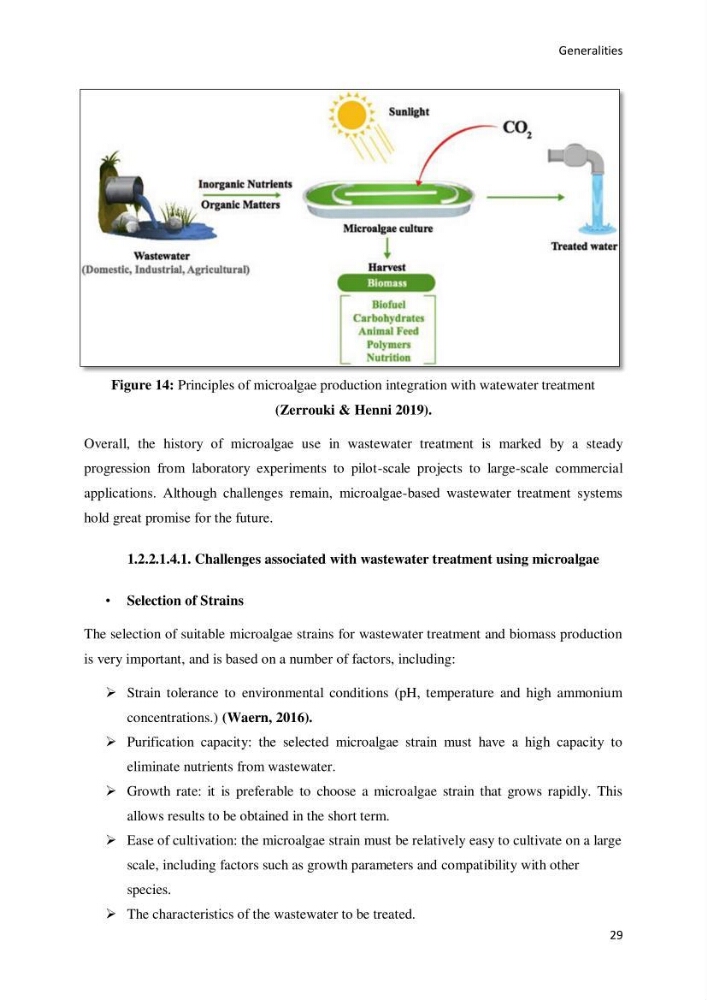
Figure 14: Principles of microalgae production integration with watewater treatment
(Zerrouki & Henni 2019).
Overall, the history of microalgae use in wastewater treatment is marked by a steady
progression from laboratory experiments to pilot-scale projects to large-scale commercial
applications. Although challenges remain, microalgae-based wastewater treatment systems
hold great promise for the future.
1.2.2.1.4.1. Challenges associated with wastewater treatment using microalgae
• Selection of Strains
The selection of suitable microalgae strains for wastewater treatment and biomass production
is very important, and is based on a number of factors, including:
Strain tolerance to environmental conditions (pH, temperature and high ammonium
concentrations.) (Waern, 2016).
Purification capacity: the selected microalgae strain must have a high capacity to
eliminate nutrients from wastewater.
Growth rate: it is preferable to choose a microalgae strain that grows rapidly. This
allows results to be obtained in the short term.
Ease of cultivation: the microalgae strain must be relatively easy to cultivate on a large
scale, including factors such as growth parameters and compatibility with other
species.
The characteristics of the wastewater to be treated.
29
Figure 14: Principles of microalgae production integration with watewater treatment
(Zerrouki & Henni 2019).
Overall, the history of microalgae use in wastewater treatment is marked by a steady
progression from laboratory experiments to pilot-scale projects to large-scale commercial
applications. Although challenges remain, microalgae-based wastewater treatment systems
hold great promise for the future.
1.2.2.1.4.1. Challenges associated with wastewater treatment using microalgae
• Selection of Strains
The selection of suitable microalgae strains for wastewater treatment and biomass production
is very important, and is based on a number of factors, including:
Strain tolerance to environmental conditions (pH, temperature and high ammonium
concentrations.) (Waern, 2016).
Purification capacity: the selected microalgae strain must have a high capacity to
eliminate nutrients from wastewater.
Growth rate: it is preferable to choose a microalgae strain that grows rapidly. This
allows results to be obtained in the short term.
Ease of cultivation: the microalgae strain must be relatively easy to cultivate on a large
scale, including factors such as growth parameters and compatibility with other
species.
The characteristics of the wastewater to be treated.