

Generalities
4
1.1. Generalities on microalgae
Photosynthetic organisms are attracting growing interest, thanks to their interesting
biological and metabolic properties. The term "microalgae" has gradually gained acceptance in
the scientific and industrial worlds. In recent years, microalgal biotechnology has become a key
area of research, enabling us to explore and exploit the enormous potential of these
microorganisms in a wide range of systems and industrial sectors.
1.1.1. Definition
Microalgae are microscopic algae ranging in size from a few microns to a hundred
microns (Cadoret & Bernard, 2008), photosynthetic, they can be unicellular or
undifferentiated multicellular. Thanks to their great adaptability and high growth rate, they
thrive in a variety of habitats, mainly in aquatic environments (Tebbani et al., 2014).
Microalgae are thallophytes, possessing chlorophyll as well as other pigments to carry out
the process of photosynthesis (Becerra, 2009), a process by which they convert light energy
from the sun into electrochemical energy to split the water molecule (with release of O2)
and synthesize organic compounds (biomass) from carbon dioxide and mineral elements
(Fischer et al., 2016), they are also considered the main primary producers of the biosphere.
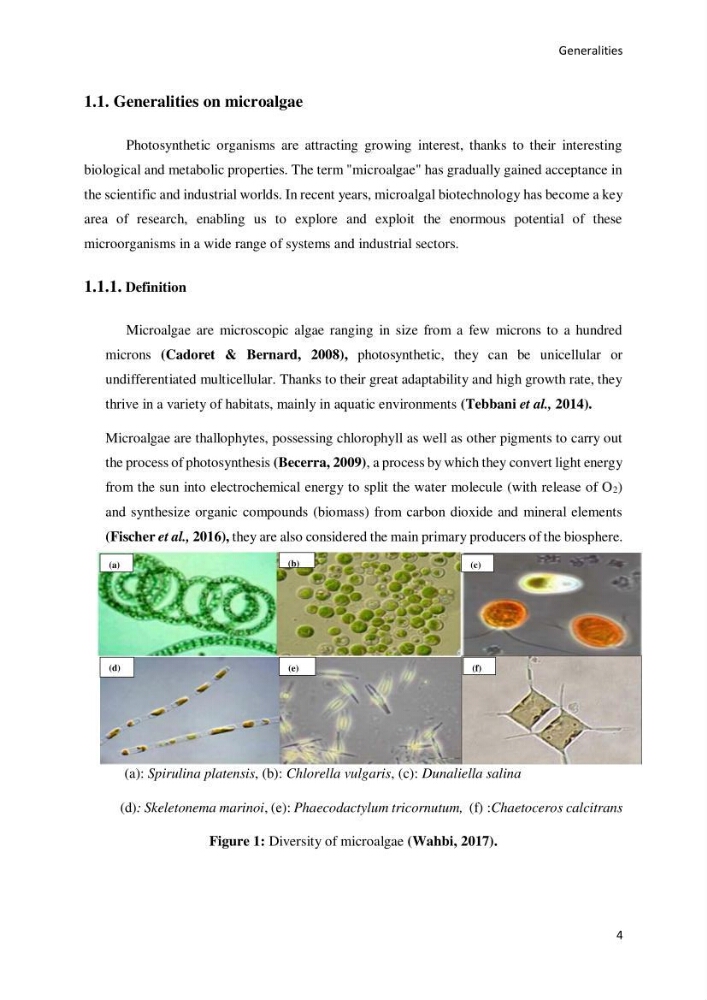
(a): Spirulina platensis, (b): Chlorella vulgaris, (c): Dunaliella salina
(d): Skeletonema marinoi, (e): Phaecodactylum tricornutum, (f) :Chaetoceros calcitrans
Figure 1: Diversity of microalgae (Wahbi, 2017).
(f)
(e)
(d)
(c)
(b)
(a)
4
1.1. Generalities on microalgae
Photosynthetic organisms are attracting growing interest, thanks to their interesting
biological and metabolic properties. The term "microalgae" has gradually gained acceptance in
the scientific and industrial worlds. In recent years, microalgal biotechnology has become a key
area of research, enabling us to explore and exploit the enormous potential of these
microorganisms in a wide range of systems and industrial sectors.
1.1.1. Definition
Microalgae are microscopic algae ranging in size from a few microns to a hundred
microns (Cadoret & Bernard, 2008), photosynthetic, they can be unicellular or
undifferentiated multicellular. Thanks to their great adaptability and high growth rate, they
thrive in a variety of habitats, mainly in aquatic environments (Tebbani et al., 2014).
Microalgae are thallophytes, possessing chlorophyll as well as other pigments to carry out
the process of photosynthesis (Becerra, 2009), a process by which they convert light energy
from the sun into electrochemical energy to split the water molecule (with release of O2)
and synthesize organic compounds (biomass) from carbon dioxide and mineral elements
(Fischer et al., 2016), they are also considered the main primary producers of the biosphere.
(a): Spirulina platensis, (b): Chlorella vulgaris, (c): Dunaliella salina
(d): Skeletonema marinoi, (e): Phaecodactylum tricornutum, (f) :Chaetoceros calcitrans
Figure 1: Diversity of microalgae (Wahbi, 2017).
(f)
(e)
(d)
(c)
(b)
(a)