

Chapter VI
Machine Learning
76
VI.4. Description of the database
The CLASH (Crest Level Assessment of Coastal Structures by full scale monitoring, neural
network prediction and Hazard Analysis on permissible wave overtopping) database is a
comprehensive collection of data on wave overtopping of coastal structures that was developed
as part of the CLASH project. One of the main objectives of this project was to develop a
prediction model for wave overtopping on a wide variety of coastal structures (De Rouck et al.
2002). This database consists of measurements collected from various laboratories worldwide
and is described in detail in Verhaeghe et al. (2003) and Steendam et al. (2004). The database
contains 10,532 entries, each described by 31 parameters. These parameters are divided into
three groups: 3 general parameters, 11 hydraulic parameters, and 17 structural parameters. The
records have also been evaluated in terms of reliability factor (RF) and complexity factor (CF).
The RF values range from 1, indicating all parameters are available and tests are highly reliable,
to 4, indicating unreliable tests with unacceptable parameter estimates and high uncertainty.
Similarly, the CF is assigned based on the complexity of the tested structure, ranging from 1 for
"very simple" structures to 4 for "very complex" structures that cannot be precisely described by
the chosen parameters.
Contents of the database
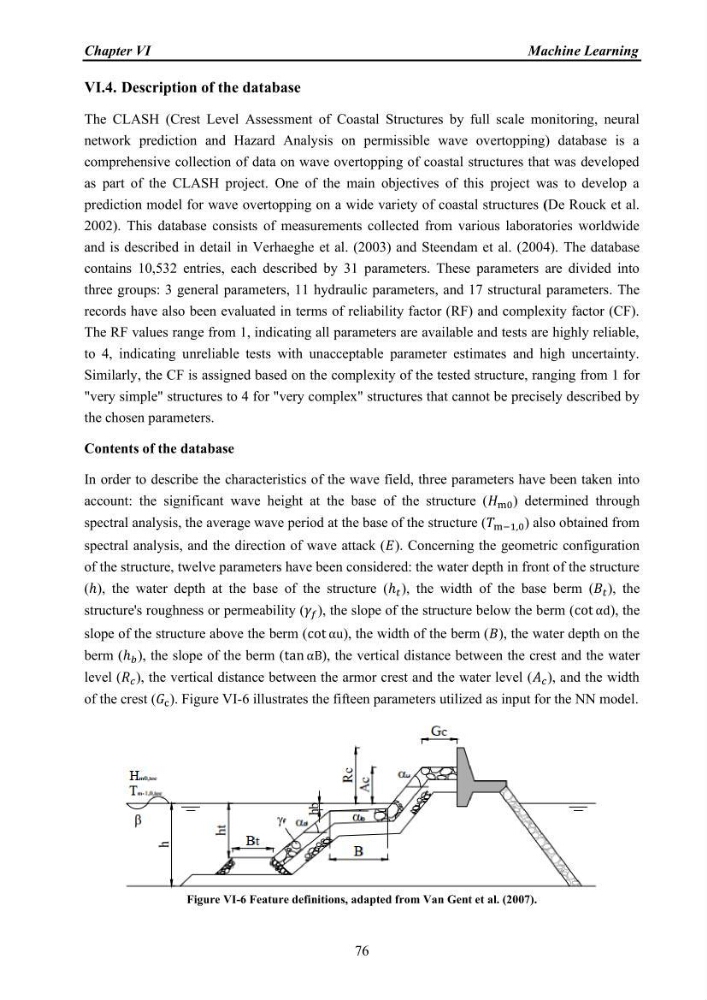
In order to describe the characteristics of the wave field, three parameters have been taken into
account: the significant wave height at the base of the structure (í µí°» m0 ) determined through
spectral analysis, the average wave period at the base of the structure (í µí± m−1,0 ) also obtained from
spectral analysis, and the direction of wave attack (í µí°¸). Concerning the geometric configuration
of the structure, twelve parameters have been considered: the water depth in front of the structure
(ℎ), the water depth at the base of the structure (ℎ í µí±¡ ), the width of the base berm (í µí°µ í µí±¡ ), the
structure's roughness or permeability (í µí»¾ í µí± ), the slope of the structure below the berm (cot αd), the
slope of the structure above the berm (cot αu), the width of the berm (í µí°µ), the water depth on the
berm (ℎ í µí± ), the slope of the berm (tan αB), the vertical distance between the crest and the water
level (í µí± í µí± ), the vertical distance between the armor crest and the water level (í µí°´ í µí± ), and the width
of the crest (í µí°º c ). Figure VI-6 illustrates the fifteen parameters utilized as input for the NN model.
Figure VI-6 Feature definitions, adapted from Van Gent et al. (2007).
Machine Learning
76
VI.4. Description of the database
The CLASH (Crest Level Assessment of Coastal Structures by full scale monitoring, neural
network prediction and Hazard Analysis on permissible wave overtopping) database is a
comprehensive collection of data on wave overtopping of coastal structures that was developed
as part of the CLASH project. One of the main objectives of this project was to develop a
prediction model for wave overtopping on a wide variety of coastal structures (De Rouck et al.
2002). This database consists of measurements collected from various laboratories worldwide
and is described in detail in Verhaeghe et al. (2003) and Steendam et al. (2004). The database
contains 10,532 entries, each described by 31 parameters. These parameters are divided into
three groups: 3 general parameters, 11 hydraulic parameters, and 17 structural parameters. The
records have also been evaluated in terms of reliability factor (RF) and complexity factor (CF).
The RF values range from 1, indicating all parameters are available and tests are highly reliable,
to 4, indicating unreliable tests with unacceptable parameter estimates and high uncertainty.
Similarly, the CF is assigned based on the complexity of the tested structure, ranging from 1 for
"very simple" structures to 4 for "very complex" structures that cannot be precisely described by
the chosen parameters.
Contents of the database
In order to describe the characteristics of the wave field, three parameters have been taken into
account: the significant wave height at the base of the structure (í µí°» m0 ) determined through
spectral analysis, the average wave period at the base of the structure (í µí± m−1,0 ) also obtained from
spectral analysis, and the direction of wave attack (í µí°¸). Concerning the geometric configuration
of the structure, twelve parameters have been considered: the water depth in front of the structure
(ℎ), the water depth at the base of the structure (ℎ í µí±¡ ), the width of the base berm (í µí°µ í µí±¡ ), the
structure's roughness or permeability (í µí»¾ í µí± ), the slope of the structure below the berm (cot αd), the
slope of the structure above the berm (cot αu), the width of the berm (í µí°µ), the water depth on the
berm (ℎ í µí± ), the slope of the berm (tan αB), the vertical distance between the crest and the water
level (í µí± í µí± ), the vertical distance between the armor crest and the water level (í µí°´ í µí± ), and the width
of the crest (í µí°º c ). Figure VI-6 illustrates the fifteen parameters utilized as input for the NN model.
Figure VI-6 Feature definitions, adapted from Van Gent et al. (2007).