

Chapter VI
Machine Learning
74
VI.3.6. Extreme Gradient Boosting (XGBoost)
Much like the previously discussed Random Forest algorithm in our study, Gradient Boosting is
an ensemble technique that constructs the final model by combining a series of weak learners,
primarily decision trees. By utilizing the gradient, it aims to minimize the loss function, which
bears resemblance to how gradient descent optimizes weights in deep learning (neural networks).
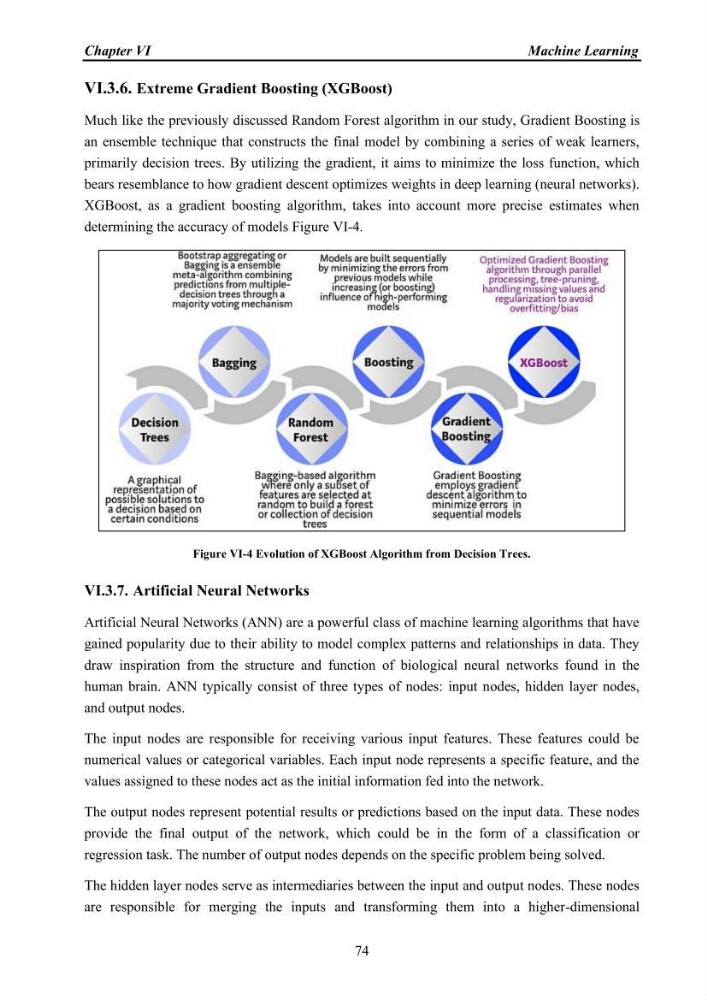
XGBoost, as a gradient boosting algorithm, takes into account more precise estimates when
determining the accuracy of models Figure VI-4.
Figure VI-4 Evolution of XGBoost Algorithm from Decision Trees.
VI.3.7. Artificial Neural Networks
Artificial Neural Networks (ANN) are a powerful class of machine learning algorithms that have
gained popularity due to their ability to model complex patterns and relationships in data. They
draw inspiration from the structure and function of biological neural networks found in the
human brain. ANN typically consist of three types of nodes: input nodes, hidden layer nodes,
and output nodes.
The input nodes are responsible for receiving various input features. These features could be
numerical values or categorical variables. Each input node represents a specific feature, and the
values assigned to these nodes act as the initial information fed into the network.
The output nodes represent potential results or predictions based on the input data. These nodes
provide the final output of the network, which could be in the form of a classification or
regression task. The number of output nodes depends on the specific problem being solved.
The hidden layer nodes serve as intermediaries between the input and output nodes. These nodes
are responsible for merging the inputs and transforming them into a higher-dimensional
Machine Learning
74
VI.3.6. Extreme Gradient Boosting (XGBoost)
Much like the previously discussed Random Forest algorithm in our study, Gradient Boosting is
an ensemble technique that constructs the final model by combining a series of weak learners,
primarily decision trees. By utilizing the gradient, it aims to minimize the loss function, which
bears resemblance to how gradient descent optimizes weights in deep learning (neural networks).
XGBoost, as a gradient boosting algorithm, takes into account more precise estimates when
determining the accuracy of models Figure VI-4.
Figure VI-4 Evolution of XGBoost Algorithm from Decision Trees.
VI.3.7. Artificial Neural Networks
Artificial Neural Networks (ANN) are a powerful class of machine learning algorithms that have
gained popularity due to their ability to model complex patterns and relationships in data. They
draw inspiration from the structure and function of biological neural networks found in the
human brain. ANN typically consist of three types of nodes: input nodes, hidden layer nodes,
and output nodes.
The input nodes are responsible for receiving various input features. These features could be
numerical values or categorical variables. Each input node represents a specific feature, and the
values assigned to these nodes act as the initial information fed into the network.
The output nodes represent potential results or predictions based on the input data. These nodes
provide the final output of the network, which could be in the form of a classification or
regression task. The number of output nodes depends on the specific problem being solved.
The hidden layer nodes serve as intermediaries between the input and output nodes. These nodes
are responsible for merging the inputs and transforming them into a higher-dimensional