

Chapter VI
Machine Learning
71
There are two main classes of machine learning supervised and unsupervised. The difference
between them lies in the way they are trained and the types of data they are used for. The first
one is based on labeled data, while the second one is based on unlabeled data.
VI.2.1. Supervised Learning
In supervised learning, the algorithm is trained on labeled data, where the correct output is
provided for each input. The goal of supervised learning is to learn a function that can accurately
map inputs to outputs based on the labeled data. There are three main types of supervised
Learning:
• Classification: This involves predicting a categorical label or class for new input data
based on the patterns learned from labeled data.
• Regression: This involves predicting a continuous numerical output for new input data.
• Forecasting: This is a special type of regression where the focus is on predicting values
over time.
VI.2.2. Unsupervised Learning
The unsupervised learning algorithm trained on unlabeled data where the correct output is not
provided. The goal of unsupervised learning is to discover patterns or relationships in the data
without any prior knowledge of what the patterns might be. Clustering and dimensionality
reduction are common tasks in unsupervised learning.
VI.3. Supervised Learning algorithms
There are several popular machine learning algorithms that are commonly used in supervised
learning. Here are some of the most common ones.
VI.3.1. Linear regression
Linear regression is a supervised learning algorithm used for predictive modeling. It involves
finding a linear relationship between the dependent variable and the independent variables. It fits
a straight line to the data points, minimizing the distance between the predicted values and the
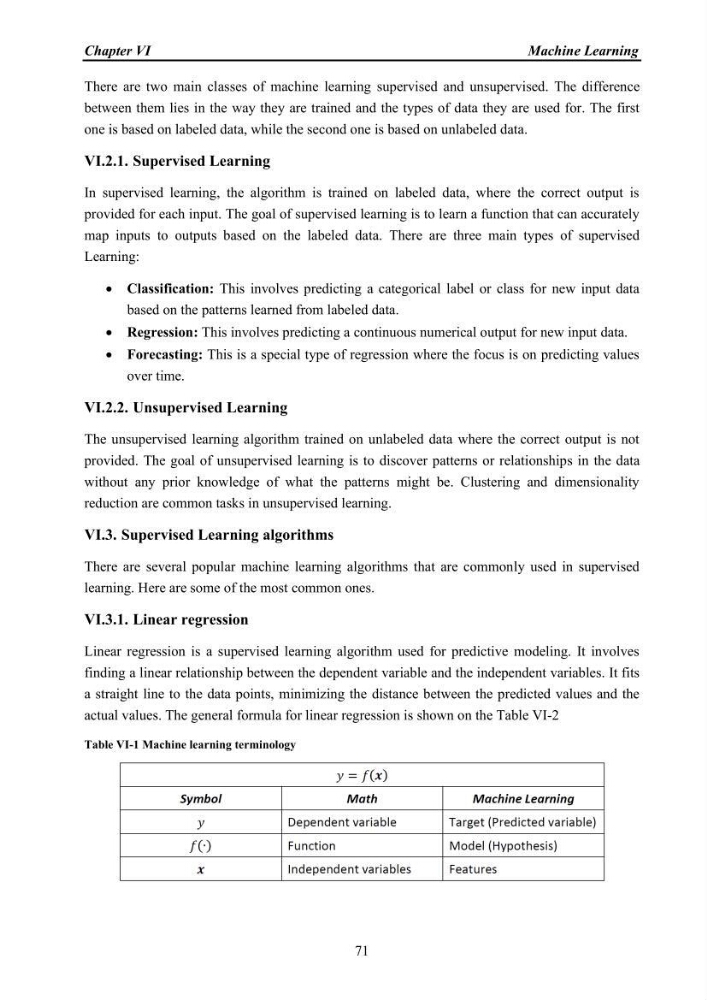
actual values. The general formula for linear regression is shown on the Table VI-2
Table VI-1 Machine learning terminology
Machine Learning
71
There are two main classes of machine learning supervised and unsupervised. The difference
between them lies in the way they are trained and the types of data they are used for. The first
one is based on labeled data, while the second one is based on unlabeled data.
VI.2.1. Supervised Learning
In supervised learning, the algorithm is trained on labeled data, where the correct output is
provided for each input. The goal of supervised learning is to learn a function that can accurately
map inputs to outputs based on the labeled data. There are three main types of supervised
Learning:
• Classification: This involves predicting a categorical label or class for new input data
based on the patterns learned from labeled data.
• Regression: This involves predicting a continuous numerical output for new input data.
• Forecasting: This is a special type of regression where the focus is on predicting values
over time.
VI.2.2. Unsupervised Learning
The unsupervised learning algorithm trained on unlabeled data where the correct output is not
provided. The goal of unsupervised learning is to discover patterns or relationships in the data
without any prior knowledge of what the patterns might be. Clustering and dimensionality
reduction are common tasks in unsupervised learning.
VI.3. Supervised Learning algorithms
There are several popular machine learning algorithms that are commonly used in supervised
learning. Here are some of the most common ones.
VI.3.1. Linear regression
Linear regression is a supervised learning algorithm used for predictive modeling. It involves
finding a linear relationship between the dependent variable and the independent variables. It fits
a straight line to the data points, minimizing the distance between the predicted values and the
actual values. The general formula for linear regression is shown on the Table VI-2
Table VI-1 Machine learning terminology