

Chapter IV
Design of rubble mounds breakwater
59
The different types of blocks used in Algiers Port and Marina
In Algiers Port and Marina, different types of blocks are utilized for construction and
stabilization purposes. Each type of block is selected based on its specific characteristics and
intended application within the port and marina.
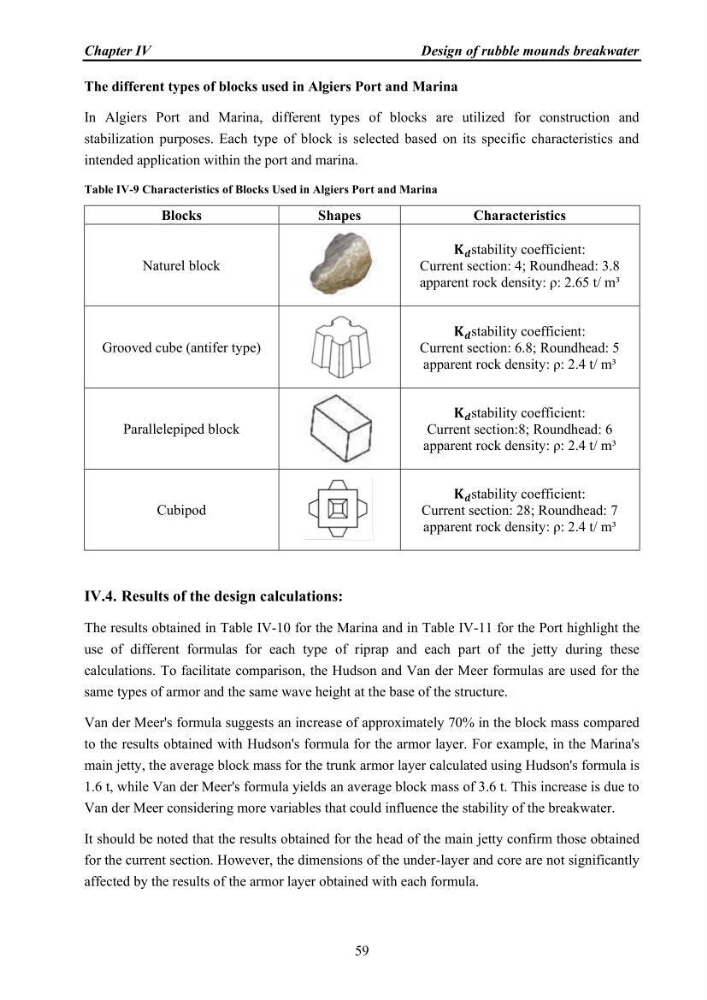
Table IV-9 Characteristics of Blocks Used in Algiers Port and Marina
Blocks
Shapes
Characteristics
Naturel block
í µí° í µí² stability coefficient:
Current section: 4; Roundhead: 3.8
apparent rock density: ρ: 2.65 t/ m³
Grooved cube (antifer type)
í µí° í µí² stability coefficient:
Current section: 6.8; Roundhead: 5
apparent rock density: ρ: 2.4 t/ m³
Parallelepiped block
í µí° í µí² stability coefficient:
Current section:8; Roundhead: 6
apparent rock density: ρ: 2.4 t/ m³
Cubipod
í µí° í µí² stability coefficient:
Current section: 28; Roundhead: 7
apparent rock density: ρ: 2.4 t/ m³
IV.4. Results of the design calculations:
The results obtained in Table IV-10 for the Marina and in Table IV-11 for the Port highlight the
use of different formulas for each type of riprap and each part of the jetty during these
calculations. To facilitate comparison, the Hudson and Van der Meer formulas are used for the
same types of armor and the same wave height at the base of the structure.
Van der Meer's formula suggests an increase of approximately 70% in the block mass compared
to the results obtained with Hudson's formula for the armor layer. For example, in the Marina's
main jetty, the average block mass for the trunk armor layer calculated using Hudson's formula is
1.6 t, while Van der Meer's formula yields an average block mass of 3.6 t. This increase is due to
Van der Meer considering more variables that could influence the stability of the breakwater.
It should be noted that the results obtained for the head of the main jetty confirm those obtained
for the current section. However, the dimensions of the under-layer and core are not significantly
affected by the results of the armor layer obtained with each formula.
Design of rubble mounds breakwater
59
The different types of blocks used in Algiers Port and Marina
In Algiers Port and Marina, different types of blocks are utilized for construction and
stabilization purposes. Each type of block is selected based on its specific characteristics and
intended application within the port and marina.
Table IV-9 Characteristics of Blocks Used in Algiers Port and Marina
Blocks
Shapes
Characteristics
Naturel block
í µí° í µí² stability coefficient:
Current section: 4; Roundhead: 3.8
apparent rock density: ρ: 2.65 t/ m³
Grooved cube (antifer type)
í µí° í µí² stability coefficient:
Current section: 6.8; Roundhead: 5
apparent rock density: ρ: 2.4 t/ m³
Parallelepiped block
í µí° í µí² stability coefficient:
Current section:8; Roundhead: 6
apparent rock density: ρ: 2.4 t/ m³
Cubipod
í µí° í µí² stability coefficient:
Current section: 28; Roundhead: 7
apparent rock density: ρ: 2.4 t/ m³
IV.4. Results of the design calculations:
The results obtained in Table IV-10 for the Marina and in Table IV-11 for the Port highlight the
use of different formulas for each type of riprap and each part of the jetty during these
calculations. To facilitate comparison, the Hudson and Van der Meer formulas are used for the
same types of armor and the same wave height at the base of the structure.
Van der Meer's formula suggests an increase of approximately 70% in the block mass compared
to the results obtained with Hudson's formula for the armor layer. For example, in the Marina's
main jetty, the average block mass for the trunk armor layer calculated using Hudson's formula is
1.6 t, while Van der Meer's formula yields an average block mass of 3.6 t. This increase is due to
Van der Meer considering more variables that could influence the stability of the breakwater.
It should be noted that the results obtained for the head of the main jetty confirm those obtained
for the current section. However, the dimensions of the under-layer and core are not significantly
affected by the results of the armor layer obtained with each formula.