

52
Chapter IV. Design of rubble mounds
breakwater
IV.1. Introduction
Coastal protection structures have the principal function of protecting the shoreline from erosion,
reducing the intensity of wave action in inshore waters, and thereby providing safe harborage.
Two different formulas will be used for the design of coastal protection structures: the Hudson
formula and the Van Der Meer formula.
In our case, we will design the rubble mound breakwaters.
IV.2. Rubble mound breakwaters
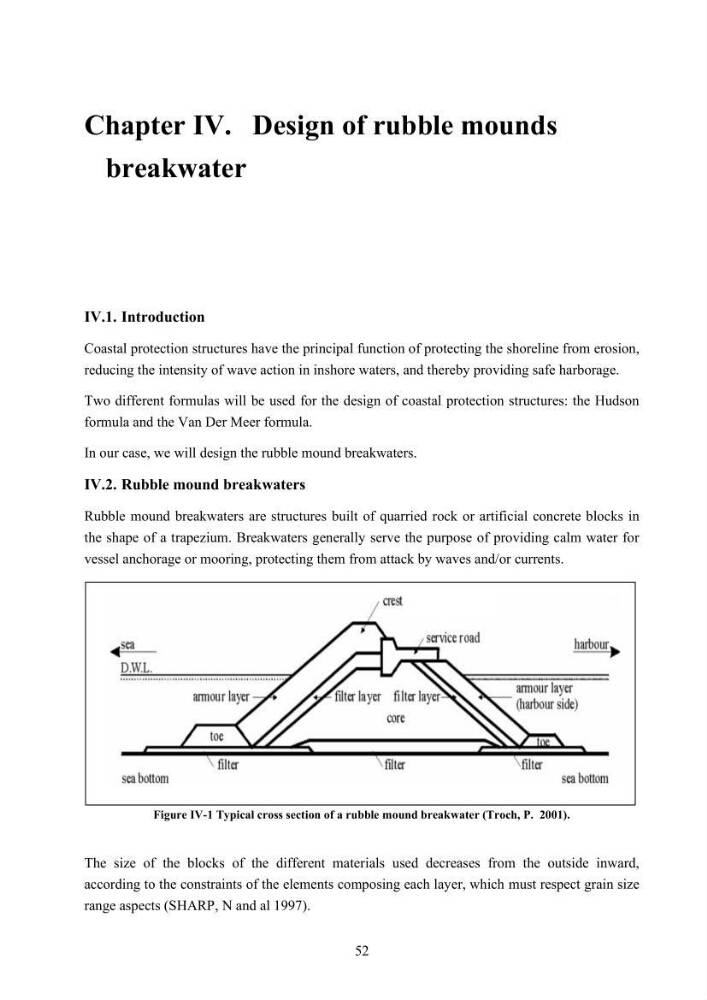
Rubble mound breakwaters are structures built of quarried rock or artificial concrete blocks in
the shape of a trapezium. Breakwaters generally serve the purpose of providing calm water for
vessel anchorage or mooring, protecting them from attack by waves and/or currents.
Figure IV-1 Typical cross section of a rubble mound breakwater (Troch, P. 2001).
The size of the blocks of the different materials used decreases from the outside inward,
according to the constraints of the elements composing each layer, which must respect grain size
range aspects (SHARP, N and al 1997).
Chapter IV. Design of rubble mounds
breakwater
IV.1. Introduction
Coastal protection structures have the principal function of protecting the shoreline from erosion,
reducing the intensity of wave action in inshore waters, and thereby providing safe harborage.
Two different formulas will be used for the design of coastal protection structures: the Hudson
formula and the Van Der Meer formula.
In our case, we will design the rubble mound breakwaters.
IV.2. Rubble mound breakwaters
Rubble mound breakwaters are structures built of quarried rock or artificial concrete blocks in
the shape of a trapezium. Breakwaters generally serve the purpose of providing calm water for
vessel anchorage or mooring, protecting them from attack by waves and/or currents.
Figure IV-1 Typical cross section of a rubble mound breakwater (Troch, P. 2001).
The size of the blocks of the different materials used decreases from the outside inward,
according to the constraints of the elements composing each layer, which must respect grain size
range aspects (SHARP, N and al 1997).