

Chapter II
Extreme Events
28
II.3. Comparison between Peak Over Threshold and Block Maxima
Our goal was to obtain more accurate and efficient results in our analysis of extreme events, so
we worked with both the POT and GEV methods. After implementing each method, we then
proceeded to compare the results of the two approaches.
In this section, our focus will be on working with the omnidirectional in order to select the most
appropriate approach for our analysis of hydraulic performance for extreme conditions in the
hydraulic performance chapter.
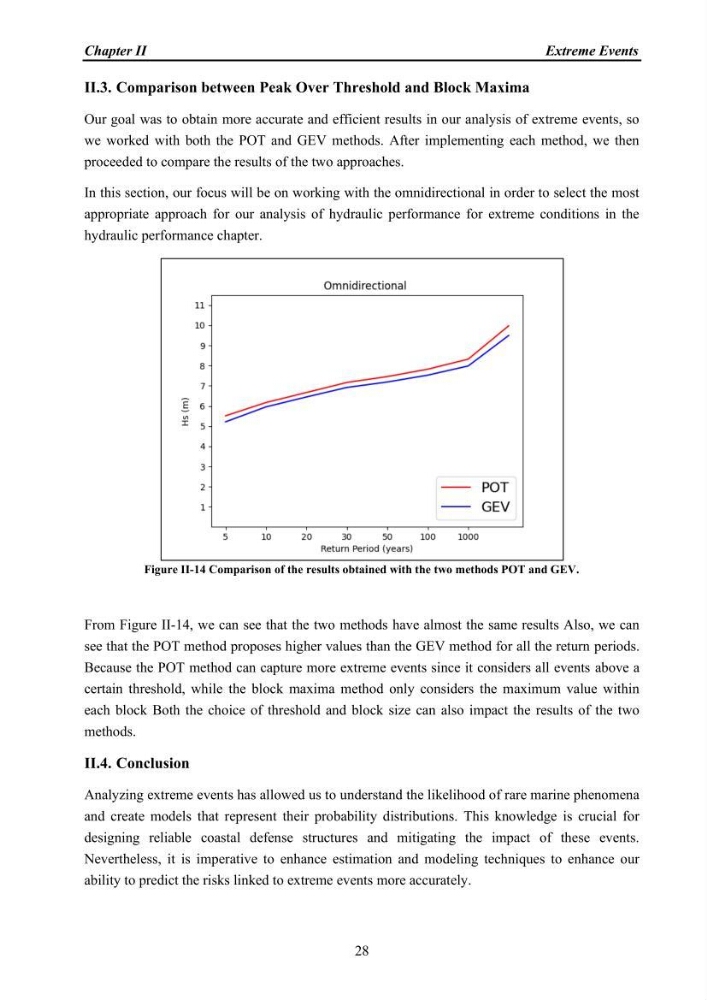
Figure II-14 Comparison of the results obtained with the two methods POT and GEV.
From Figure II-14, we can see that the two methods have almost the same results Also, we can
see that the POT method proposes higher values than the GEV method for all the return periods.
Because the POT method can capture more extreme events since it considers all events above a
certain threshold, while the block maxima method only considers the maximum value within
each block Both the choice of threshold and block size can also impact the results of the two
methods.
II.4. Conclusion
Analyzing extreme events has allowed us to understand the likelihood of rare marine phenomena
and create models that represent their probability distributions. This knowledge is crucial for
designing reliable coastal defense structures and mitigating the impact of these events.
Nevertheless, it is imperative to enhance estimation and modeling techniques to enhance our
ability to predict the risks linked to extreme events more accurately.
Extreme Events
28
II.3. Comparison between Peak Over Threshold and Block Maxima
Our goal was to obtain more accurate and efficient results in our analysis of extreme events, so
we worked with both the POT and GEV methods. After implementing each method, we then
proceeded to compare the results of the two approaches.
In this section, our focus will be on working with the omnidirectional in order to select the most
appropriate approach for our analysis of hydraulic performance for extreme conditions in the
hydraulic performance chapter.
Figure II-14 Comparison of the results obtained with the two methods POT and GEV.
From Figure II-14, we can see that the two methods have almost the same results Also, we can
see that the POT method proposes higher values than the GEV method for all the return periods.
Because the POT method can capture more extreme events since it considers all events above a
certain threshold, while the block maxima method only considers the maximum value within
each block Both the choice of threshold and block size can also impact the results of the two
methods.
II.4. Conclusion
Analyzing extreme events has allowed us to understand the likelihood of rare marine phenomena
and create models that represent their probability distributions. This knowledge is crucial for
designing reliable coastal defense structures and mitigating the impact of these events.
Nevertheless, it is imperative to enhance estimation and modeling techniques to enhance our
ability to predict the risks linked to extreme events more accurately.