

98
reserve situation in other categories, such as grazing land (Algeria and Tipaza), fishing grounds
and forests (Algiers), forest areas (Tipaza).
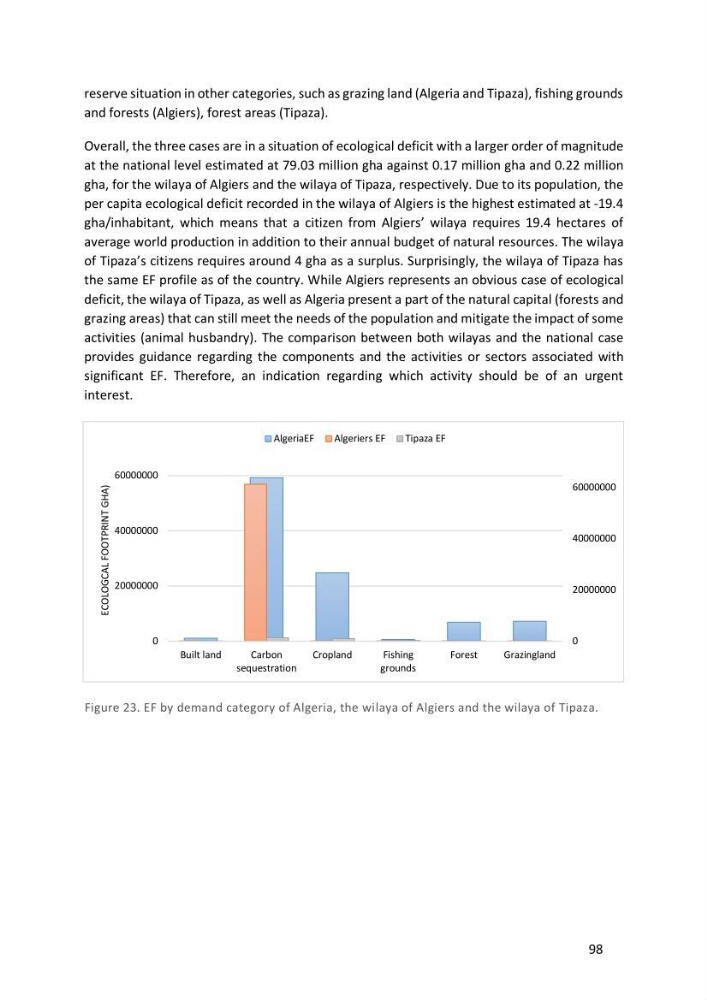
Overall, the three cases are in a situation of ecological deficit with a larger order of magnitude
at the national level estimated at 79.03 million gha against 0.17 million gha and 0.22 million
gha, for the wilaya of Algiers and the wilaya of Tipaza, respectively. Due to its population, the
per capita ecological deficit recorded in the wilaya of Algiers is the highest estimated at -19.4
gha/inhabitant, which means that a citizen from Algiers’ wilaya requires 19.4 hectares of
average world production in addition to their annual budget of natural resources. The wilaya
of Tipaza’s citizens requires around 4 gha as a surplus. Surprisingly, the wilaya of Tipaza has
the same EF profile as of the country. While Algiers represents an obvious case of ecological
deficit, the wilaya of Tipaza, as well as Algeria present a part of the natural capital (forests and
grazing areas) that can still meet the needs of the population and mitigate the impact of some
activities (animal husbandry). The comparison between both wilayas and the national case
provides guidance regarding the components and the activities or sectors associated with
significant EF. Therefore, an indication regarding which activity should be of an urgent
interest.
Figure 23. EF by demand category of Algeria, the wilaya of Algiers and the wilaya of Tipaza.
0
20000000
40000000
60000000
0
20000000
40000000
60000000
Built land
Carbon
sequestration
Cropland
Fishing
grounds
Forest
Grazingland
ECOLOGCAL FOOTPRINT GHA)
AlgeriaEF
Algeriers EF
Tipaza EF
reserve situation in other categories, such as grazing land (Algeria and Tipaza), fishing grounds
and forests (Algiers), forest areas (Tipaza).
Overall, the three cases are in a situation of ecological deficit with a larger order of magnitude
at the national level estimated at 79.03 million gha against 0.17 million gha and 0.22 million
gha, for the wilaya of Algiers and the wilaya of Tipaza, respectively. Due to its population, the
per capita ecological deficit recorded in the wilaya of Algiers is the highest estimated at -19.4
gha/inhabitant, which means that a citizen from Algiers’ wilaya requires 19.4 hectares of
average world production in addition to their annual budget of natural resources. The wilaya
of Tipaza’s citizens requires around 4 gha as a surplus. Surprisingly, the wilaya of Tipaza has
the same EF profile as of the country. While Algiers represents an obvious case of ecological
deficit, the wilaya of Tipaza, as well as Algeria present a part of the natural capital (forests and
grazing areas) that can still meet the needs of the population and mitigate the impact of some
activities (animal husbandry). The comparison between both wilayas and the national case
provides guidance regarding the components and the activities or sectors associated with
significant EF. Therefore, an indication regarding which activity should be of an urgent
interest.
Figure 23. EF by demand category of Algeria, the wilaya of Algiers and the wilaya of Tipaza.
0
20000000
40000000
60000000
0
20000000
40000000
60000000
Built land
Carbon
sequestration
Cropland
Fishing
grounds
Forest
Grazingland
ECOLOGCAL FOOTPRINT GHA)
AlgeriaEF
Algeriers EF
Tipaza EF