

85
4.2.6. Urban waste sector
The EF of waste management expresses the surface area required to sequester the GHG
emissions resulting from the manufacture of consumable products upstream of their
consumption and their deposit at the level of the LTCs or their recycling. This is based on the
tonnage of these products and their basic materials, i.e., Plastic (PET, HDPE, and PP); metal
(steel, aluminum), paper (cardboard, newsprint).
The EF of the energy of maintenance and conditioning is that consumed in the activities of
transportation and treatment of the various forms of waste (solid waste, liquid waste). Finally,
the area occupied by the landfills and the wastewater plants is used to estimate the EF_built.
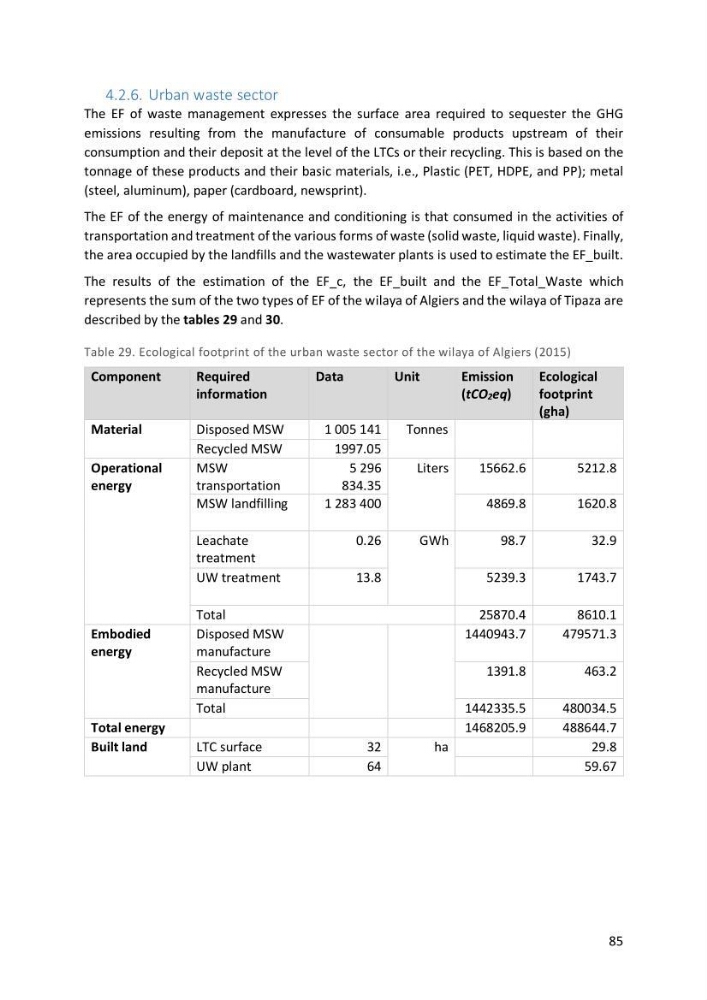
The results of the estimation of the EF_c, the EF_built and the EF_Total_Waste which
represents the sum of the two types of EF of the wilaya of Algiers and the wilaya of Tipaza are
described by the tables 29 and 30.
Table 29. Ecological footprint of the urban waste sector of the wilaya of Algiers (2015)
Component
Required
information
Data
Unit
Emission
(tCO2eq)
Ecological
footprint
(gha)
Material
Disposed MSW
1 005 141
Tonnes
Recycled MSW
1997.05
Operational
energy
MSW
transportation
5 296
834.35
Liters
15662.6
5212.8
MSW landfilling
1 283 400
4869.8
1620.8
Leachate
treatment
0.26
GWh
98.7
32.9
UW treatment
13.8
5239.3
1743.7
Total
25870.4
8610.1
Embodied
energy
Disposed MSW
manufacture
1440943.7
479571.3
Recycled MSW
manufacture
1391.8
463.2
Total
1442335.5
480034.5
Total energy
1468205.9
488644.7
Built land
LTC surface
32
ha
29.8
UW plant
64
59.67
4.2.6. Urban waste sector
The EF of waste management expresses the surface area required to sequester the GHG
emissions resulting from the manufacture of consumable products upstream of their
consumption and their deposit at the level of the LTCs or their recycling. This is based on the
tonnage of these products and their basic materials, i.e., Plastic (PET, HDPE, and PP); metal
(steel, aluminum), paper (cardboard, newsprint).
The EF of the energy of maintenance and conditioning is that consumed in the activities of
transportation and treatment of the various forms of waste (solid waste, liquid waste). Finally,
the area occupied by the landfills and the wastewater plants is used to estimate the EF_built.
The results of the estimation of the EF_c, the EF_built and the EF_Total_Waste which
represents the sum of the two types of EF of the wilaya of Algiers and the wilaya of Tipaza are
described by the tables 29 and 30.
Table 29. Ecological footprint of the urban waste sector of the wilaya of Algiers (2015)
Component
Required
information
Data
Unit
Emission
(tCO2eq)
Ecological
footprint
(gha)
Material
Disposed MSW
1 005 141
Tonnes
Recycled MSW
1997.05
Operational
energy
MSW
transportation
5 296
834.35
Liters
15662.6
5212.8
MSW landfilling
1 283 400
4869.8
1620.8
Leachate
treatment
0.26
GWh
98.7
32.9
UW treatment
13.8
5239.3
1743.7
Total
25870.4
8610.1
Embodied
energy
Disposed MSW
manufacture
1440943.7
479571.3
Recycled MSW
manufacture
1391.8
463.2
Total
1442335.5
480034.5
Total energy
1468205.9
488644.7
Built land
LTC surface
32
ha
29.8
UW plant
64
59.67