

56
3.2.1. Conversion figures
The GHG emissions resulting from energy consumption (embodied or operational) required
using LCA for the production of conversion factors.
3.2.1.1.
Fisheries sector (operational energy)
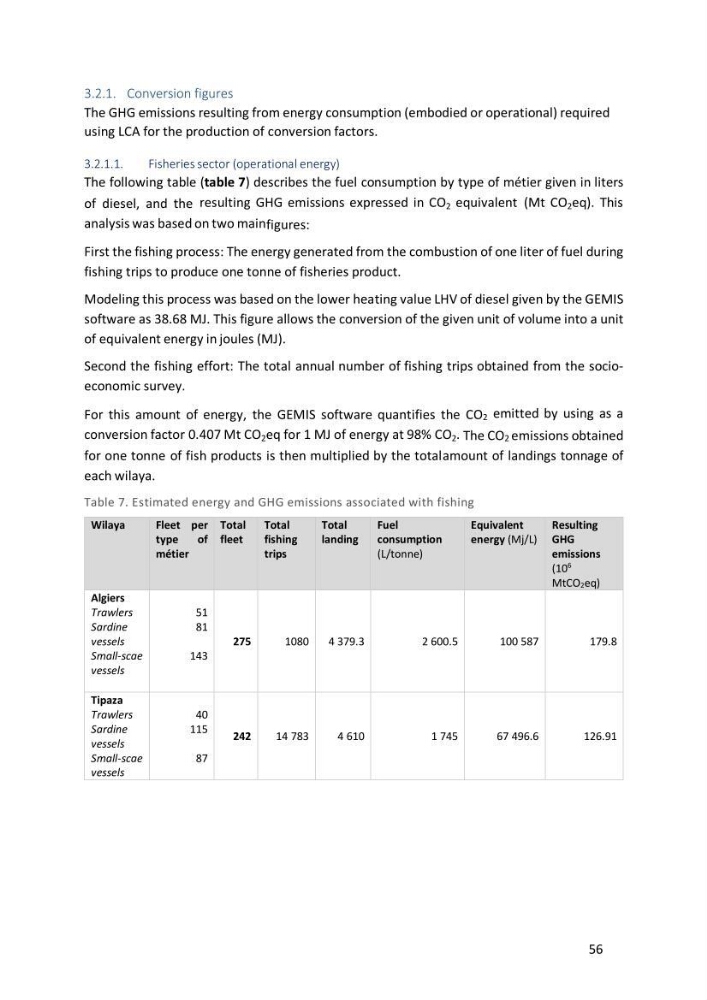
The following table (table 7) describes the fuel consumption by type of métier given in liters
of diesel, and the resulting GHG emissions expressed in CO 2 equivalent (Mt CO 2 eq). This
analysis was based on two main figures:
First the fishing process: The energy generated from the combustion of one liter of fuel during
fishing trips to produce one tonne of fisheries product.
Modeling this process was based on the lower heating value LHV of diesel given by the GEMIS
software as 38.68 MJ. This figure allows the conversion of the given unit of volume into a unit
of equivalent energy in joules (MJ).
Second the fishing effort: The total annual number of fishing trips obtained from the socioeconomic survey.
For this amount of energy, the GEMIS software quantifies the CO2 emitted by using as a
conversion factor 0.407 Mt CO 2 eq for 1 MJ of energy at 98% CO 2 . The CO2 emissions obtained
for one tonne of fish products is then multiplied by the total amount of landings tonnage of
each wilaya.
Table 7. Estimated energy and GHG emissions associated with fishing
Wilaya
Fleet per
type
of
métier
Total
fleet
Total
fishing
trips
Total
landing
Fuel
consumption
(L/tonne)
Equivalent
energy (Mj/L)
Resulting
GHG
emissions
(10
6
MtCO2eq)
Algiers
Trawlers
Sardine
vessels
Small-scae
vessels
51
81
143
275
1080
4 379.3
2 600.5
100 587
179.8
Tipaza
Trawlers
Sardine
vessels
Small-scae
vessels
40
115
87
242
14 783
4 610
1 745
67 496.6
126.91
3.2.1. Conversion figures
The GHG emissions resulting from energy consumption (embodied or operational) required
using LCA for the production of conversion factors.
3.2.1.1.
Fisheries sector (operational energy)
The following table (table 7) describes the fuel consumption by type of métier given in liters
of diesel, and the resulting GHG emissions expressed in CO 2 equivalent (Mt CO 2 eq). This
analysis was based on two main figures:
First the fishing process: The energy generated from the combustion of one liter of fuel during
fishing trips to produce one tonne of fisheries product.
Modeling this process was based on the lower heating value LHV of diesel given by the GEMIS
software as 38.68 MJ. This figure allows the conversion of the given unit of volume into a unit
of equivalent energy in joules (MJ).
Second the fishing effort: The total annual number of fishing trips obtained from the socioeconomic survey.
For this amount of energy, the GEMIS software quantifies the CO2 emitted by using as a
conversion factor 0.407 Mt CO 2 eq for 1 MJ of energy at 98% CO 2 . The CO2 emissions obtained
for one tonne of fish products is then multiplied by the total amount of landings tonnage of
each wilaya.
Table 7. Estimated energy and GHG emissions associated with fishing
Wilaya
Fleet per
type
of
métier
Total
fleet
Total
fishing
trips
Total
landing
Fuel
consumption
(L/tonne)
Equivalent
energy (Mj/L)
Resulting
GHG
emissions
(10
6
MtCO2eq)
Algiers
Trawlers
Sardine
vessels
Small-scae
vessels
51
81
143
275
1080
4 379.3
2 600.5
100 587
179.8
Tipaza
Trawlers
Sardine
vessels
Small-scae
vessels
40
115
87
242
14 783
4 610
1 745
67 496.6
126.91