

137
3.2.3. Scenario and results
Represents the combination of demand (e.g. heat, electricity, transportation) and supply
processes (e.g. heating system, power plant, and car). The scenario window also leads to a
comparison between several processes (e.g., electricity generation processes in various
countries). The classification of this category also follows specific filters.
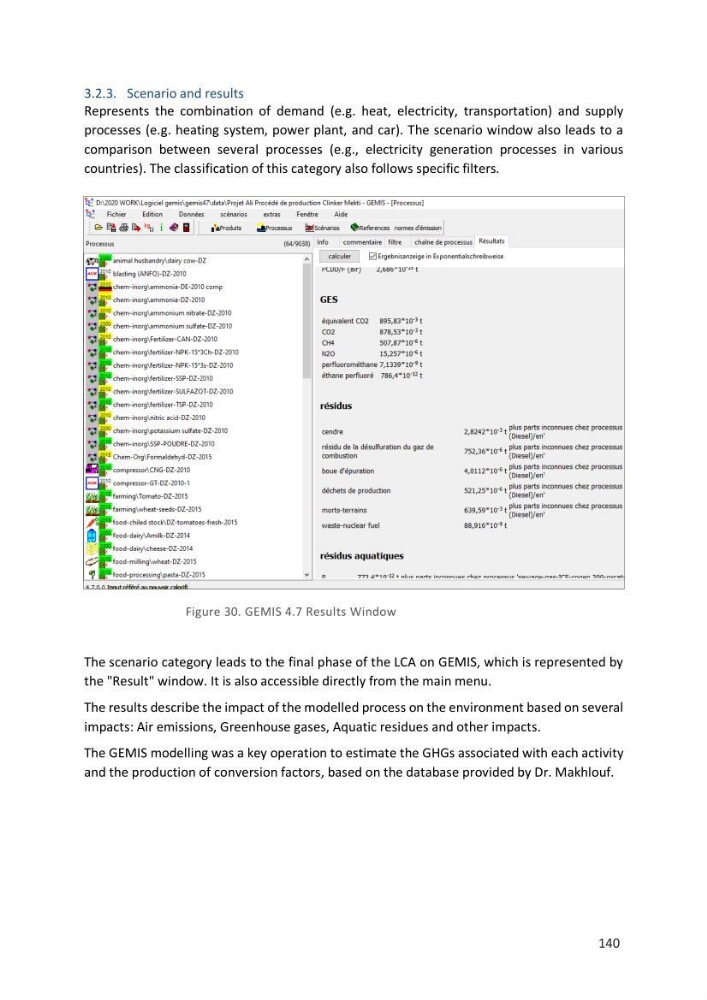
The scenario category leads to the final phase of the LCA on GEMIS, which is represented by
the "Result" window. It is also accessible directly from the main menu.
The results describe the impact of the modelled process on the environment based on several
impacts: Air emissions, Greenhouse gases, Aquatic residues and other impacts.
The GEMIS modelling was a key operation to estimate the GHGs associated with each activity
and the production of conversion factors, based on the database provided by Dr. Makhlouf.
Figure 30. GEMIS 4.7 Results Window
140
3.2.3. Scenario and results
Represents the combination of demand (e.g. heat, electricity, transportation) and supply
processes (e.g. heating system, power plant, and car). The scenario window also leads to a
comparison between several processes (e.g., electricity generation processes in various
countries). The classification of this category also follows specific filters.
The scenario category leads to the final phase of the LCA on GEMIS, which is represented by
the "Result" window. It is also accessible directly from the main menu.
The results describe the impact of the modelled process on the environment based on several
impacts: Air emissions, Greenhouse gases, Aquatic residues and other impacts.
The GEMIS modelling was a key operation to estimate the GHGs associated with each activity
and the production of conversion factors, based on the database provided by Dr. Makhlouf.
Figure 30. GEMIS 4.7 Results Window
140