

103
Furthermore, one of the most frequent limitations is the data structure and organization,
which is not standardized within the collection institutions of each sector. Indeed, the data
can be differently arranged among the management entities (EPIC NRTCOM, EPIC EXTRANET),
from one wilaya to another (DPSB Tipaza, DPSB Algiers), and for the same sector and for the
same year from one management office to another, which is the case at the level of the DPRH
of each wilaya. This case has been particularly challenging during the assessment of the fishing
EF. Considering that the PPR calculation depends on the trophic level (TL) of the harvested
species. Thus, each species has a well-defined trophic level, inventoried on Fishbase.
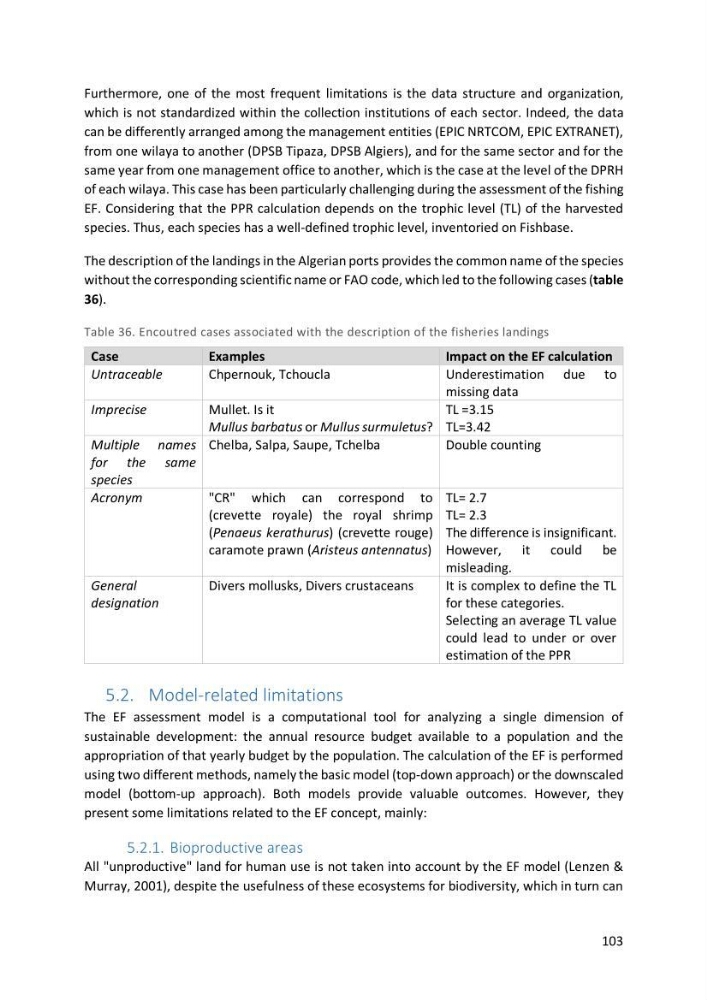
The description of the landings in the Algerian ports provides the common name of the species
without the corresponding scientific name or FAO code, which led to the following cases (table
36).
Table 36. Encoutred cases associated with the description of the fisheries landings
Case
Examples
Impact on the EF calculation
Untraceable
Chpernouk, Tchoucla
Underestimation due to
missing data
Imprecise
Mullet. Is it
Mullus barbatus or Mullus surmuletus?
TL =3.15
TL=3.42
Multiple names
for the same
species
Chelba, Salpa, Saupe, Tchelba
Double counting
Acronym
"CR" which can correspond to
(crevette royale) the royal shrimp
(Penaeus kerathurus) (crevette rouge)
caramote prawn (Aristeus antennatus)
TL= 2.7
TL= 2.3
The difference is insignificant.
However, it could be
misleading.
General
designation
Divers mollusks, Divers crustaceans
It is complex to define the TL
for these categories.
Selecting an average TL value
could lead to under or over
estimation of the PPR
5.2. Model-related limitations
The EF assessment model is a computational tool for analyzing a single dimension of
sustainable development: the annual resource budget available to a population and the
appropriation of that yearly budget by the population. The calculation of the EF is performed
using two different methods, namely the basic model (top-down approach) or the downscaled
model (bottom-up approach). Both models provide valuable outcomes. However, they
present some limitations related to the EF concept, mainly:
5.2.1. Bioproductive areas
All "unproductive" land for human use is not taken into account by the EF model (Lenzen &
Murray, 2001), despite the usefulness of these ecosystems for biodiversity, which in turn can
Furthermore, one of the most frequent limitations is the data structure and organization,
which is not standardized within the collection institutions of each sector. Indeed, the data
can be differently arranged among the management entities (EPIC NRTCOM, EPIC EXTRANET),
from one wilaya to another (DPSB Tipaza, DPSB Algiers), and for the same sector and for the
same year from one management office to another, which is the case at the level of the DPRH
of each wilaya. This case has been particularly challenging during the assessment of the fishing
EF. Considering that the PPR calculation depends on the trophic level (TL) of the harvested
species. Thus, each species has a well-defined trophic level, inventoried on Fishbase.
The description of the landings in the Algerian ports provides the common name of the species
without the corresponding scientific name or FAO code, which led to the following cases (table
36).
Table 36. Encoutred cases associated with the description of the fisheries landings
Case
Examples
Impact on the EF calculation
Untraceable
Chpernouk, Tchoucla
Underestimation due to
missing data
Imprecise
Mullet. Is it
Mullus barbatus or Mullus surmuletus?
TL =3.15
TL=3.42
Multiple names
for the same
species
Chelba, Salpa, Saupe, Tchelba
Double counting
Acronym
"CR" which can correspond to
(crevette royale) the royal shrimp
(Penaeus kerathurus) (crevette rouge)
caramote prawn (Aristeus antennatus)
TL= 2.7
TL= 2.3
The difference is insignificant.
However, it could be
misleading.
General
designation
Divers mollusks, Divers crustaceans
It is complex to define the TL
for these categories.
Selecting an average TL value
could lead to under or over
estimation of the PPR
5.2. Model-related limitations
The EF assessment model is a computational tool for analyzing a single dimension of
sustainable development: the annual resource budget available to a population and the
appropriation of that yearly budget by the population. The calculation of the EF is performed
using two different methods, namely the basic model (top-down approach) or the downscaled
model (bottom-up approach). Both models provide valuable outcomes. However, they
present some limitations related to the EF concept, mainly:
5.2.1. Bioproductive areas
All "unproductive" land for human use is not taken into account by the EF model (Lenzen &
Murray, 2001), despite the usefulness of these ecosystems for biodiversity, which in turn can