

Belcheva et al. (2015), Chandurvelan et al. (2015), and Yigit
et al. (2018).
The mussel RST showed low metal contents in comparison
with the digestive gland and gill for the studied heavy metals.
This result could be attributed to the limit ways of metals
entering into the rest of soft tissues (mantle and muscle) by
endocytosis, and the low heavy metals transport through
heamocytes to interior organs. Conversely, in few cases,
RST showed high heavy metal levels (for Cd, Pb, and Ni at
Sercouf and Cd and Pb at Algiers port). This suggested that
the decontamination of both organs gill and digestive gland
was carried out through metallothioneins proteins and/or the
high metal introduction in RST through passive diffusion,
protein of transport in membrane, pinocytosis process, and
the transfer of metals from gill and digestive gland.
Gonad revealed low metal concentrations compared with the
remainder organs for the non-essential metals (Cd and Pb),
while as for the Mn and Ni, a relative enrichment of metal
charge is observed at all sampling sites, sometimes exceeding
the concentration detected in gill and RST. This result indicates slight contribution of gamete production in the nonessential heavy metal decontamination process in mussels
(Cossa and Lassus, 1989; Wang and Fisher, 1998; Firth
et al., 2019). Furthermore, several processes intervene in metal depuration such as the defecation, the loss via the permeable
surface, passive desorption, the expulsion of granules (Phillips
and Rainbow, 1994), the synthesis of byssus (Regoli, 1992),
and shell (Cossa and Lassus 1989; Wang and Fisher 1998).
The annual mean concentrations of heavy metals in different
organs presented in Fig. 5 showed distinct distribution of
heavy metals in the organs among the sites of sampling.
Indeed, Cd was more concentrated in the gill and digestive
gland at Figuier; however, it was much concentrated in digestive gland and RST at Sercouf. At Algiers port, Cd was much
abundant in digestive gland than in gill and RST. For Pb, at
Figuier site, high similar levels were found in both organs
digestive gland and gill compared with RST and gonad.
However, at Sercouf, the gill, digestive gland, and RST had
similar level. At Algiers port, the gill followed by digestive
gland and RST showed high amount of Pb. A similar pattern
of Ni distribution in gills, digestive glands, RST, and gonads
was observed at the three sampling sites with the decreasing
abundance order of digestive gland ˃ gill ˃ RST and gonad.
The annual average Mn contents were remarkably high in the
digestive gland and low in the gill of Figuier mussels.
However, high Mn contents were found in both organs gill
and digestive gland in mussel samples at Sercouf and Algiers
port.
Heavy metal results of this investigation demonstrate clear
distinct repartition of Cd, Pb, and Mn in different organs of
mussels at Figuier (P. perna species), Sercouf, and Algiers
port sites (M. galloprovincialis species). This could be related
to the significant disparity in the mechanism of heavy metal
uptake storage and excretion due to the proper natural characteristics of each species. Furthermore, many environmental
factors such as tempefig7rature, salinity, organic matter concentration (Kumar et al. 2015), pH, and biological factors as
body size, sex, and reproductive and nutritional status of the
individual (García-Navarro et al. 2017), as well as the heavy
metal dose (Baudrimont et al. 2019), the speciation, the time
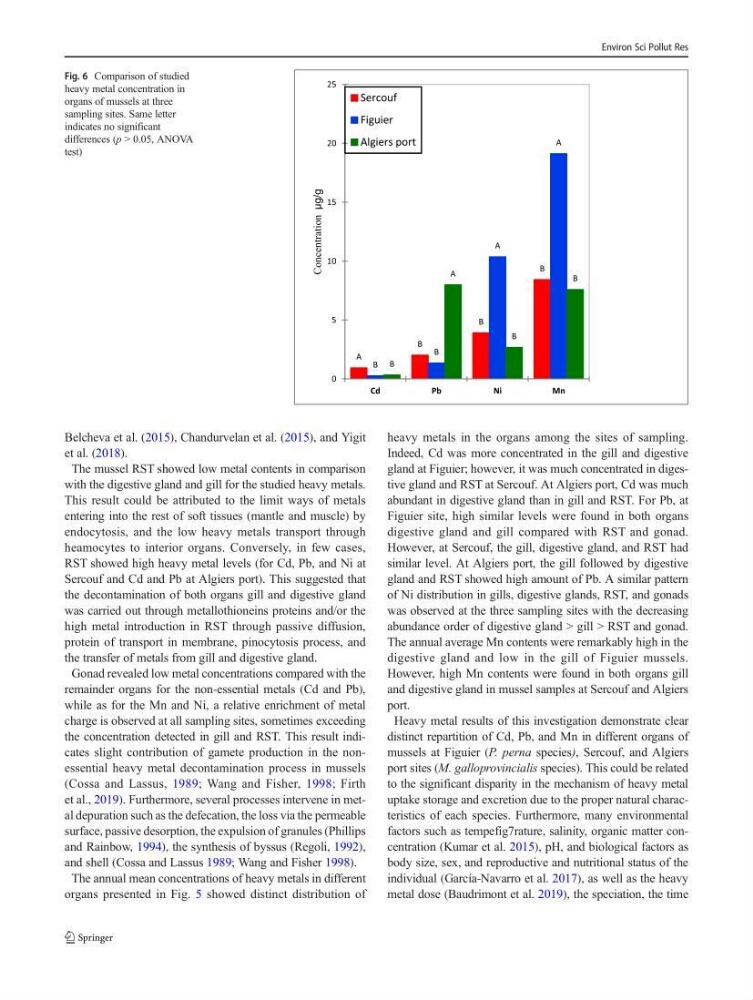
Fig. 6 Comparison of studied
heavy metal concentration in
organs of mussels at three
sampling sites. Same letter
indicates no significant
differences (p ˃ 0.05, ANOVA
test)
Environ Sci Pollut Res
et al. (2018).
The mussel RST showed low metal contents in comparison
with the digestive gland and gill for the studied heavy metals.
This result could be attributed to the limit ways of metals
entering into the rest of soft tissues (mantle and muscle) by
endocytosis, and the low heavy metals transport through
heamocytes to interior organs. Conversely, in few cases,
RST showed high heavy metal levels (for Cd, Pb, and Ni at
Sercouf and Cd and Pb at Algiers port). This suggested that
the decontamination of both organs gill and digestive gland
was carried out through metallothioneins proteins and/or the
high metal introduction in RST through passive diffusion,
protein of transport in membrane, pinocytosis process, and
the transfer of metals from gill and digestive gland.
Gonad revealed low metal concentrations compared with the
remainder organs for the non-essential metals (Cd and Pb),
while as for the Mn and Ni, a relative enrichment of metal
charge is observed at all sampling sites, sometimes exceeding
the concentration detected in gill and RST. This result indicates slight contribution of gamete production in the nonessential heavy metal decontamination process in mussels
(Cossa and Lassus, 1989; Wang and Fisher, 1998; Firth
et al., 2019). Furthermore, several processes intervene in metal depuration such as the defecation, the loss via the permeable
surface, passive desorption, the expulsion of granules (Phillips
and Rainbow, 1994), the synthesis of byssus (Regoli, 1992),
and shell (Cossa and Lassus 1989; Wang and Fisher 1998).
The annual mean concentrations of heavy metals in different
organs presented in Fig. 5 showed distinct distribution of
heavy metals in the organs among the sites of sampling.
Indeed, Cd was more concentrated in the gill and digestive
gland at Figuier; however, it was much concentrated in digestive gland and RST at Sercouf. At Algiers port, Cd was much
abundant in digestive gland than in gill and RST. For Pb, at
Figuier site, high similar levels were found in both organs
digestive gland and gill compared with RST and gonad.
However, at Sercouf, the gill, digestive gland, and RST had
similar level. At Algiers port, the gill followed by digestive
gland and RST showed high amount of Pb. A similar pattern
of Ni distribution in gills, digestive glands, RST, and gonads
was observed at the three sampling sites with the decreasing
abundance order of digestive gland ˃ gill ˃ RST and gonad.
The annual average Mn contents were remarkably high in the
digestive gland and low in the gill of Figuier mussels.
However, high Mn contents were found in both organs gill
and digestive gland in mussel samples at Sercouf and Algiers
port.
Heavy metal results of this investigation demonstrate clear
distinct repartition of Cd, Pb, and Mn in different organs of
mussels at Figuier (P. perna species), Sercouf, and Algiers
port sites (M. galloprovincialis species). This could be related
to the significant disparity in the mechanism of heavy metal
uptake storage and excretion due to the proper natural characteristics of each species. Furthermore, many environmental
factors such as tempefig7rature, salinity, organic matter concentration (Kumar et al. 2015), pH, and biological factors as
body size, sex, and reproductive and nutritional status of the
individual (García-Navarro et al. 2017), as well as the heavy
metal dose (Baudrimont et al. 2019), the speciation, the time
Fig. 6 Comparison of studied
heavy metal concentration in
organs of mussels at three
sampling sites. Same letter
indicates no significant
differences (p ˃ 0.05, ANOVA
test)
Environ Sci Pollut Res