

Application of Probability to Mechanical Design
83
The endurance strength of anodized aluminum in general is not
affected. Osgood [2.47] and Forrest [2.11] present effects of other surface
treatments.
Surface hardening of steel produces a hardened layer to resist wear and
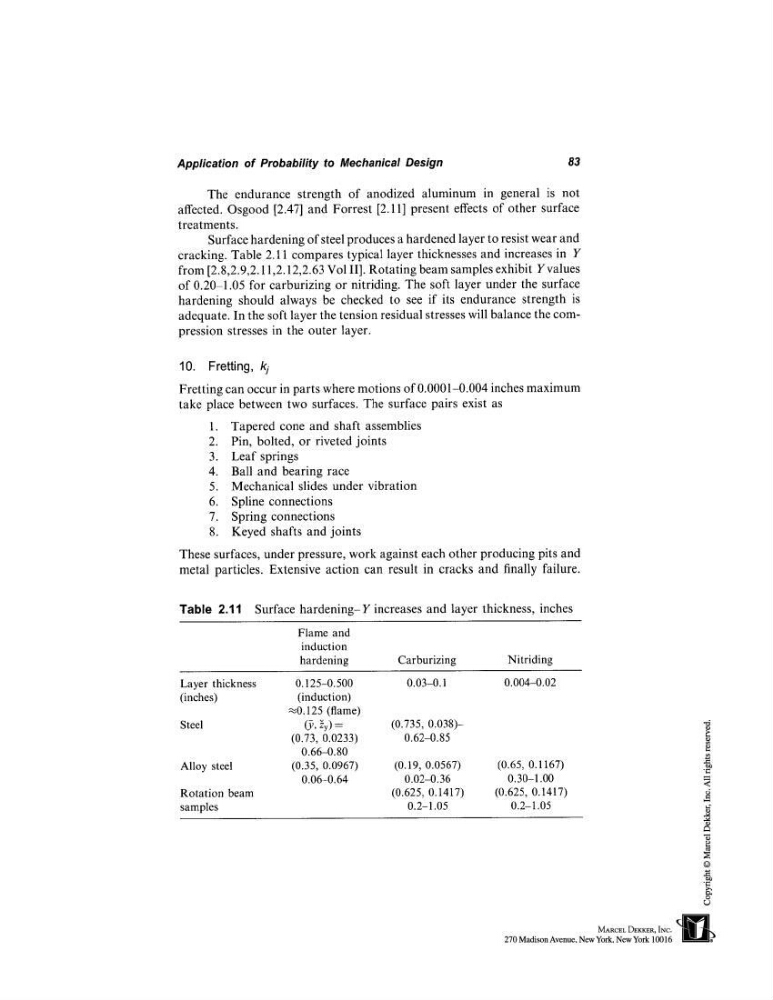
cracking. Table 2.11 compares typical layer thicknesses and increases in Y
from [2.8,2.9,2.11,2.12,2.63 Vol II]. Rotating beam samples exhibit Yvalues
of 0.20-1.05 for carburizing or nitriding. The soft layer under the surface
hardening should always be checked to see if its endurance strength is
adequate. In the soft layer the tension residual stresses will balance the compression stresses in the outer layer.
10. Frettino, /~j
Fretting can occur in parts where motions of 0.0001-0.004 inches maximum
take place between two surfaces. The surface pairs exist as
1. Tapered cone and shaft assemblies
2. Pin, bolted, or riveted joints
3. Leaf springs
4. Ball and bearing race
5. Mechanical slides under vibration
6. Spline connections
7. Spring connections
8. Keyed shafts and joints
These surfaces, under pressure, work against each other producing pits and
metal particles. Extensive action can result in cracks and finally failure.
Table 2.11 Surface hardening-Y increases and layer thickness, inches
Flame and
induction
hardening
Carburizing
Nitriding
Layer thickness
0.125-0.500
0.03-0.1
0.004-0.02
(inches)
(induction)
~0.125 (flame)
Steel
@, ~y)
(0.735, 0.038)(0.73, 0.0233)
0.62-0.85
0.66-0.80
Alloy steel
(0.35, 0.0967)
(0.19, 0.0567)
(0.65, 0.1167)
0.06-0.64
0.02-0.36
0.30-1.00
Rotation beam
(0.625, 0.1417)
(0.625, 0.1417)
samples
0.2-1.05
0.2-1.05
83
The endurance strength of anodized aluminum in general is not
affected. Osgood [2.47] and Forrest [2.11] present effects of other surface
treatments.
Surface hardening of steel produces a hardened layer to resist wear and
cracking. Table 2.11 compares typical layer thicknesses and increases in Y
from [2.8,2.9,2.11,2.12,2.63 Vol II]. Rotating beam samples exhibit Yvalues
of 0.20-1.05 for carburizing or nitriding. The soft layer under the surface
hardening should always be checked to see if its endurance strength is
adequate. In the soft layer the tension residual stresses will balance the compression stresses in the outer layer.
10. Frettino, /~j
Fretting can occur in parts where motions of 0.0001-0.004 inches maximum
take place between two surfaces. The surface pairs exist as
1. Tapered cone and shaft assemblies
2. Pin, bolted, or riveted joints
3. Leaf springs
4. Ball and bearing race
5. Mechanical slides under vibration
6. Spline connections
7. Spring connections
8. Keyed shafts and joints
These surfaces, under pressure, work against each other producing pits and
metal particles. Extensive action can result in cracks and finally failure.
Table 2.11 Surface hardening-Y increases and layer thickness, inches
Flame and
induction
hardening
Carburizing
Nitriding
Layer thickness
0.125-0.500
0.03-0.1
0.004-0.02
(inches)
(induction)
~0.125 (flame)
Steel
@, ~y)
(0.735, 0.038)(0.73, 0.0233)
0.62-0.85
0.66-0.80
Alloy steel
(0.35, 0.0967)
(0.19, 0.0567)
(0.65, 0.1167)
0.06-0.64
0.02-0.36
0.30-1.00
Rotation beam
(0.625, 0.1417)
(0.625, 0.1417)
samples
0.2-1.05
0.2-1.05