

44
Chapter 2
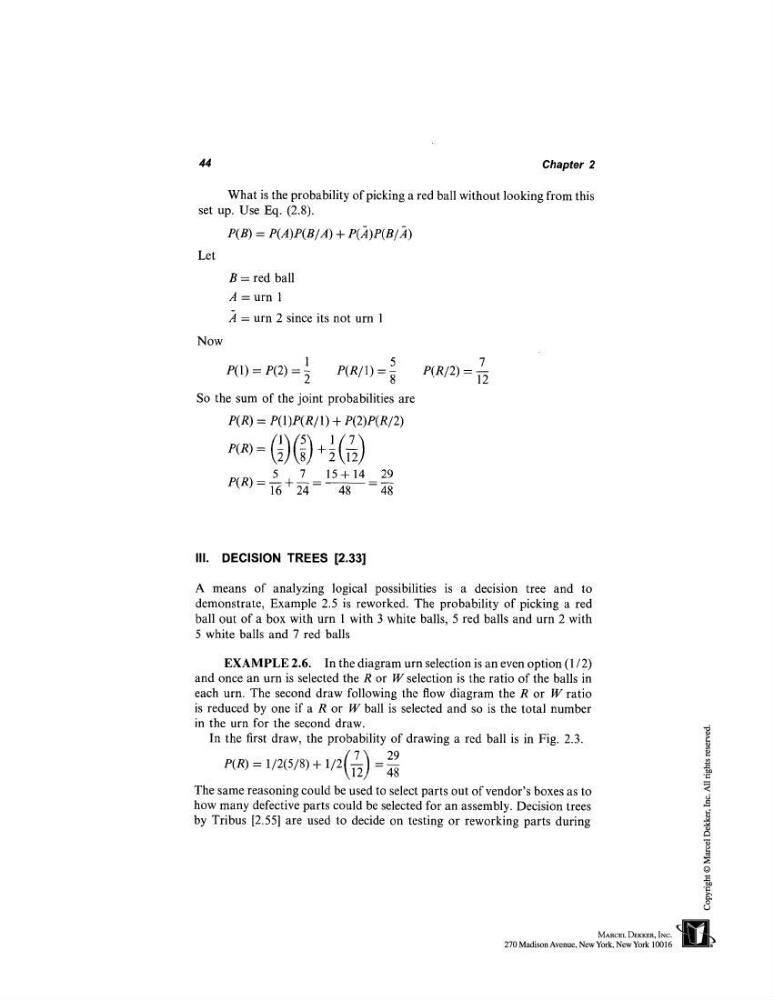
What is the probability of picking a red ball without looking from this
set up. Use Eq. (2.8).
P(B) = P(A)P(B/A) + P(~4)P(B/~4)
Let
red ball
urn 1
urn 2 since its not urn 1
Now
1
5
e(1) = P(2) P( R/ 1) = ~
So the sum of the joint probabilities are
P(R) = P(1)P(R/1) + P(2)P(R/2)
5 7 15+ 14 29
P(R) = ]-~+24-- 48 -- 48
7
P(R/2) = -(~
III. DECISION TREES [2.33]
A means of analyzing logical possibilities
is a decision tree and to
demonstrate, Example 2.5 is reworked. The probability of picking a red
ball out of a box with urn 1 with 3 white balls, 5 red balls and urn 2 with
5 white balls and 7 red balls
EXAMPLE 2.6. In the diagram urn selection is an even option (1 /2)
and once an urn is selected the R or W selection is the ratio of the balls in
each urn. The second draw following the flow diagram the R or W ratio
is reduced by one if a R or W ball is selected and so is the total number
in the urn for the second draw.
In the first draw, the probability of drawing a red ball is in Fig. 2.3.
(~2)
P(R) = 1/2(5/8)
+ 1/2 =
The same reasoning could be used to select parts out of vendor’s boxes as to
how many defective parts could be selected for an assembly. Decision trees
by Tribus [2.55] are used to decide on testing or reworking parts during
Chapter 2
What is the probability of picking a red ball without looking from this
set up. Use Eq. (2.8).
P(B) = P(A)P(B/A) + P(~4)P(B/~4)
Let
red ball
urn 1
urn 2 since its not urn 1
Now
1
5
e(1) = P(2) P( R/ 1) = ~
So the sum of the joint probabilities are
P(R) = P(1)P(R/1) + P(2)P(R/2)
5 7 15+ 14 29
P(R) = ]-~+24-- 48 -- 48
7
P(R/2) = -(~
III. DECISION TREES [2.33]
A means of analyzing logical possibilities
is a decision tree and to
demonstrate, Example 2.5 is reworked. The probability of picking a red
ball out of a box with urn 1 with 3 white balls, 5 red balls and urn 2 with
5 white balls and 7 red balls
EXAMPLE 2.6. In the diagram urn selection is an even option (1 /2)
and once an urn is selected the R or W selection is the ratio of the balls in
each urn. The second draw following the flow diagram the R or W ratio
is reduced by one if a R or W ball is selected and so is the total number
in the urn for the second draw.
In the first draw, the probability of drawing a red ball is in Fig. 2.3.
(~2)
P(R) = 1/2(5/8)
+ 1/2 =
The same reasoning could be used to select parts out of vendor’s boxes as to
how many defective parts could be selected for an assembly. Decision trees
by Tribus [2.55] are used to decide on testing or reworking parts during