

Appendix G
Software Considerations
I. DATA REDUCTION
SAS (Statistical
Analysis System, Cory NC) was used exclusively in the
development of the examples in this book. However, SAS is not the only
software package that yields successful results.
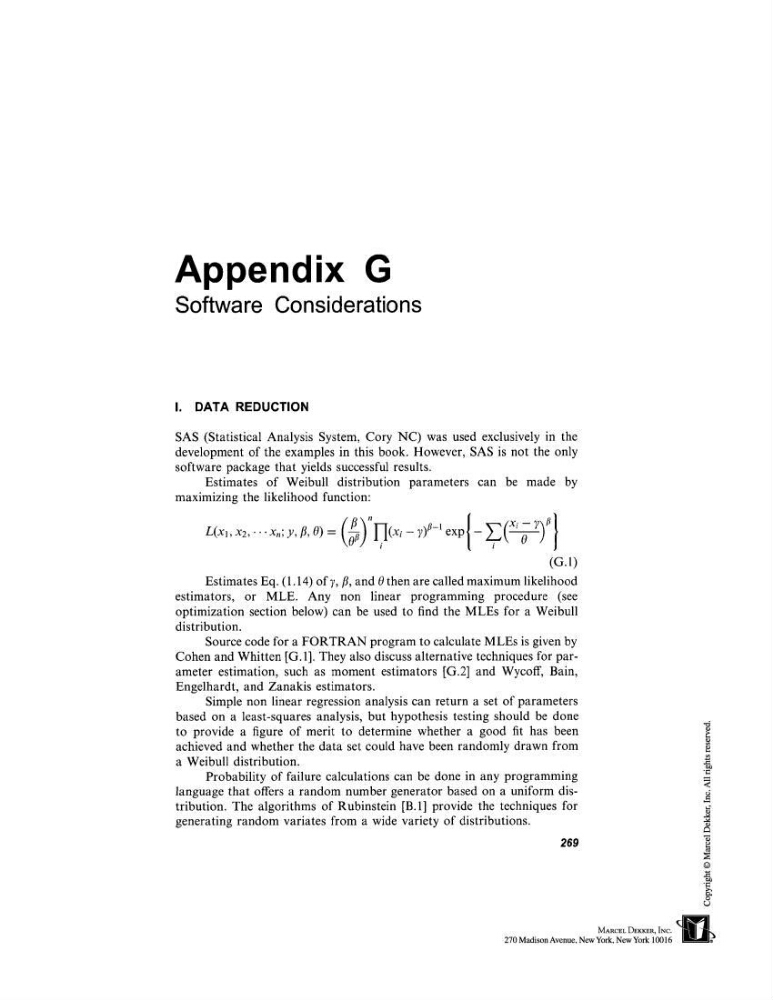
Estimates of Weibull distribution
parameters can be made by
maximizing the likelihood function:
L(Xl, x2, " " x,; y, #, O) = ~ I-l(xi _ y)t~-~ exp -
"
(G.1)
Estimates Eq. (1.14) of y, ¢/, and 0 then are called maximum likelihood
estimators,
or MLE. Any non linear programming procedure (see
optimization section below) can be used to find the MLEs for a Weibull
distribution.
Source code for a FORTRAN program to calculate MLEs is given by
Cohen and Whitten [G. 1]. They also discuss alternative techniques for parameter estimation, such as moment estimators [G.2] and Wycoff, Bain,
Engelhardt, and Zanakis estimators.
Simple non linear regression analysis can return a set of parameters
based on a least-squares analysis, but hypothesis testing should be done
to provide a figure of merit to determine whether a good fit has been
achieved and whether the data set could have been randomly drawn from
a Weibull distribution.
Probability of failure calculations can be done in any programming
language that offers a random nmber generator based on a uniform distribution. The algorithms of Rubinstein [B.1] provide the techniques for
generating random variates from a wide variety of distributions.
269
Software Considerations
I. DATA REDUCTION
SAS (Statistical
Analysis System, Cory NC) was used exclusively in the
development of the examples in this book. However, SAS is not the only
software package that yields successful results.
Estimates of Weibull distribution
parameters can be made by
maximizing the likelihood function:
L(Xl, x2, " " x,; y, #, O) = ~ I-l(xi _ y)t~-~ exp -
"
(G.1)
Estimates Eq. (1.14) of y, ¢/, and 0 then are called maximum likelihood
estimators,
or MLE. Any non linear programming procedure (see
optimization section below) can be used to find the MLEs for a Weibull
distribution.
Source code for a FORTRAN program to calculate MLEs is given by
Cohen and Whitten [G. 1]. They also discuss alternative techniques for parameter estimation, such as moment estimators [G.2] and Wycoff, Bain,
Engelhardt, and Zanakis estimators.
Simple non linear regression analysis can return a set of parameters
based on a least-squares analysis, but hypothesis testing should be done
to provide a figure of merit to determine whether a good fit has been
achieved and whether the data set could have been randomly drawn from
a Weibull distribution.
Probability of failure calculations can be done in any programming
language that offers a random nmber generator based on a uniform distribution. The algorithms of Rubinstein [B.1] provide the techniques for
generating random variates from a wide variety of distributions.
269