

194
Chapter 4
As an example: telephone equipment for underwater Atlantic phone
cables have been tested for a 20 years burn in so that the remaining 20 years
life at lower constant rate failure is available.
From another standpoint,
assume that chance or random events
(failures) are most likely to cause unreliability. If these chance or random
events have a small probability
of occurrence in a large number of
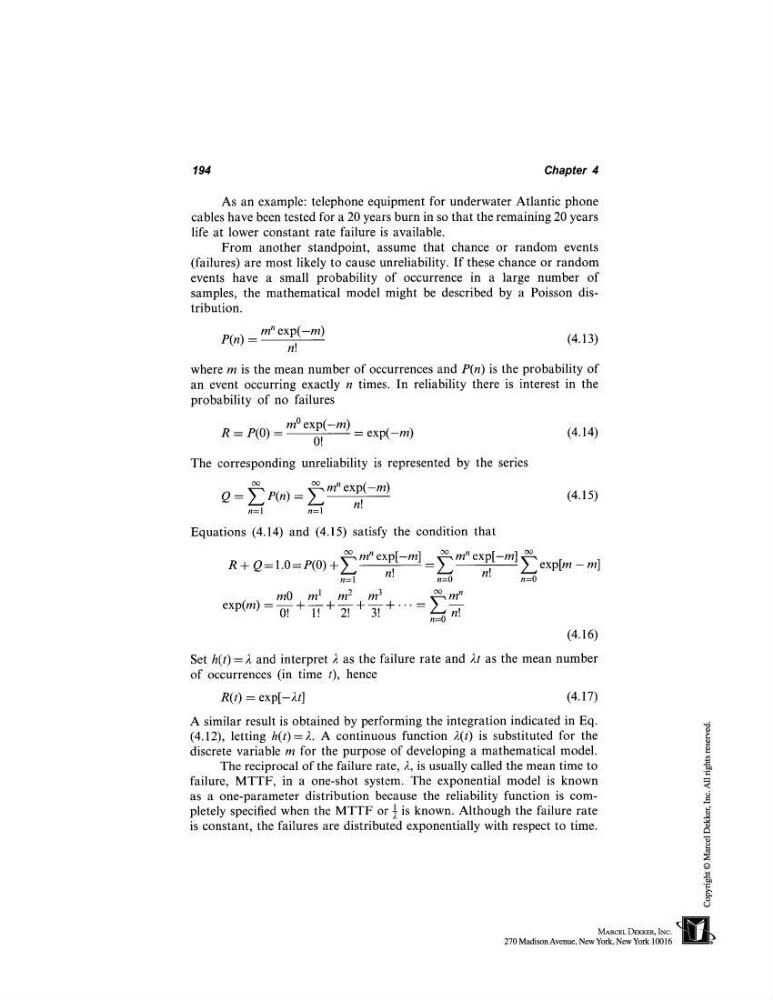
samples, the mathematical model might be described by a Poisson distribution.
m ~ exp(-m)
(4.13)
P(n)
n!
where rn is the mean number of occurrences and P(n) is the probability of
an event occurring exactly n times. In reliability there is interest in the
probability of no failures
m ° exp(-m)
R = P(0) -
0!
-- exp(-m)
(4.14)
The corresponding unreliability is represented by the series
~
oo m ~ exp(-m)
(4.15)
e-- Z .,
n=l
n=l
Equations (4.14) and (4.15) satisfy the condition
R + Q = 1.0 = P(0) +
-
~.~
2_, exp[m - m]
n=l
n=0
n=0
m0 m 1
m 2 m 3
~ n
exp(m) = ~ + ~ + ~ + ~ + ....
~
(4.16)
Set h(t)--2 and interpret 2 as the failure rate and 2t as the mean number
of occurrences (in time t), hence
R(t) = exp[-2t]
(4.17)
A similar result is obtained by performing the integration indicated in Eq.
(4.12), letting h(t)=2. A continuous function 2(0 is substituted for
discrete variable m for the purpose of developing a mathematical model.
The reciprocal of the failure rate, 2, is usually called the mean time to
failure, MTTF, in a one-shot system. The exponential model is known
as a one-parameter distribution because the reliability function is completely specified when the MTTF or ½ is known. Although the failure rate
is constant, the failures are distributed exponentially with respect to time.
Chapter 4
As an example: telephone equipment for underwater Atlantic phone
cables have been tested for a 20 years burn in so that the remaining 20 years
life at lower constant rate failure is available.
From another standpoint,
assume that chance or random events
(failures) are most likely to cause unreliability. If these chance or random
events have a small probability
of occurrence in a large number of
samples, the mathematical model might be described by a Poisson distribution.
m ~ exp(-m)
(4.13)
P(n)
n!
where rn is the mean number of occurrences and P(n) is the probability of
an event occurring exactly n times. In reliability there is interest in the
probability of no failures
m ° exp(-m)
R = P(0) -
0!
-- exp(-m)
(4.14)
The corresponding unreliability is represented by the series
~
oo m ~ exp(-m)
(4.15)
e-- Z .,
n=l
n=l
Equations (4.14) and (4.15) satisfy the condition
R + Q = 1.0 = P(0) +
-
~.~
2_, exp[m - m]
n=l
n=0
n=0
m0 m 1
m 2 m 3
~ n
exp(m) = ~ + ~ + ~ + ~ + ....
~
(4.16)
Set h(t)--2 and interpret 2 as the failure rate and 2t as the mean number
of occurrences (in time t), hence
R(t) = exp[-2t]
(4.17)
A similar result is obtained by performing the integration indicated in Eq.
(4.12), letting h(t)=2. A continuous function 2(0 is substituted for
discrete variable m for the purpose of developing a mathematical model.
The reciprocal of the failure rate, 2, is usually called the mean time to
failure, MTTF, in a one-shot system. The exponential model is known
as a one-parameter distribution because the reliability function is completely specified when the MTTF or ½ is known. Although the failure rate
is constant, the failures are distributed exponentially with respect to time.