

Optimum Design
177
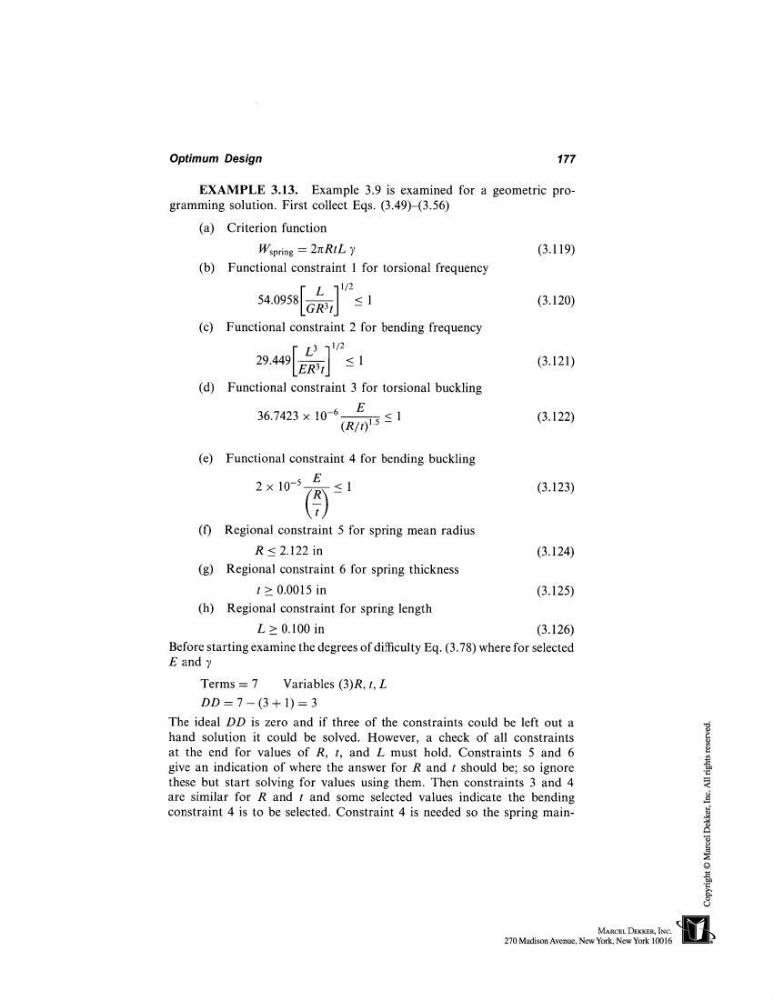
EXAMPLE 3.13.
gramming solution. First collect Eqs. (3.49)-(3.56)
(a) Criterion function
Wspring = 2~RtL 3;
(3.119)
(b) Functional constraint 1 for torsional frequency
[- L -]1/2
54.0958 [~-~J 51
(3.120)
(c) Functional constraint 2 for bending frequency
29.449
~ < 1
(3.121)
(d) Functional constraint 3 for torsional buckling
36.7423 x 10 .6 E
-< 1
(3.122)
(1~/t)~.5
Example 3.9 is examined for a geometric pro(e) Functional constraint 4 for bending buckling
2 × 10 -5 .E. < 1
(3.123)
(f) Regional constraint 5 for spring mean radius
R _< 2.122 in
(3.124)
(g) Regional constraint 6 for spring thickness
t > 0.0015 in
(3.125)
(h) Regional constraint for spring length
L >_ 0.100 in
(3.126)
Before starting examine the degrees of difficulty Eq. (3.78) where for selected
E and 7
Terms = 7
Variables (3)R, t,
DD---- 7- (3 + t) =
The ideal DD is zero and if three of the constraints could be left out a
hand solution it could be solved. However, a check of all constraints
at the end for values of R, t, and L must hold. Constraints 5 and 6
give an indication of where the answer for R and t should be; so ignore
these but start solving for values using them. Then constraints 3 and 4
are similar for R and t and some selected values indicate the bending
constraint 4 is to be selected. Constraint 4 is needed so the spring main-
177
EXAMPLE 3.13.
gramming solution. First collect Eqs. (3.49)-(3.56)
(a) Criterion function
Wspring = 2~RtL 3;
(3.119)
(b) Functional constraint 1 for torsional frequency
[- L -]1/2
54.0958 [~-~J 51
(3.120)
(c) Functional constraint 2 for bending frequency
29.449
~ < 1
(3.121)
(d) Functional constraint 3 for torsional buckling
36.7423 x 10 .6 E
-< 1
(3.122)
(1~/t)~.5
Example 3.9 is examined for a geometric pro(e) Functional constraint 4 for bending buckling
2 × 10 -5 .E. < 1
(3.123)
(f) Regional constraint 5 for spring mean radius
R _< 2.122 in
(3.124)
(g) Regional constraint 6 for spring thickness
t > 0.0015 in
(3.125)
(h) Regional constraint for spring length
L >_ 0.100 in
(3.126)
Before starting examine the degrees of difficulty Eq. (3.78) where for selected
E and 7
Terms = 7
Variables (3)R, t,
DD---- 7- (3 + t) =
The ideal DD is zero and if three of the constraints could be left out a
hand solution it could be solved. However, a check of all constraints
at the end for values of R, t, and L must hold. Constraints 5 and 6
give an indication of where the answer for R and t should be; so ignore
these but start solving for values using them. Then constraints 3 and 4
are similar for R and t and some selected values indicate the bending
constraint 4 is to be selected. Constraint 4 is needed so the spring main-