

160
Chapter 3
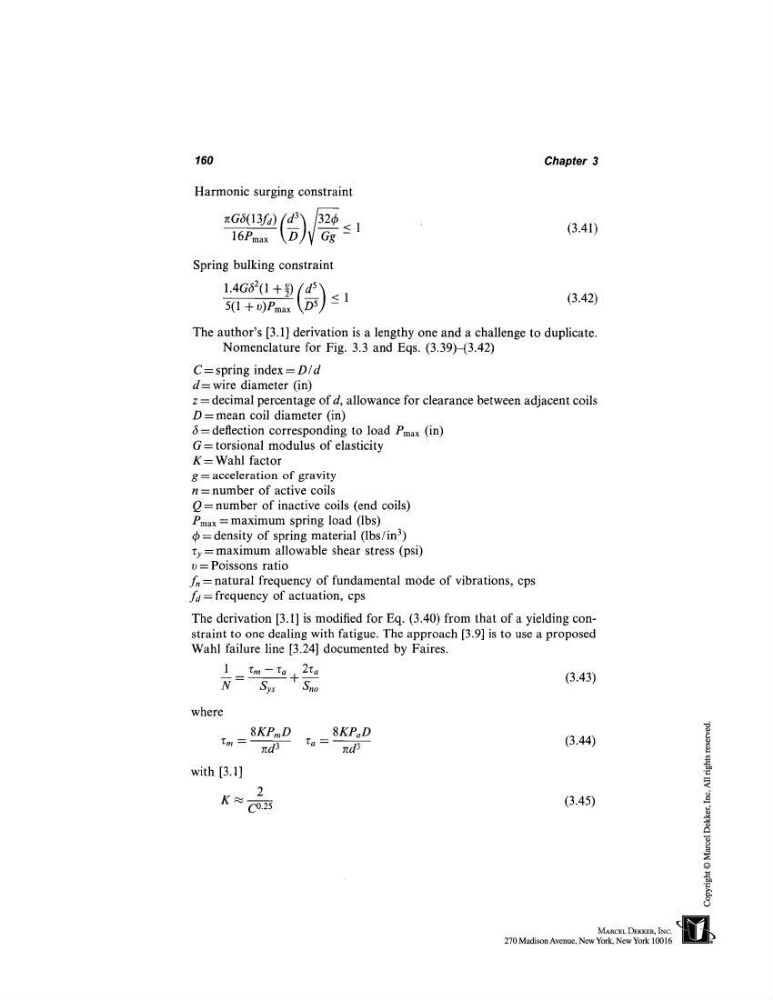
Harmonic surging constraint
~,/V--~g < 1
(3.41)
Spring bulking constraint
1.4G62(l +~) ’)
5(1 + o)emax ~-~ < 1
(3.42)
The author’s [3.1] derivation is a lengthy one and a challenge to duplicate.
Nomenclature for Fig. 3.3 and Eqs. (3.39)-(3.42)
C = spring index = D/d
d= wire diameter (in)
z = decimal percentage of d, allowance for clearance between adjacent coils
D = mean coil diameter (in)
3 = deflection corresponding to load ernax (in)
G = torsional modulus of elasticity
K = Wahl factor
g = acceleration of gravity
n = number of active coils
Q = number of inactive coils (end coils)
Pmax = maximum spring load (lbs)
~b = density of spring material (lbs/in
3)
~y = maximum allowable shear stress (psi)
v = Poissons ratio
f~ = natural frequency of fundamental mode of vibrations, cps
fa = frequency of actuation, cps
The derivation [3.1] is modified for Eq. (3.40) from that of a yielding constraint to one dealing with fatigue. The approach [3.9] is to use a proposed
Wahl failure line [3.24] documented by Faires.
1 Zm -- "Ca 2"Ca
¢
(3.43)
N
Sy s
Sno
where
with [3.1]
8KPmD
8KP,~D
red3
"ca-- ~zd3
(3.44)
2
C0.25
(3.45)
Chapter 3
Harmonic surging constraint
~,/V--~g < 1
(3.41)
Spring bulking constraint
1.4G62(l +~) ’)
5(1 + o)emax ~-~ < 1
(3.42)
The author’s [3.1] derivation is a lengthy one and a challenge to duplicate.
Nomenclature for Fig. 3.3 and Eqs. (3.39)-(3.42)
C = spring index = D/d
d= wire diameter (in)
z = decimal percentage of d, allowance for clearance between adjacent coils
D = mean coil diameter (in)
3 = deflection corresponding to load ernax (in)
G = torsional modulus of elasticity
K = Wahl factor
g = acceleration of gravity
n = number of active coils
Q = number of inactive coils (end coils)
Pmax = maximum spring load (lbs)
~b = density of spring material (lbs/in
3)
~y = maximum allowable shear stress (psi)
v = Poissons ratio
f~ = natural frequency of fundamental mode of vibrations, cps
fa = frequency of actuation, cps
The derivation [3.1] is modified for Eq. (3.40) from that of a yielding constraint to one dealing with fatigue. The approach [3.9] is to use a proposed
Wahl failure line [3.24] documented by Faires.
1 Zm -- "Ca 2"Ca
¢
(3.43)
N
Sy s
Sno
where
with [3.1]
8KPmD
8KP,~D
red3
"ca-- ~zd3
(3.44)
2
C0.25
(3.45)